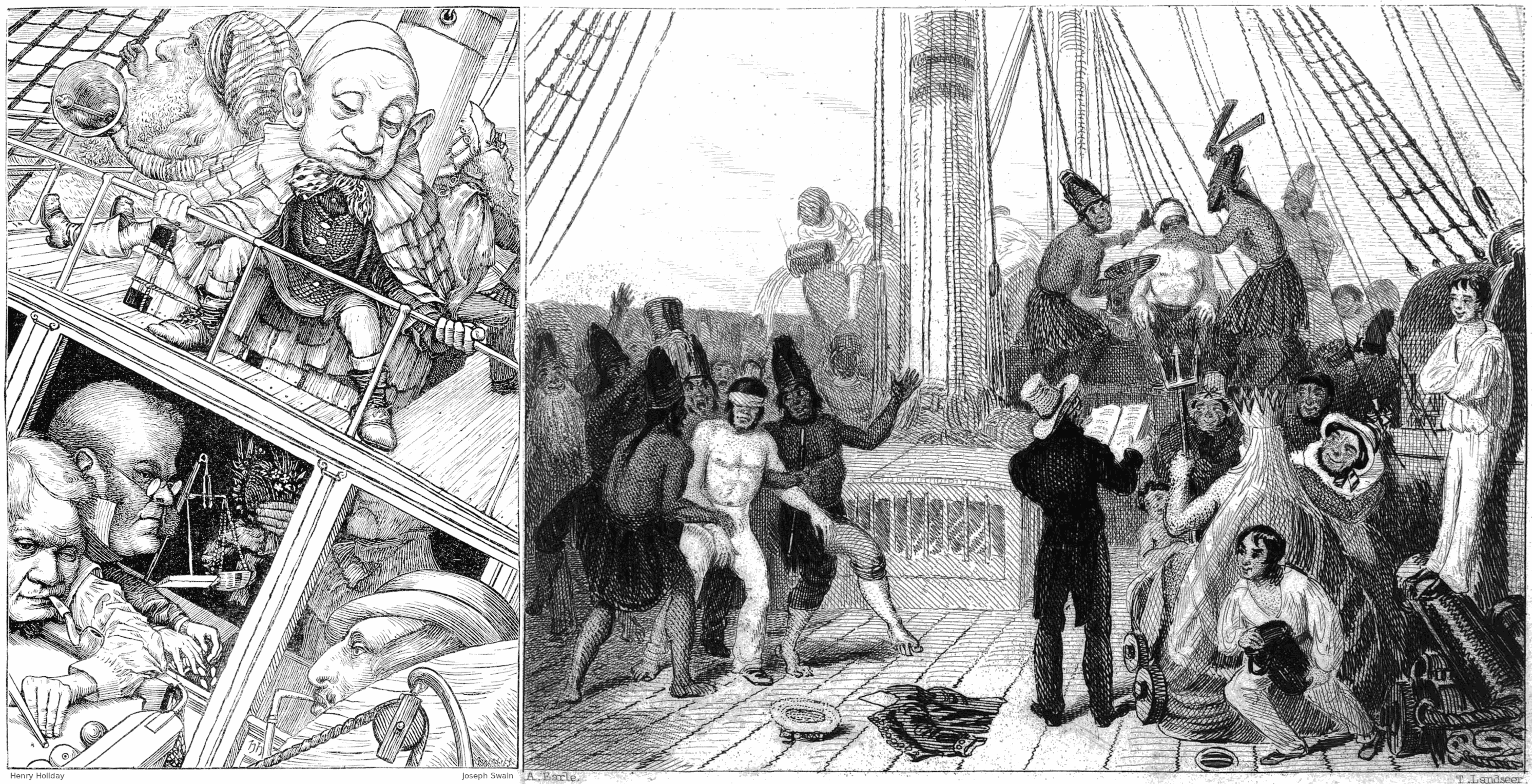
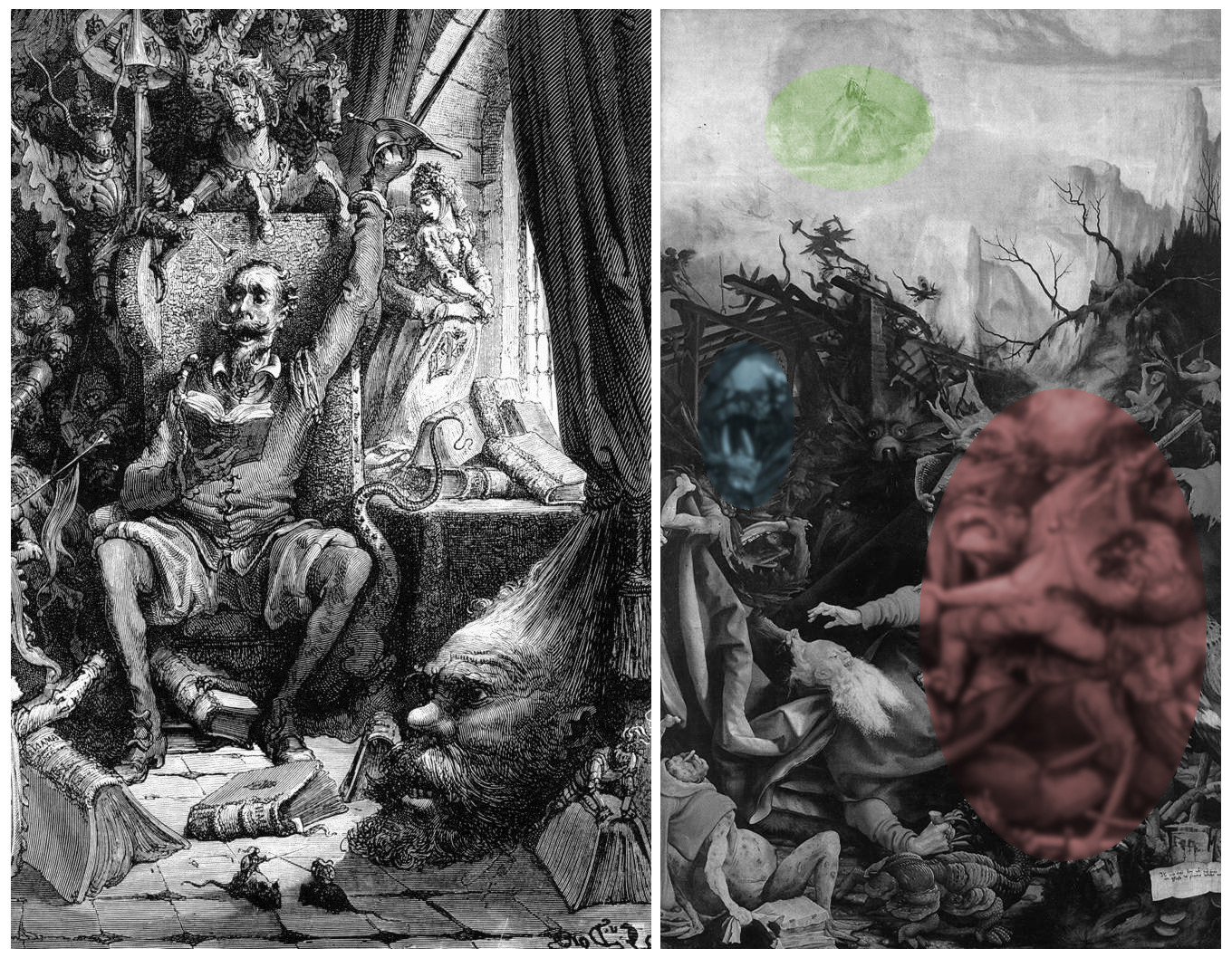
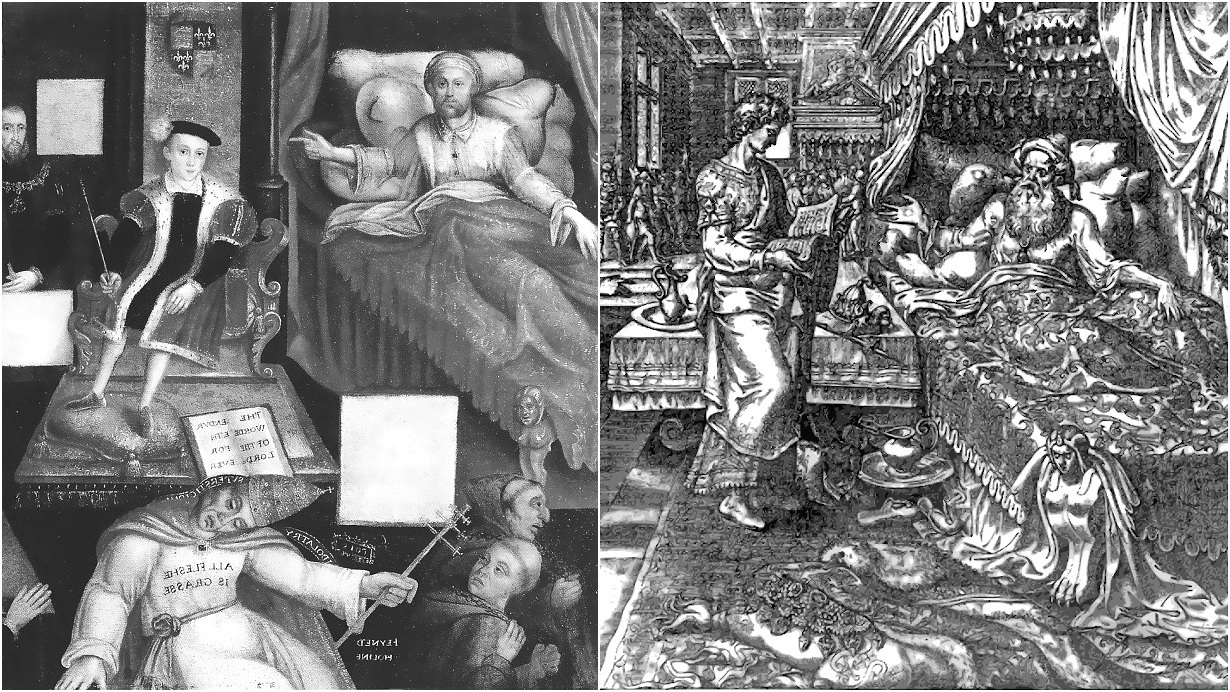
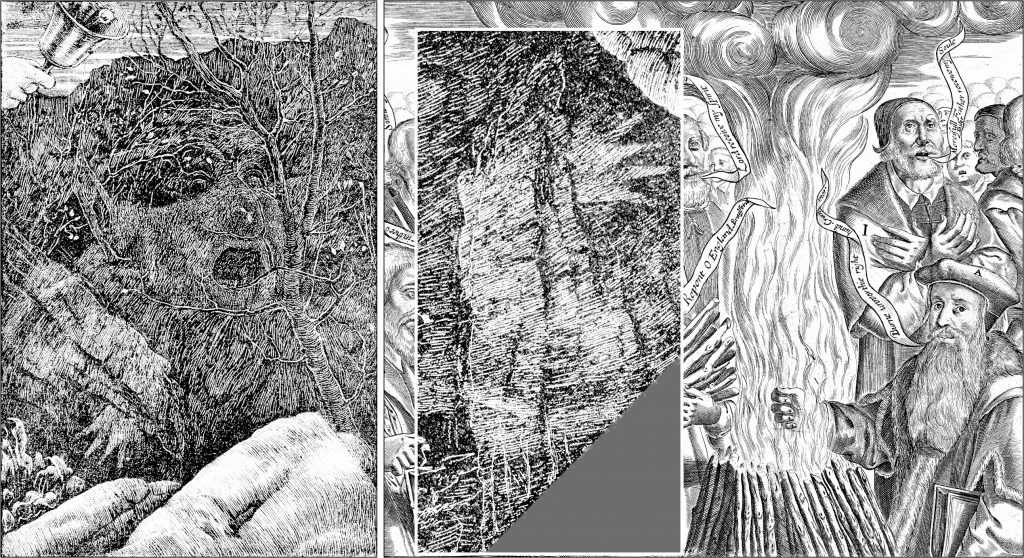
※ Segment (mirror view) from an Illustration by Gustave Doré to Miguel de Cervantes’ Don Quixote, 1863 edition.
※ Segment from The Temptation of St. Anthony (c. 1512-1516) by Matthias Grünewald (Mathis Gothardt Neithardt), a painting in one of the panels of the Isenheim Altarpiece.
blog
不佳
In the midst of the word he was trying to say,
In the midst of his laughter and glee,
He had softly and suddenly vanished away —
For the Snark was a Boojum, you see.
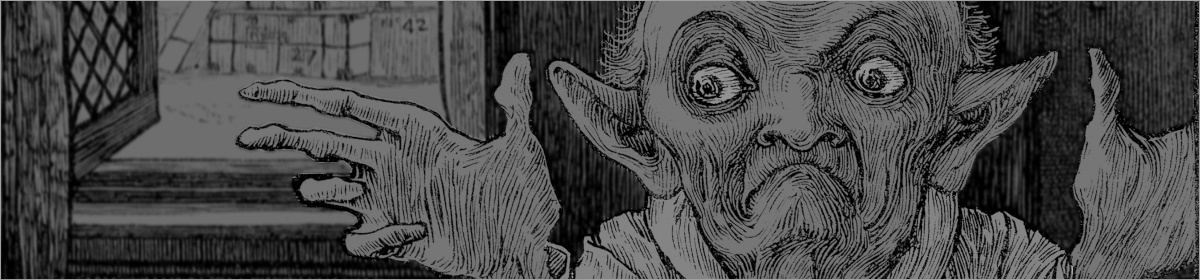
2021-12-23: Illustration mostly by Henry Holiday
How would Chinese call the Boojum?
- Boojum can be approximately transcribed with 不佳 (bù jiā). The pronouncation in English is explained to Chinese people in fanyi.baidu.com.
- I also found 布经 (bù jīng) as a Chinese transcription.
- As for vanishing away, one also could consider to use 不见 (bù jiàn).
- I call the beast 不佳不见 (bù jiā bù jiàn).
在他想說的話中間,
在他的笑聲和喜悅中,
他輕輕地突然消失了—
因為斯納克變成了
一個不佳不見,你看
So what is a Snark and what is a Boojum?
Lewis Carroll wrote about The Hunting of the Snark:
As to the meaning of the Snark, I’m very much afraid I didn’t mean anything but nonsense. Still, you know, words mean more than we mean to express when we use them; so a whole book ought to mean a great deal more than the writer means. So, whatever good meanings are in the book, I’m glad to accept as the meaning of the book. The best that I’ve seen is by a lady (she published it in a letter to a newspaper), that the whole book is an allegory on the search after happiness.
- Snark: Neither the usage in the year 1866 nor the contemporary usage of the term help to understand the meaning of Carroll’s “Snark”. According to Carroll, The Hunting of the Snark has at least one meaning: The pursuit of happiness. To Carroll, that pursuit could be about the Anglican path to happiness. That path is “meagre and hollow, but crisp“, because it is void of any catholic decor and superstition. The dispute about how to achieve happiness is not always comfortable, but it is necessary, because for different people there always are different paths to happiness. In civilized societies the Snark helps us to find a path which optimizes our happiness. As people and their environments keep constantly changing, the Snark hunt will never end.
- Boojum: I think that Lewis Carroll and Henry Holiday’s tragicomedy (a “tragedy” in Holiday’s opinion) is about how walking the meagre and hollow, but crisp path (Snark) towards happiness (whatever that might be) can turn into terrible fights with very sad ends (Boojum). Unfortunately, also in the 21st century too often good Snark hunters “softly and suddenly vanish away”. They and their work “disappear”, erased by those who walk along the path of the Boojum. It seems that this will never end as well.
In a nutshell: In my view, a Boojum is a monster or a monstrous process. Once you encounter it (for example at the violent end of a fierce controversy), then you might softly and suddenly vanish away. Thomas Cranmer’s fate is just one out of many examples for how Boojum works.
2017-12-17, update: 2023-09-25
Questions
- Did Henry Holiday visit Coursham Court before 1876?
- Are there letters in the waves, or is it asemic writing or are those lines in the waves just in Henry Holiday’s back cover illustration just something like meaningless hatching?
- What is the earliest publishing date of a facsimile reproduction of Charles Darwin’s “Tree of Life” sketch in newspapers, magazines, books etc?
- Are there 9 or 10 Snark hunters?
- Could jubjub be the sound of a chronometer?
- In the 1st Snark stanza the Bellman is “supporting each man on the top of the tide by a finger entwined in his hair”. What does it mean if the hair is the Bellman’s hair?
- Could there be a pictorial references to The Hunting ot the Snark in a print by Alfred Parson depicting Charles Darwin’s study?
There probably will be more questions. How about asking them in groups.io/g/TheHuntingOfTheSnark?
2023-09-24
What I tell you three times is true!
001 “Just the place for a Snark!” the Bellman cried,
002 As he landed his crew with care;
003 Supporting each man on the top of the tide
004 By a finger entwined in his hair.005 “Just the place for a Snark! I have said it twice:
006 That alone should encourage the crew.
007 Just the place for a Snark! I have said it thrice:
008 What I tell you three times is true.”
329 “’Tis the voice of the Jubjub!” he suddenly cried.
330 (This man, that they used to call “Dunce.”)
331 “As the Bellman would tell you,” he added with pride,
332 “I have uttered that sentiment once.333 “’Tis the note of the Jubjub! Keep count, I entreat;
334 You will find I have told it you twice.
335 ’Tis the song of the Jubjub! The proof is complete,
336 If only I’ve stated it thrice.”
Referring to Edith Wharton’s biography of Theodore Roosevelt (MG007), Kelly Ramsdell Fineman told us …
… that President Theodore Roosevelt and Edith Wharton were huge fans of the Snark. On one visit to the White House, Wharton learned of the following exchange that occurred between the President and the Secretary of the Navy (undoubtedly unaware of Carroll’s poem, or at least unaware that Roosevelt was quoting):
During discussion, Roosevelt said to the secretary of the Navy,
“Mr. Secretary, what I tell you three times is true!”
The Secretary replied stiffly,
“Mr. President, it would never for a moment have occurred to me to impugn your veracity.”
Already Shakespeare applied the Bellman’s Rule. It is stated in Lewis Carroll’s The Hunting of the Snark, line #7 and line #335. I said it in Lua – wrote it in Python and Scratch, I made that indeed, but I wholly forgot (when finally done), that Haskell is what you need! So, here is an example for how to implement that rule:
#! /usr/bin/haskell
import Data.List
someAssertions :: [String]
someAssertions =
["I am a very stable genius!"
,"There are 10 Snark hunters."
,"There are 9 Snark hunters."
,"There are 10 Snark hunters."
,"I am a very stable genius!"
,"Brexit promises will be kept!"
,"6 * 7 = 39"
,"6 * 7 = 39"
,"There are 10 Snark hunters."
,"6 * 7 = 42"
,"I am a very stable genius!"
,"There are 10 Snark hunters."
,"6 * 7 = 39"
,"There are 10 Snark hunters."
]
atLeastThrice :: [String] -> [String]
atLeastThrice assertions =
[head grp | grp <-
group $ sort assertions, length grp >= 3]
Result (if loaded and executed in GHCi):
*Main> atLeastThrice someAssertions
["6 * 7 = 39","Brexit promises will be kept!","I am a very stable genius!","There are 10 Snark hunters."]
Checking my Haskell implementation of “What I tell you three times is true” using ChatGPT:![Here is an implementation of "What I tell you three times is true" in Haskell:
atlLeastThrice :: [String] -> [String]
atLeastThrice assertions =
[head grp | grp <-
group $sort assertions, length grp >= 3]
Thank you for providing the implementation in Haskell. Yes, your implementation looks correct. The "group" function groups the same elements in the list together, then you are filtering out the groups that have less than three elements, and finally returning the head of each group (which is the repeated assertion). Here is an implementation of "What I tell you three times is true" in Haskell:
atlLeastThrice :: [String] -> [String]
atLeastThrice assertions =
[head grp | grp <-
group $sort assertions, length grp >= 3]
Thank you for providing the implementation in Haskell. Yes, your implementation looks correct. The "group" function groups the same elements in the list together, then you are filtering out the groups that have less than three elements, and finally returning the head of each group (which is the repeated assertion).](http://snrk.de/wp-content/uploads/2023/09/Haskell3TimesCheck.jpg)
PS: It’s not easy. Truth isn’t truth.
2017-12-16, update: 2023-09-24
Snark Stamps
Tree of Life

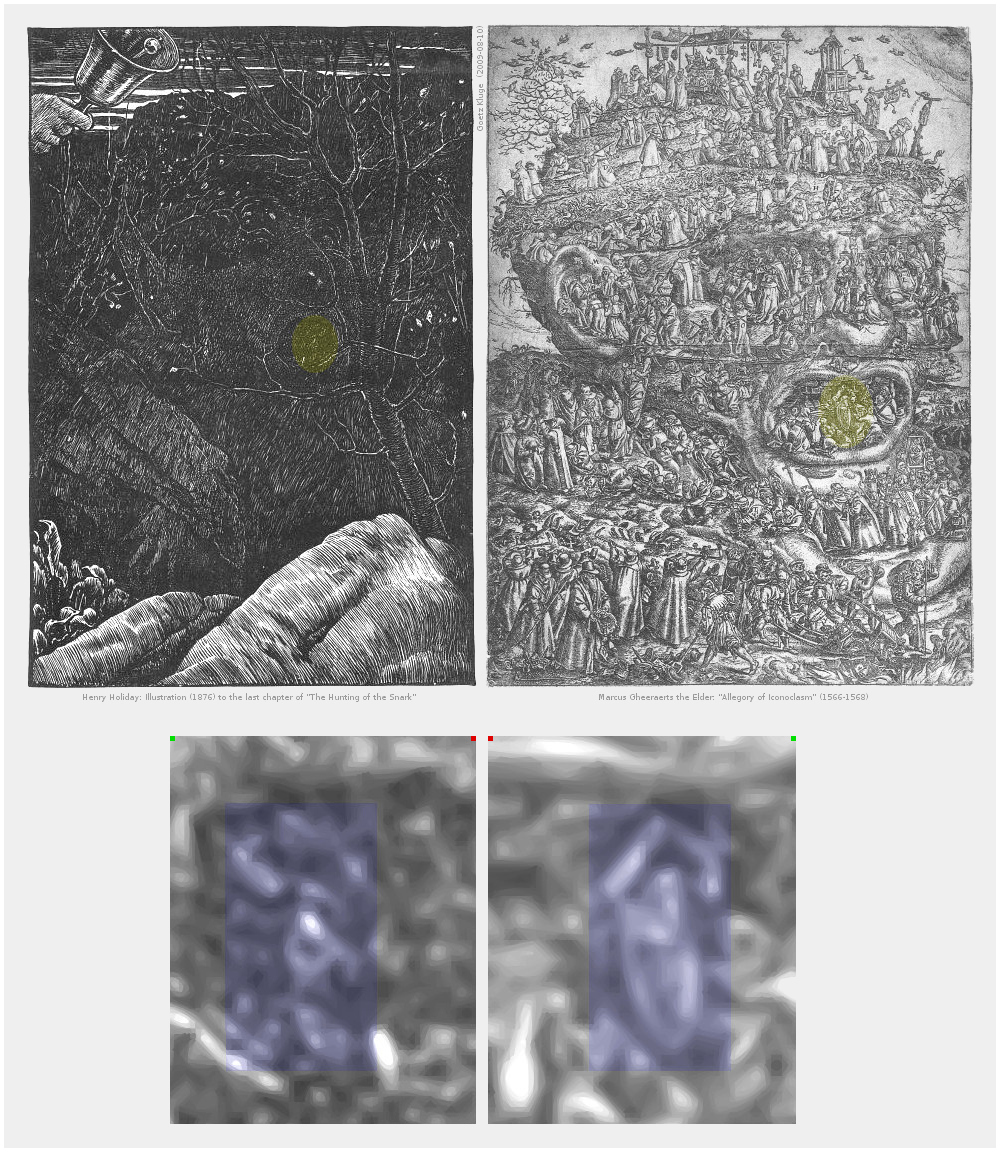
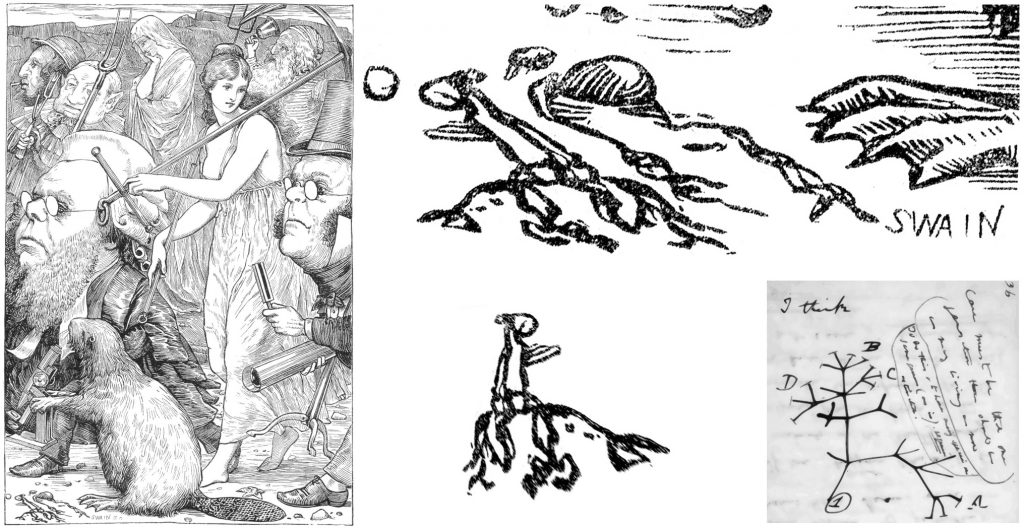
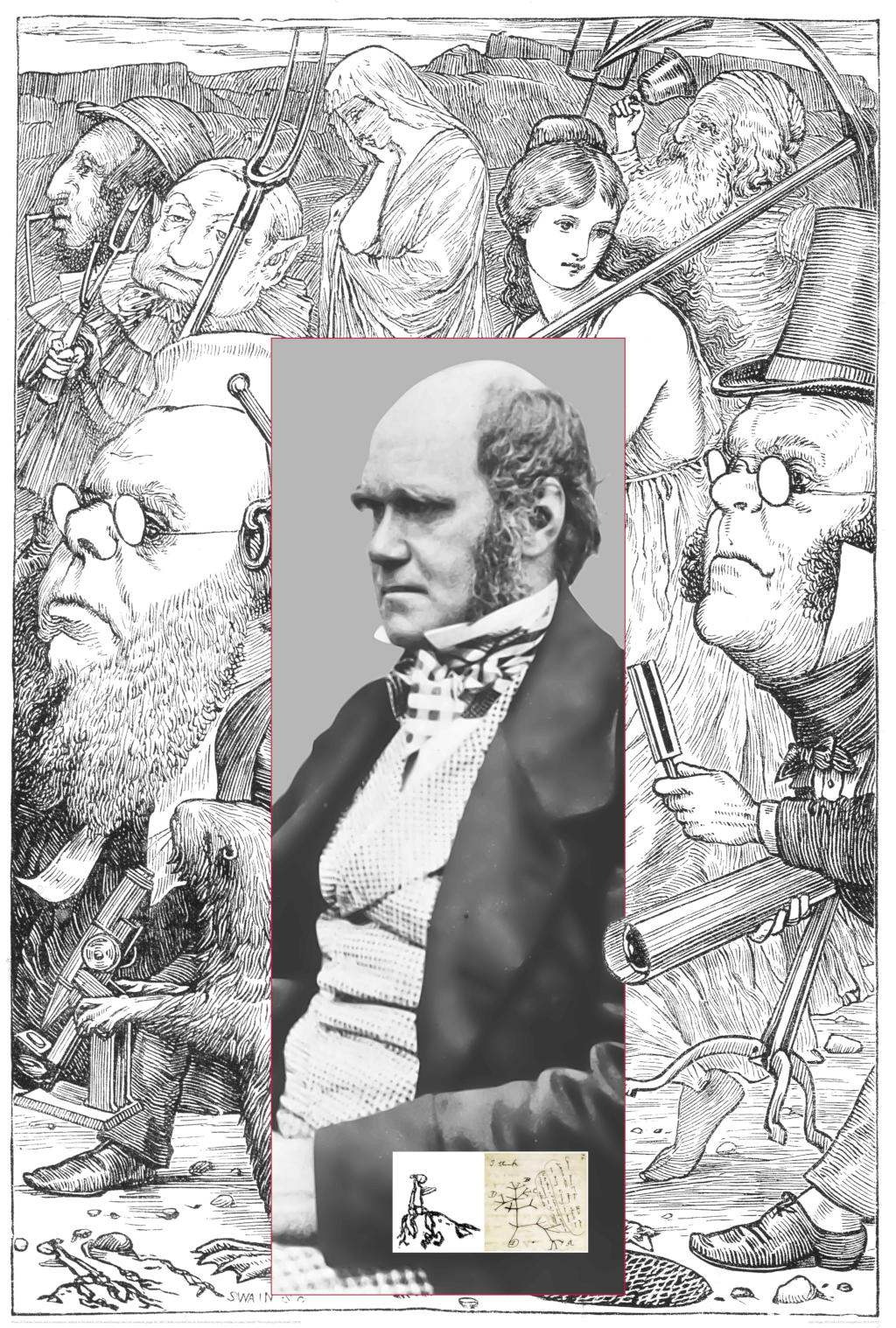
In this image, Charles Darwin’s tree of life sketch of the evolutionary tree (c. July 1837, Notebook B, 1837-1838, page 36) is compared to some “weeds” in the lower left corner of Holiday’s illustration. The sketch was not used in Darwin’s On the Origin of Species.
To my knowledge, the earliest publishing of a facsimile from Darwin’s hand drawing occurred in the 20th century. A “tree” was published in Charles Darwin’s Origin of Species. But that was an image arranged by a typographer, not Darwin’s sketch from his Notebook B. Darwin did not keep his notebook B secret after the publication of On the Origin of Species, but I do not know of any presentation of his sketch before 1876. Thus, the resemblance between the “weed” and Darwin’s evolutionary tree probably may be purely incidental.
Are any earlier publishing dates for facsimile reproductions of his drawing known before 1876?
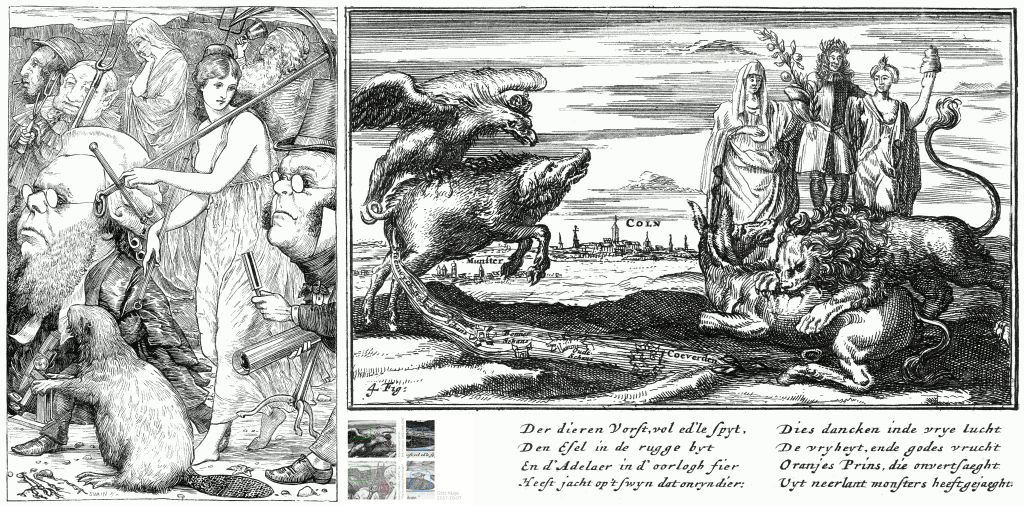
I am searching the earliest publishing date of that image e.g. in newspapers, magazines, books etc. Can you give me any hints?
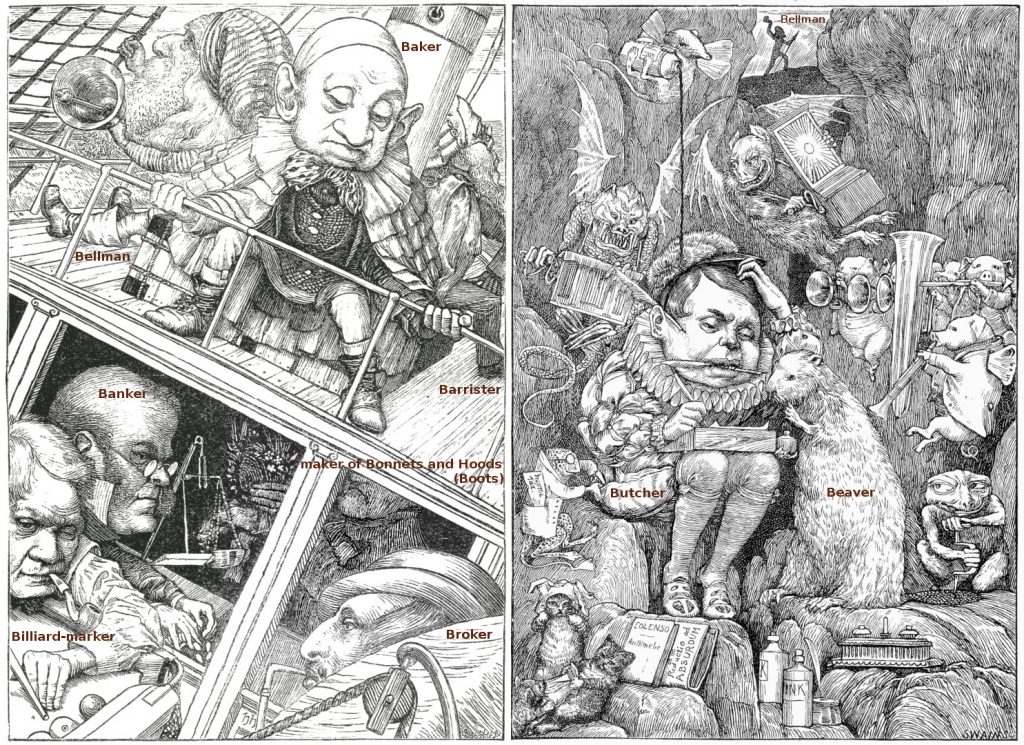
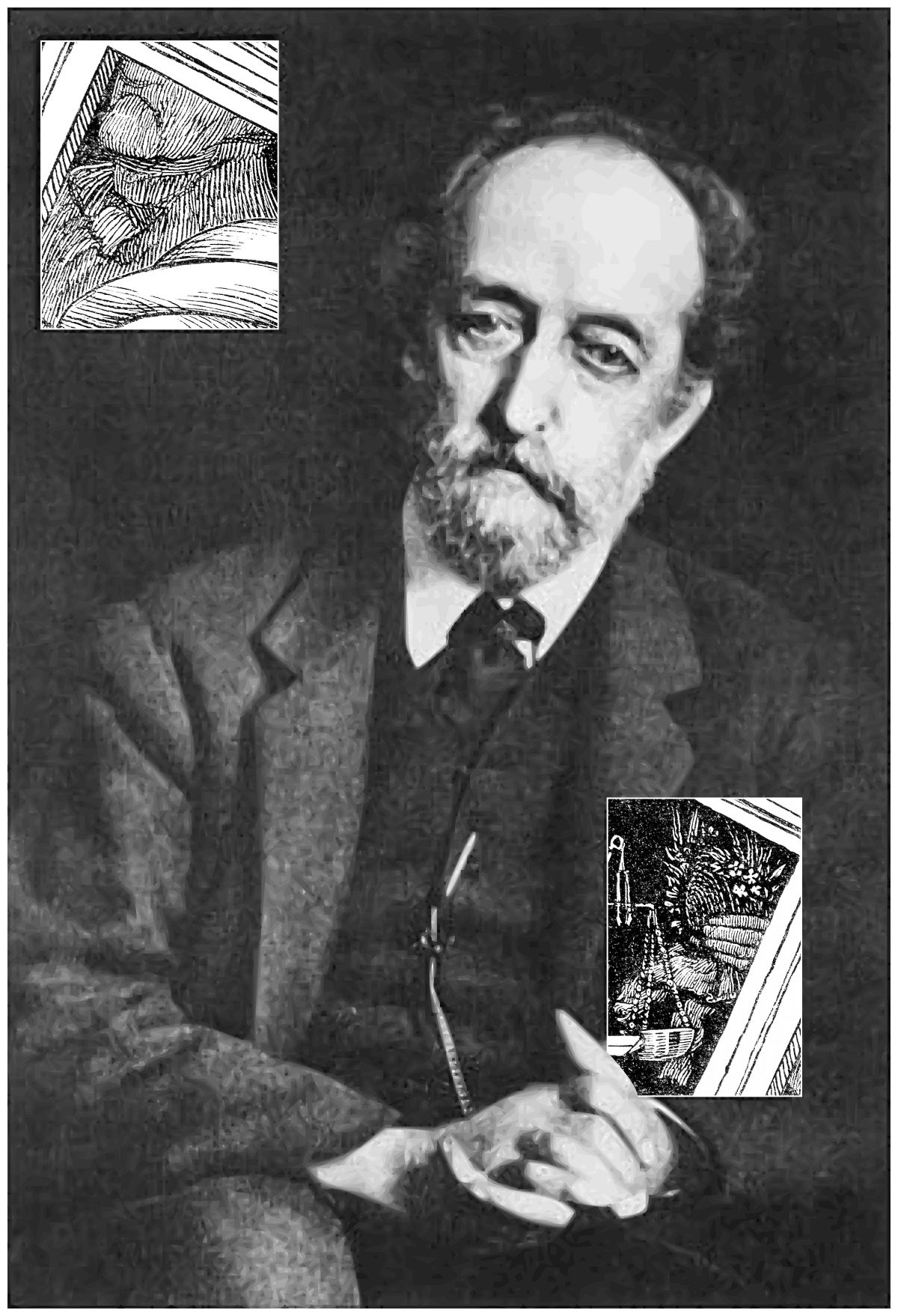
In the illustration, there is no clear resemblance between Darwin and the Banker, who, however, is carrying a tuning fork. On his expedition with the HMS Beagle, Charles Darwin used such an instrument for experiments with spiders.
Links:
- Darwin’s notebooks
- Notepads worth millions lost for 20 years
- Bulletin of the British Museum (Natural History) Volume2, Vol.1 (1953) – 19 (1991)
Remark (by Ivaldo)- June 18, 2008: «Contains “Darwin’s Notebooks on transmutation of species” edited by Sir Gavin de Beer (some pages lacking in .pdf files)» - Darwin’s Tree of Life by Steven Burke, 2017-02-03 in Scientists
- Darwin’s Evolutionary Trees
2018-12-09, updated: 2023-09-22
Article 42 in the 42 Articles
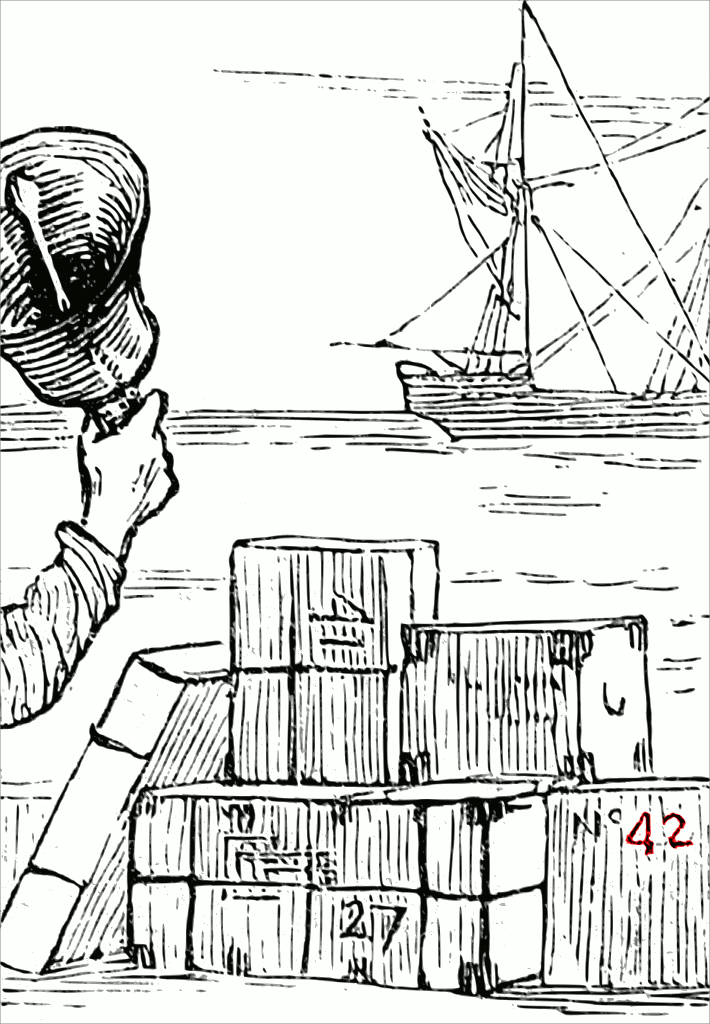
The helmsman used to stand by with tears in his eyes; he knew it was all wrong, but alas! Rule 42 of the Code, “No one shall speak to the Man at the Helm,” had been completed by the Bellman himself with the words “and the Man at the Helm shall speak to no one.“ So remonstrance was impossible, and no steering could be done till the next varnishing day. During these bewildering intervals the ship usually sailed backwards.
Lewis Carroll, The Hunting of the Snark, Preface
#42. All men shall not be saved at the length. They also are worthy of condemnation, who endeavour at this time in restore the dangerous opinion that all men, by they never so ungodly, shall at length be saved, when they have suffered pains for their sins a certain time appointed by God’s justice.
Article 42 in Thomas Cranmer’s Forty-Two Articles
As far as I understand, some Christians define eternal damnation as being separated from God for ever. (Even as an atheist I am capitalizing that first letter. I respect others’ beliefs.) That sounds like what “Rule 42” of the Bellman’s “Naval Code” (capitalized first letters as in Carroll’s Snark) says.
Thomas Cranmer’s 42th Article about eternal damnation didn’t make it into the 39 Articles of the Anglicans, but the debate continued. The Deacon C.L. Dodgson was opposed to the dogma of eternal damnation.
In 1994, Angus MacIntyre suggested (The Reverend Snark, Jabberwocky 23, p. 51~52): “The Baker’s 42 Boxes are the original Protestant Articles of 1553, with Thomas Cranmer’s name on each.” I learned about MacIntire’s suggestion in an article by Karen Gardiner, an Anglican priest. In June 2018 she suggested that in The Hunting of the Snark, Carroll/Dodgson addressed the Article 42 in Thomas Cranmer‘s Articles (Life, Eternity, and Everything: Hidden Eschatology in the Works of Lewis Carroll, July 2018, p.25~41 in THE CARROLLIAN, No. 31).
My approach to a possible reference in The Hunting of the Snark to the 42 Articles was different. It started with discovering a pictorial reference in one of Henry Holiday’s Snark illustrations to Thomas Cranmer’s burning. If I look back at what came into my mind in the year 2014, it was Henry Holiday who made me curious to learn more about the articles 27, 41 and 42 and whether they might have been an issue for the Dodgson, the Deacon.
There is a reference to this blog page in Karen Gardiner’s PhD thesis A New Evaluation: The Theological Influence of F. D. Maurice on the Imaginative Works of Lewis Carroll (2022-09).
- The version referenced on 2022-05-24 is in archive.org.
- The correct link is “snrk.de/article-42-in-the-42-articles/”. It doesn’t end with “--articles/”. Luckily the web server knows where to find the right page.
2018-07-08, updated: 2023-09-18
Original Manuscript Found Among Brexit Impact Study Tables
Here is the manuscript (it’s so-so). And there is a secret road map used by the British government to navigate through the Brexit.
What I tell you three times is true:
349 “The thing can be done,” said the Butcher, “I think.
350 The thing must be done, I am sure.
351 The thing shall be done! …”
Getting the Brexit done:
https://youtu.be/2N2kp1r-WkI
Links:
- Snark and Brexit
- “Brexit” is a “portmanteau”, by Merrill Perlman, 2016-04-18
- But the principal failing occurred in the sailing
- No Pause for Thought? Brexit, Bias and Political Manipulation, by Volker Patent, 2017-05-16
- On Brexit, What the EU Tells You 10 Times Is True – Prime Minister Theresa May should finally stop ignoring her negotiating partners’ red lines., by Leonid Bershidsky, Bloomberg Opinion, 2018-07-27
- The Trumping of the Snark – and why Brexit means Boojum, by Tom Evans, Liverpool Echo, 2017-01-27
- Dean Burnett
- www.referendumanalysis.eu (archived)
- Fintan O’Toole
2017-11-14, update: 2023-09-10
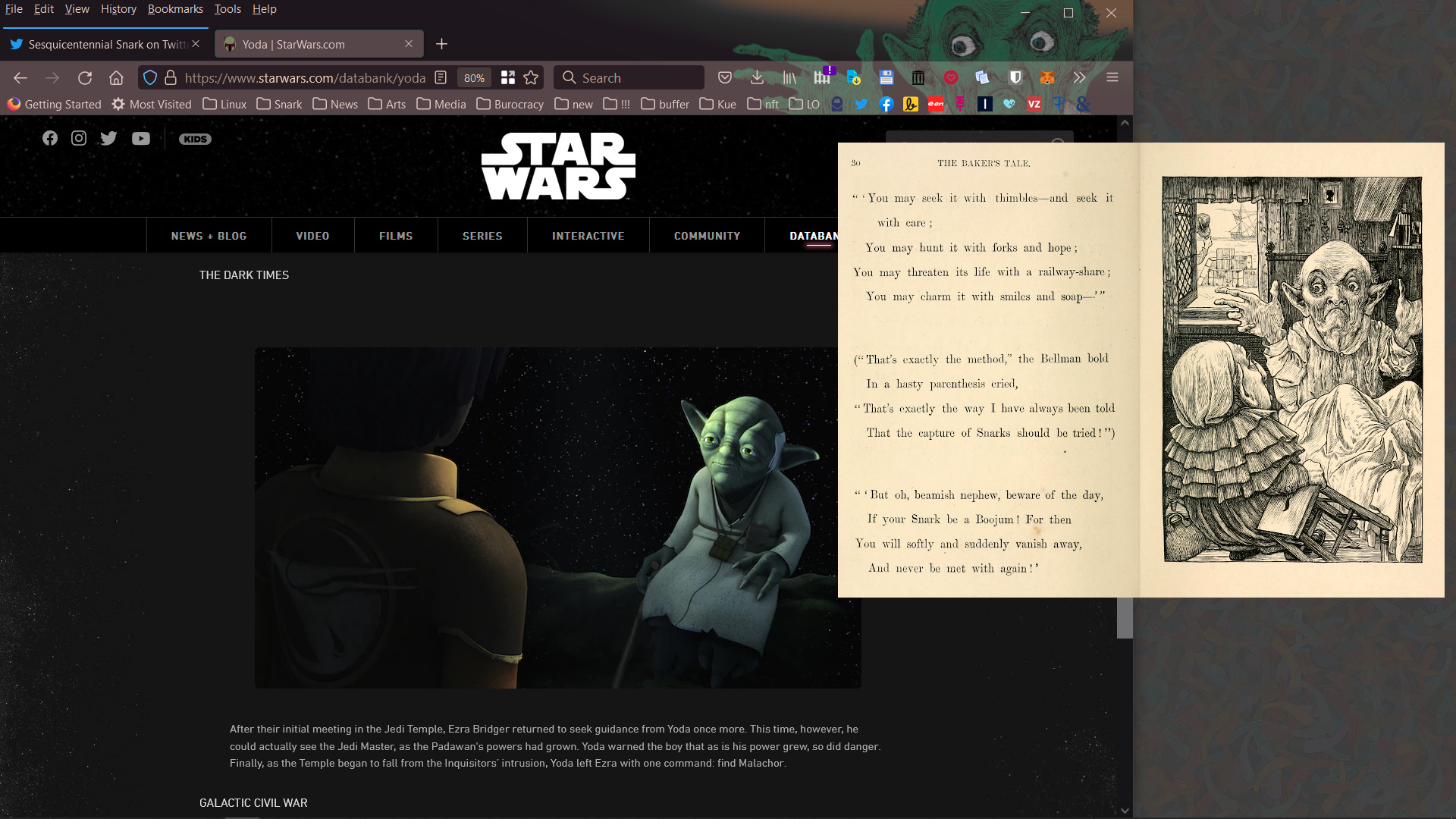
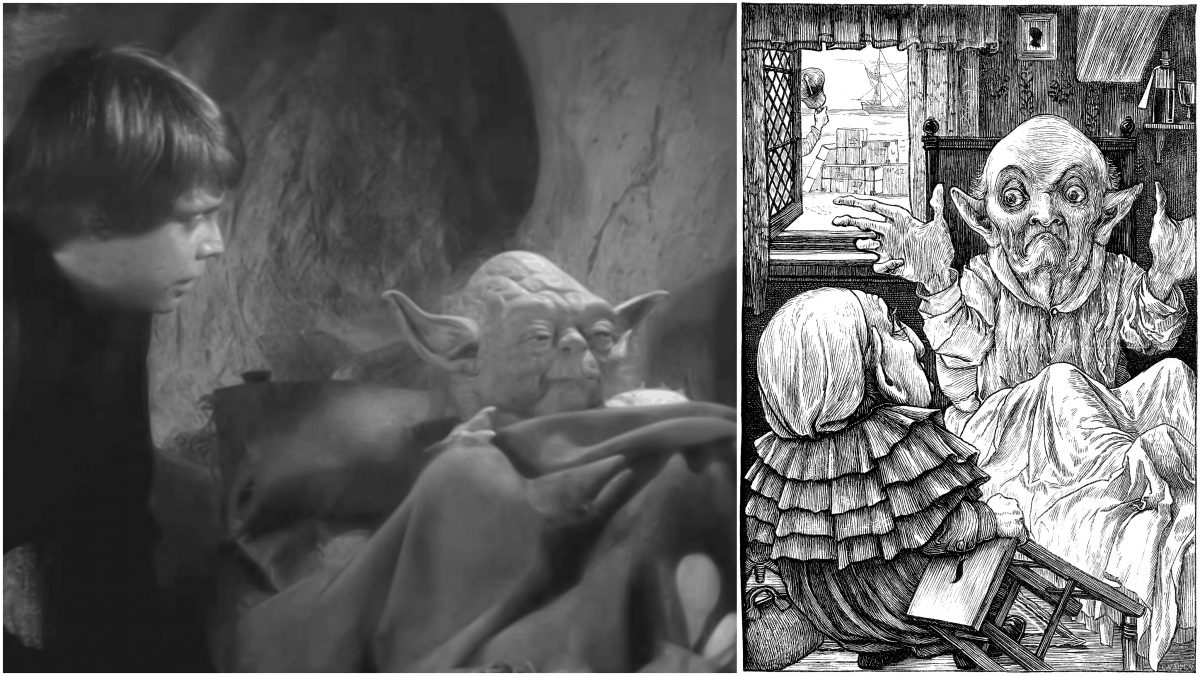
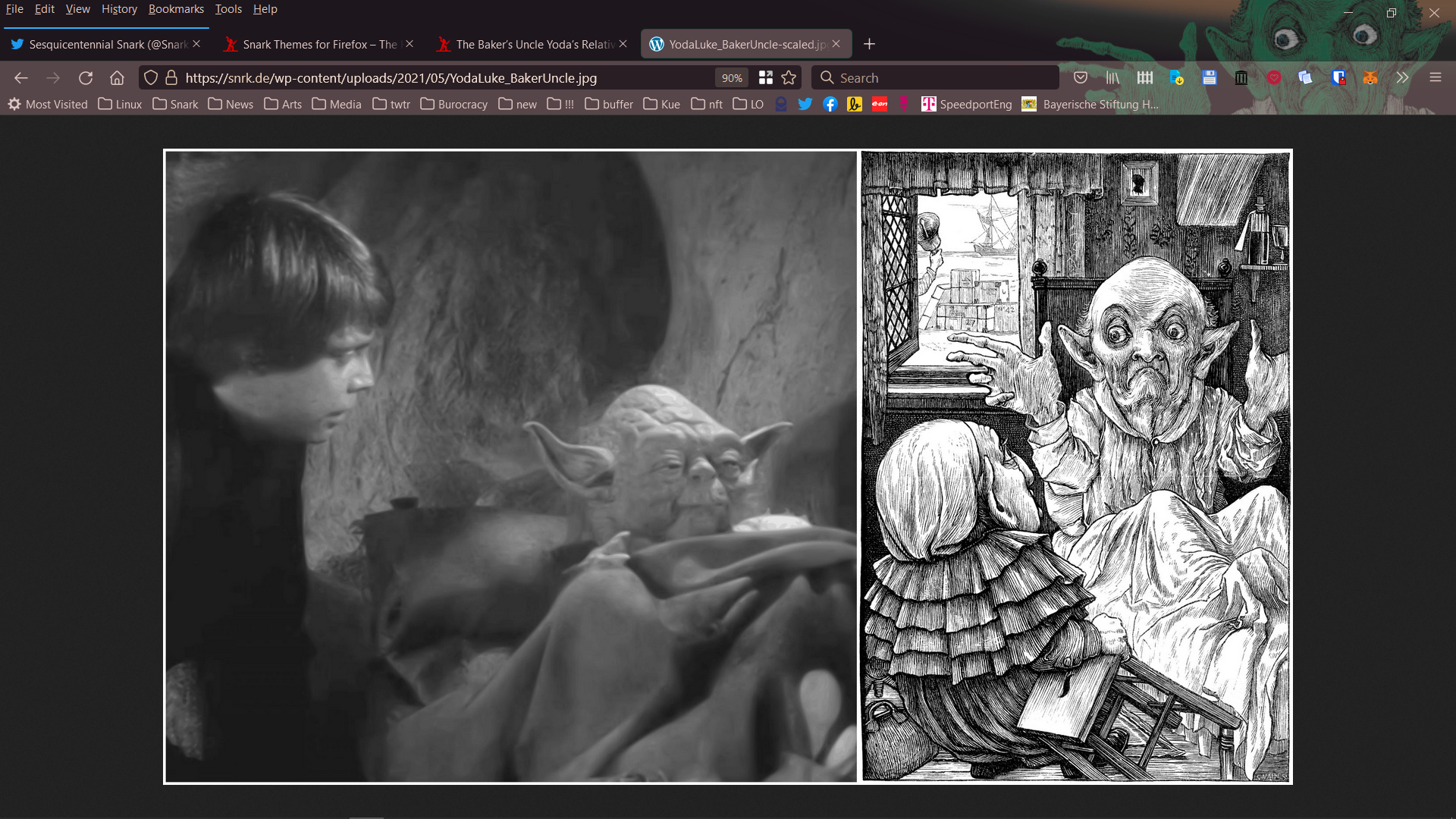
The Baker’s Uncle Yoda’s Relative is
«L.C. forgot that “the Snark” is a tragedy»
To the illustrator Henry Holiday, Lewis Carroll’s The Hunting of the Snark was a “tragedy”. That might have been Carroll’s intention in 1874, when he started to write the poem as one of the many chapters of his Sylvie and Bruno project. But when the poem was published as a separate book in 1876 with more than 500 lines, it turned out to be a tragicomedy.
Page from a letter (The Chestnuts, Guilford, 1876-01-04) by C.L. Dodgson (aka Lewis Carroll) to Henry Holiday about Holiday’s illustration to the chapter The Beaver’s Lesson. The two lines at the bottom are a note written by Henry Holiday.
Source: www.pbagalleries.com/… (archive)
I think the note is:
× L.C. forgot that “the Snark” is a tragedy and [should]
on no account be made jovial. h.h.
In the end, Carroll produced a tragicomedy.
Link: Twitter
Update 2018-09-01
An institution’s rare collections make it unique in the world. Here a sample of the feast @USC shown to @LibSrFellows, including a handwritten note from Lewis Carroll on the verso of his poem “The Hunting of the Snark.” @McGill_ROAAr pic.twitter.com/0v0QKj6owg
— Nathalie Cooke (@CookeNathalie) August 16, 2018
See also: https://twitter.com/Bonnetmaker/status/1033366198535286785
Update 2022-01-06
Karina
@KJakubowicz
On a geeky note, it thrills me that this was filled out in purple ink.Like Lewis Carroll and many an Oxbridge university prof, Virginia wrote in purple. It was traditionally cheaper than black & so became linked with academics and aesthetes.
1:19 PM · Jan 6, 2022
2017-09-06, update: 2023-08-27
Beyond Obscure
I assume that in The Hunting of the Snark, Lewis Carroll and Henry Holiday took references to Thomas Cranmer and his Forty-Two articles. I discussed that with an anglican priest and church historian. As this blog isn’t my echo chamber, I’ll show you his objections to what I think.
me: I think, that the “Baker’s” 42 boxes may be a reference to Thomas Cranmer’s 42 Articles. And I learned that Dodgson/Carroll had issues with the 39 Articles and therefore didn’t take ordination. Could you give me any hints where Dodgson/Carroll may have had issues with the 39 Articles? And as for the 42 Articles, I think, that Carroll may have rejected #42 (“All men shall not be saved at the length…”).
him: Why go for the 42 Articles, hardly in force for a month in 1553, when if Dodgson was denying any doctrinal statement, it would be the 39 Articles which had been in place since 1563? The articles of the 42 omitted in 1563 did include the article about universal salvation, but also matters about soul-sleep and millenarianism. As an allegorical reference, it seems beyond obscure.
me: Carroll did not accept (https://snrk.de/wp-content/uploads/2019/04/lewiscarrollpict00carruoft_bw_ocrmypdf_345-355.pdf) the last Article in the Forty-Two Articles. The Article 42 didn’t make it into the 39 Articles, but there is a publication which shows that this still was a controversial issue which Carroll had to deal with.
him: The argument makes no logical sense at all.
See also: Karen Gardiner’s PhD Thesis.
Discussion: 𝕏witter | Facebook
2019-04-02, update: 2023-08-24
Three Creeds, Three Dogmata, Trinity
To what could the Baker’s “three pairs of boots” refer?
This office [of the Helmsman] was usually undertaken by the Boots, who found in it a refuge from the Baker’s constant complaints about the insufficient blacking of his three pairs of boots.
029 The loss of his clothes hardly mattered, because
030 He had seven coats on when he came,
031 With three pairs of boots—but the worst of it was,
032 He had wholly forgotten his name.
In Understanding Carroll’s Theological and Philosophical Views” (2010), John Tufail wrote:
The Jowett controversy was just a small part of what he [Pusey] saw as an extremely serious challenge to the authority of the Anglican Church and the basic tenets (the 39 articles and the three Creeds) upon which the Church was based. To Pusey three things were absolute both in terms of faith and of meaning. These were
※ the inviolability of ‘The Word’ discussed above,
※ the concept of ‘Original Sin’, and
※ the idea of ‘Eternal damnation’ for those deemed unrepentant or beyond Salvation.
Of the three, the one closest to Pusey’s heart – the thing that most of all kept the Christian flock close to the fold, was the idea of Eternal Damnation. Pusey’s views on this were clearly defined in a letter he wrote on the subject to Bishop Wilberforce in February 1864:One can hardly think of anything for the hidden blasphemy of that judgement which declares to be uncertain which our Lord taught, and for the loss of the countless souls which it will involve, if not repudiated by the Church. For nothing, I suppose. Keeps men from any sin except the love of God or the fear of Hell.
People like lists with three points. They list up what a god may be (Trinity), and the Three Creeds are another list among such lists with three items.
The Baker’s “three boots” could be a reference to more than one of theese three items lists.
Links:
- Search:
- Ecumenical creeds (Wikipedia)
- How Old Are Christian Doctrines?
- Ecumenical Christian Creeds
- List of Christian creeds (Wikipedia)
(Frankly speaking, to me as an atheist all this is more difficult to digest than one important apperance of “three” in nature, the three generations of matter.)
2018-07-07, updated: 2023-07-14
Repetition increases perceived truth
https://link.springer.com/article/10.3758/s13423-019-01651-4
Psychonomic Bulletin & Review
October 2019, Volume 26, Issue 5, pp 1705–1710
Repetition increases perceived truth equally for plausible and implausible statements
Lisa K. Fazio, David G. Rand, Gordon Pennycook
Abstract:
Repetition increases the likelihood that a statement will be judged as true. This illusory truth effect is well established; however, it has been argued that repetition will not affect belief in unambiguous statements. When individuals are faced with obviously true or false statements, repetition should have no impact. We report a simulation study and a preregistered experiment that investigate this idea. Contrary to many intuitions, our results suggest that belief in all statements is increased by repetition. The observed illusory truth effect is largest for ambiguous items, but this can be explained by the psychometric properties of the task, rather than an underlying psychological mechanism that blocks the impact of repetition for implausible items. Our results indicate that the illusory truth effect is highly robust and occurs across all levels of plausibility. Therefore, even highly implausible statements will become more plausible with enough repetition.Keywords: Truth, Repetition, Illusory truth, Plausibility
Cite the article as: Fazio, L.K., Rand, D.G. & Pennycook, G. Psychon Bull Rev (2019) 26: 1705. https://doi.org/10.3758/s13423-019-01651-4
※ Cognitive Ability and Vulnerability to Fake News
Researchers identify a major risk factor for pernicious effects of misinformation.
By David Z. Hambrick, Madeline Marquardt on February 6
Scientific American, 2018
※ How liars create the ‘illusion of truth’ by Tom Stafford, BBC Future, 26th October 2016
※ What I tell you three times is true!
2020-01-11, updated: 2023-07-11 (MG007)
Knight Letter № 100
In July 2018, the members of the LCSNA (Lewis Carroll Society of North America) received the 100th Knight Letter.
Also in this issue, Goetz Kluge makes the case that a seventeenth-century engraving may have influenced Henry Holiday’s last illustration for The Hunting of the Snark. Goetz’s excellent blog about all things Snark is at http://snrk.de/
Preface to the Knight Letter № 100, LCSNA, 2018
On pages 55~56 you find a few lines which I wrote about the Baker and Thomas Cranmer in The Hunting of the Snark.
There also is an accompanying web page.
In the end, the Baker met the Boojum. As an allusion to Thomas Cranmer, the hero in Carroll’s Snark tragicomedy had been named “Baker” and also got some “hot” nicknames. Carroll went to the limits of black humor: The Baker got baked.
Incidentally, in parallel to my little note (p. 55~56 in the Knight Letter № 100) on the Baker’s hot names and on Henry Holiday’s pictorial reference to Thomas Cranmer’s burning, a paper «Life, Eternity and Everything, Hidden Eschatology in the Works of Lewis Carroll» suggesting textual references from The Hunting of the Snark to Thomas Cranmer’s Forty-Two Articles has been published in The Carrollian (July 2018, № 31, p.25~41), a journal of the Lewis Carroll Society in the UK. The author, Karen Gardiner, is an Anglican priest. She also addresses the objections of Revd. C.L. Dodgson (aka Lewis Carroll) against the dogma addressed by Article № 42 of Thomas Cranmer’s Forty-Two Articles.
Angus MacIntyre (1994), myself (2010, 2015, 2015), Mary Hibbs (2017), as well as Karen Gardiner (2018), we all suggested independently from each other that there are such references to Thomas Cranmer and his Forty-Two Articles (the Baker’s forty-two boxes). We arrived there coming from different starting points and different backgrounds. As for me, I initially just looked for Lewis Carroll’s (C.L. Dodgson’s) textual references as guidance for finding pictorial references in Henry Holiday’s illustrations.
(MG064)
PS: A friend told me that the caterpillar (here without hookah) on the front page of the 100th Knight Letter is a Hickory Horned Devil.
2018-07-28, update: 2023-07-07
Page 83

«With ‘Baker’ not ‘Butcher’ on p. 83.»
(Source: abebooks.com)
Do you think that this “Baker” on page 83 really proves that the book is a first edition and that it should be “butcher”? You find the answer in any contemporary Snark edition. No mistake, the Baker still is there. There never was a Butcher on page 83. By the way, there also never as a Banker on page 83.
More Examples for advertising the first edition of “The Hunting of the Snark”, offered for prices between €200 and €2000:
First edition, first issue of Carroll’s whimsical nonsense poem with “baker” on p. 83 which was later corrected to “butcher”.
First edition, first printing, with “Baker” for “Banker” on page 83.
First issue with “baker” not “butcher” on page 83. It is unknown how many copies were printed this way.
No, it is known: All copies were and are printed this way!
This is about line 560 on page 83, the last page of Lewis Carroll’s tragicomedy. A “Baker” in that line is no proof that the book is a rare first Snark edition. Actually, all copies are printed this way, because that is how it should be. In Henry Holiday’s illustration on page 82 you see the head and a hand of the Baker, not the Butcher and not the Banker. Remember, the Banker had to be left behind in the previous chapter, so he cannot show up in the final chapter. And the Butcher didn’t meet the Snark either.
Thus, there is nothing special about “Where the Baker had met with the Snark.” This alleged error is a myth. Those rare book traders just didn’d (and still don’t) check the facts.
Then there is the JubJub. If you read somewhere that the bird never will look at a “bride”, then better check line 386 on page 55 in the original Snark edition. It’s “bribe”. You can find “It will never look at a bride” in the Internet many times. But that’s wrong.
Removed (not by me) from Wikipedia:
Rare book sellers often claim, that the first edition of ”The Hunting of the Snark” can be identified by the word “Baker” instead of “Butcher” or “Banker” in the 560th line on page 83. However, “Where the Baker had met with the Snark” is correct. “Butcher” or “Banker” in the 560th line would be wrong. Also “bribe” in the 386th line on page 55 is correct, even though in the Internet the erratic “It never will look at a bride” can be found.
(The hyperlinks in this text where not part of the WP text.)
2024-04-11
Alan Tannenbaum: Baker for Butcher on p. 83, The Snarkologist, Vol. 1, Fit 7, March 2024, p. 15~16
2018-04-02, updated: 2024-04-11
Simon Davison’s Snark Movie
2023-01-12, update: 2023-05-21
2023-05-06
See also: Simon Davison | Snark film | Steampunk Carroll
2022-11-14
2018-10-06
There is a crowd funding page associated with this project run by Imperious Films. Simon already managed to crowd fund one earlier project. To me this crowd funding looks more like an offer to pre-order a personal copy of the movie rather than to cover the production cost. Good idea.
Snark Alarm
This is from Simon DaVison’s Snark film. I have his permission to offer this in public domain.
Face it!
The Failing Occurred in the Sailing
“Just the place for a Snark!” the Bellman cried,
As he landed his crew with care;
Supporting each man on the top of the tide
By a finger entwined in his hair.“Just the place for a Snark! I have said it twice:
That alone should encourage the crew.
Just the place for a Snark! I have said it thrice:
What I tell you three times is true.”
Then the bowsprit got mixed with the rudder sometimes:
A thing, as the Bellman remarked,
That frequently happens in tropical climes,
When a vessel is, so to speak, “snarked.”But the principal failing occurred in the sailing,
And the Bellman, perplexed and distressed,
Said he had hoped, at least, when the wind blew due East,
That the ship would not travel due West!
This was charming, no doubt; but they shortly found out
That the Captain they trusted so well
Had only one notion for crossing the ocean,
And that was to tingle his bell.

Sir Nicholas Soames’ speech | Repetition increases perceived truth | Code
2018-08-26, updated: 2023-05-06 (MG007)
ChatGPT understands the Bellman’s rule
Embedded Mastodon toot:
2023-04-16