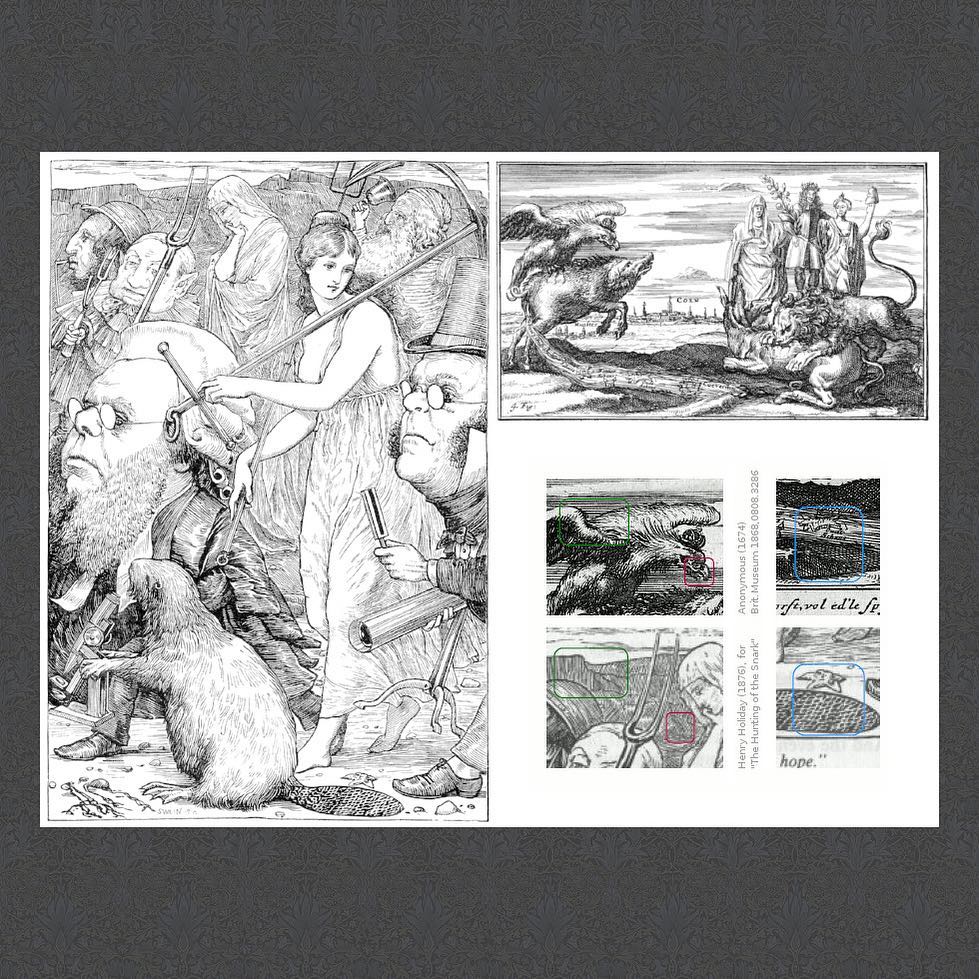
Who was first?
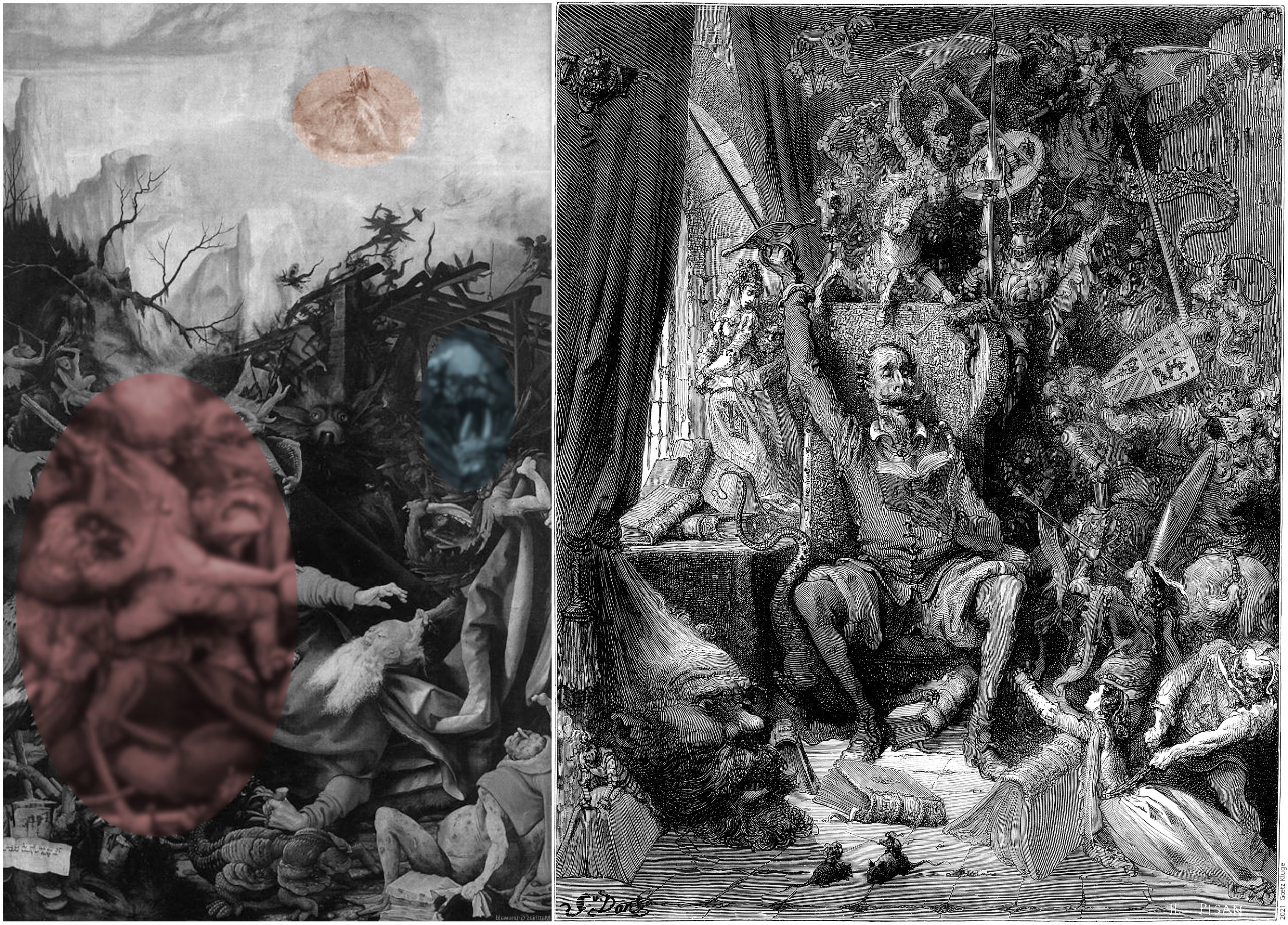
※ Gustave Doré’s illustration to Samuel Taylor Coleridge’s “The Rime of the Ancient Mariner”,
※ Henry Holiday’s book cover design to Lewis Carroll’s “The Hunting of the Snark”.
2024-06-17 (Henry Holiday’s 185th birthday)
Götz Kluge's blog about Lewis Carroll and Henry Holiday's tragicomedy

Who was first?
※ Gustave Doré’s illustration to Samuel Taylor Coleridge’s “The Rime of the Ancient Mariner”,
※ Henry Holiday’s book cover design to Lewis Carroll’s “The Hunting of the Snark”.
2024-06-17 (Henry Holiday’s 185th birthday)
Louis Zukofsky, “Review of Lewis Carroll, Russian Journal,” The New Masses (1935-10-08)
Authors, who say that they “don’t not know” whether their book is satire, might just tell an honest lie. Explaining that satire is satire is boring.
Of course “The Hunting of the Snark” contains satire. Dodgson wasn’t stupid. Satirists who explain their work would kill their work. E.g. in case of the “bathing machines“, “The Hunting of the Snark” took a reference to one of Carroll’s obvious satires.
By the way: I thought that Carroll’s Snark creation story “I was walking on a hillside, alone, one bright summer day, when suddenly there came into my head one line of verse — one solitary line — ‘For the Snark was a Boojum, you see.'” was another honest lie, a “lime twig for critics“. But after checking the weather of that day I am not so sure anymore. It was a bright summer day.
ex Twitter | contextualising Carroll
2019-06-23, update: 2024-06-11
Summary
This work presents a theory that Lewis Carroll’s life and works were profoundly affected by a conflict between his logical world view and his religious beliefs. Three examinations are presented – the first of convention and logic in Carroll’s life, the second of the nature of his religion and the third of his response to contemporary science. The thesis concludes that Victorian science brought Carroll’s beliefs into contradiction, causing him to experience religious and existential doubts. It is suggested that an understanding of these doubts can inform an understanding of Carroll’s relationships with Alice Liddell and other young girls, and indeed has repercussions for his entire life and works beyond the scope of this thesis.
Two brief appendices expand upon issues mentioned in the text: the first considers the artefacts at Ripon Cathedral which are supposed by some to have influenced Carroll; and the second discusses Effie’s Dream-Garden, a children’s book which bears some resemblance to the Alice story but which was published several years before that story was first told.
Contents
3 Summary
4 Contents
7 Acknowledgements
8 Author’s Declarations
9 Definitions
10 Chapter 1: Introduction
23 Chapter 2: Convention
46 Chapter 3: Religion
64 Chapter 4: Science
88 Chapter 5: Darwin and the Dodo
114 Chapter 6: Dreams and Doubts
135 Chapter 7: Conclusion
139 Appendix A: Ripon Cathedral
142 Appendix B: Effie’s Dream Garden
147 Works cited
Amazon (Kindle): B010Y2T5GS
If you want to use Darien Graham-Smith‘ thesis for your own research, I recommend to discuss it with the author and with Simon Davison, the maker of the British 2023 Snark film.
2024-06-02, update: 2024-06-11
On 1875-11-06 Carroll wrote in his diary about his Snark poem:
The first stanza was composed in July 22. 1874. “In the midst of the word…” which stands as the last verse of the poem. But the very last line, “For the Snark was a Boojum, you see” came into my head while out on a walk at Guildford, July 18[.]
Source: Edward Wakeling (Ed.), Lewis Carroll’s Diaries, Vol. 6, 2001, p. 432
I was walking on a hillside, alone, one bright summer day, when suddenly there came into my head one line of verse — one solitary line — “For the Snark was a Boojum, you see.” I knew not what it meant, then: I know not what it means, now; but I wrote it down: and, some time afterwards, the rest of the stanza occurred to me, that being its last line: and so by degrees, at odd moments during the next year or two, the rest of the poem pieced itself together, that being its last stanza.
Source: From Lewis Carroll’s notes, found in Alice on Stage, The Theatre, April 1887.
See also: https://web.archive.org/web/20240504231527/https://kellyrfineman.livejournal.com/173027.html
I think that leaving such a nice origination story to his readers is part of Carroll’s skillful marketing of his Snark ballade. Oliver Sturm, who translated The Hunting of the Snark into German (Die Jagd nach dem Schnatz. 1996, ISBN 978-3-15-009433-4, p. 85) called that a “Leimrute für Kritiker” (“lime twig for critics”). Sturm might be wrong. At least, Carroll didn’t make up the bright summer day: “The sky was clear and the weather was very fine.”
I don’t think that Carroll dishonestly misleads his readers when he said “I know not what it means“. Of course he knows. He just made his poem as ambiguous as possible. The motive: Widening the interpretation space of his Snark poem. With that wider space, a book makes more readers happy (and therefore sells better, which is a nice side effect).
In case his readers (like me) think they have discovered some obfuscated meaning, it is the reader (again like me) who can be hold responsible for her or his interpretation, not the author. So, as for my interpretations, there still is the possibility that I am misleading myself.
This is why the Snark hunt never will end.
2017-12-17, updated: 2024-06-04
2022-11-05, updated: 2024-06-02
This is the first page published in snrk.de, a blog which was set up in 2017. It’s mostly about Lewis Carroll‘s, Henry Holiday‘s and Joseph Swain‘s illustrations to The Hunting of the Snark.

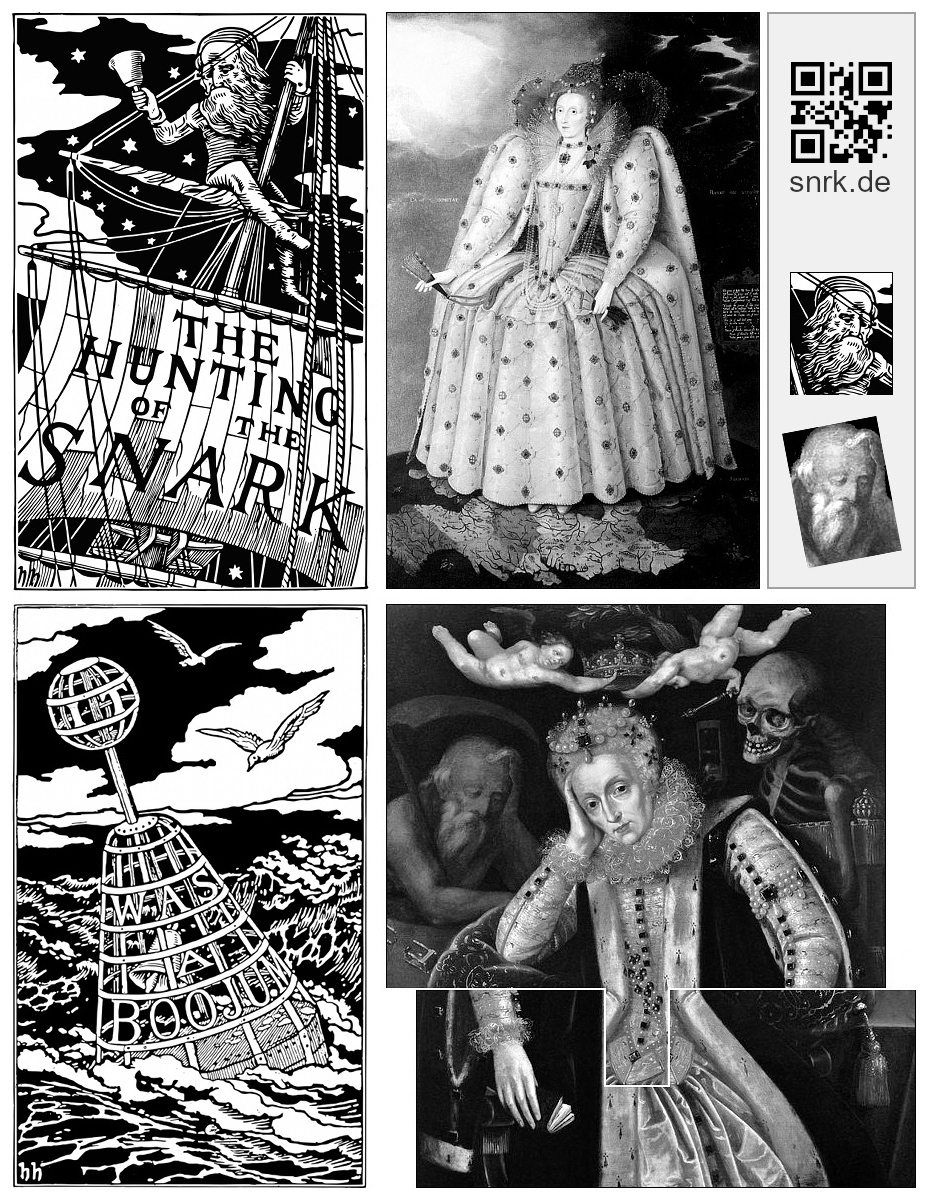
In his Illuminated Snark, John Tufail assumed that the night sky in the front cover of The Hunting of the Snark could be a map. Together with my assumption that Henry Holiday drew inspiration from several paintings by Marcus Gheeraerts (I+II), John’s paper helped me to find the Ditchley Portrait. That again helped me to find the painting by an unknown artist depicting Elizabeth I at old age.
It took me several years to find another map to which Henry Holiday might have referred as well.
2017-08-28, update: 2024-05-12
2017-09-02, updated: 2024-05-07
2017-09-17, update: 2024-05-01
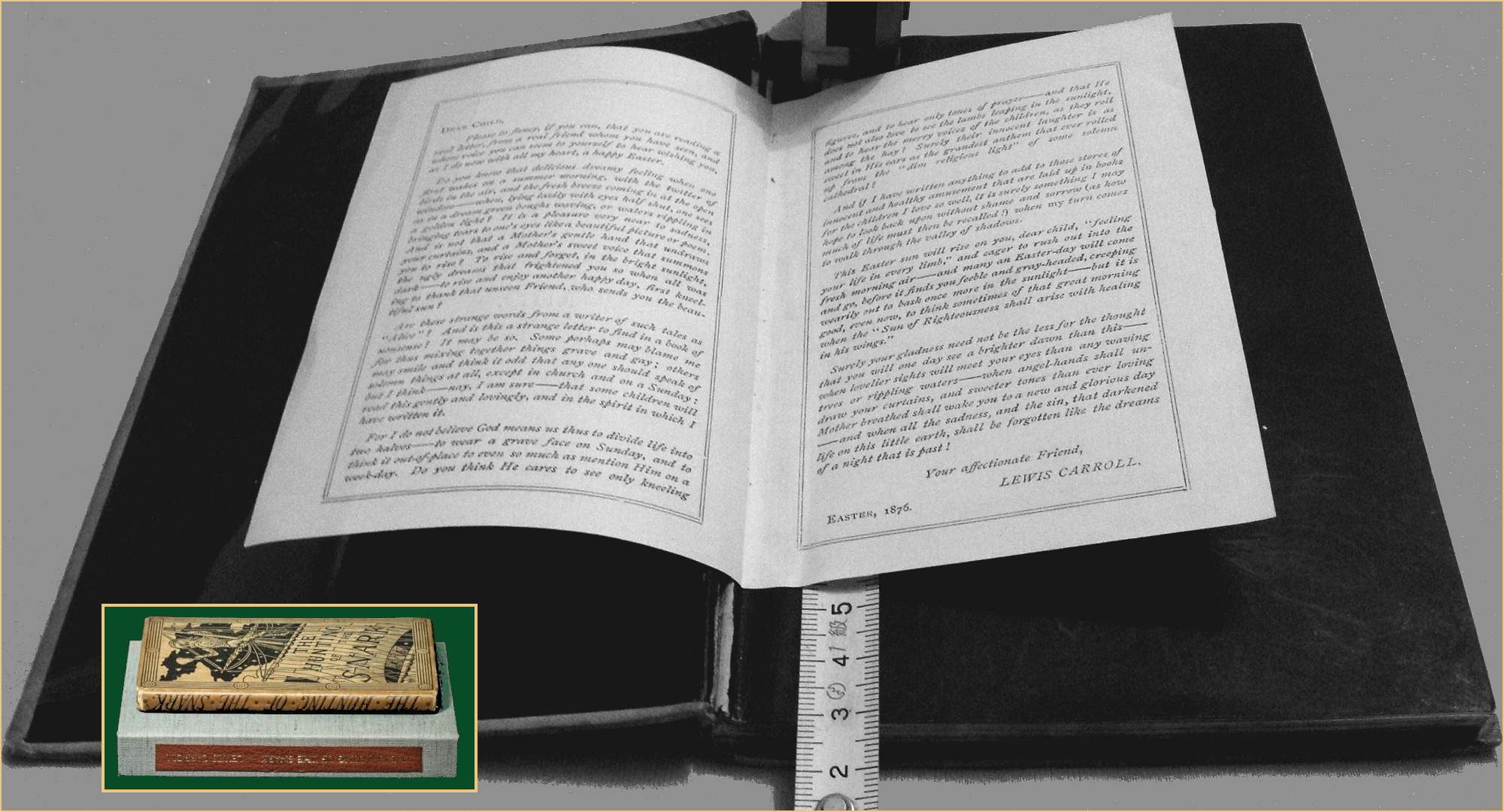
On 1875-10-25, C.L. Dodgson noted in his diary that publishing The Hunting of the Snark as a book «would give me a good opportunity to of circulating two papers (which might be lightly gummed in), one a new “Christmas Greeting” to my 40,000 child-readers, the other an advertisement for a house (and a garden perhaps) in or near London».
Later, because the book wasn’t ready for the Christmas sales due to delays in preparing the printing blocks for the illustrations, an Easter Greeting was lightly gummed into 1st editions of the book shortly before it was published on March 29th, 1876 (officially April 1st).

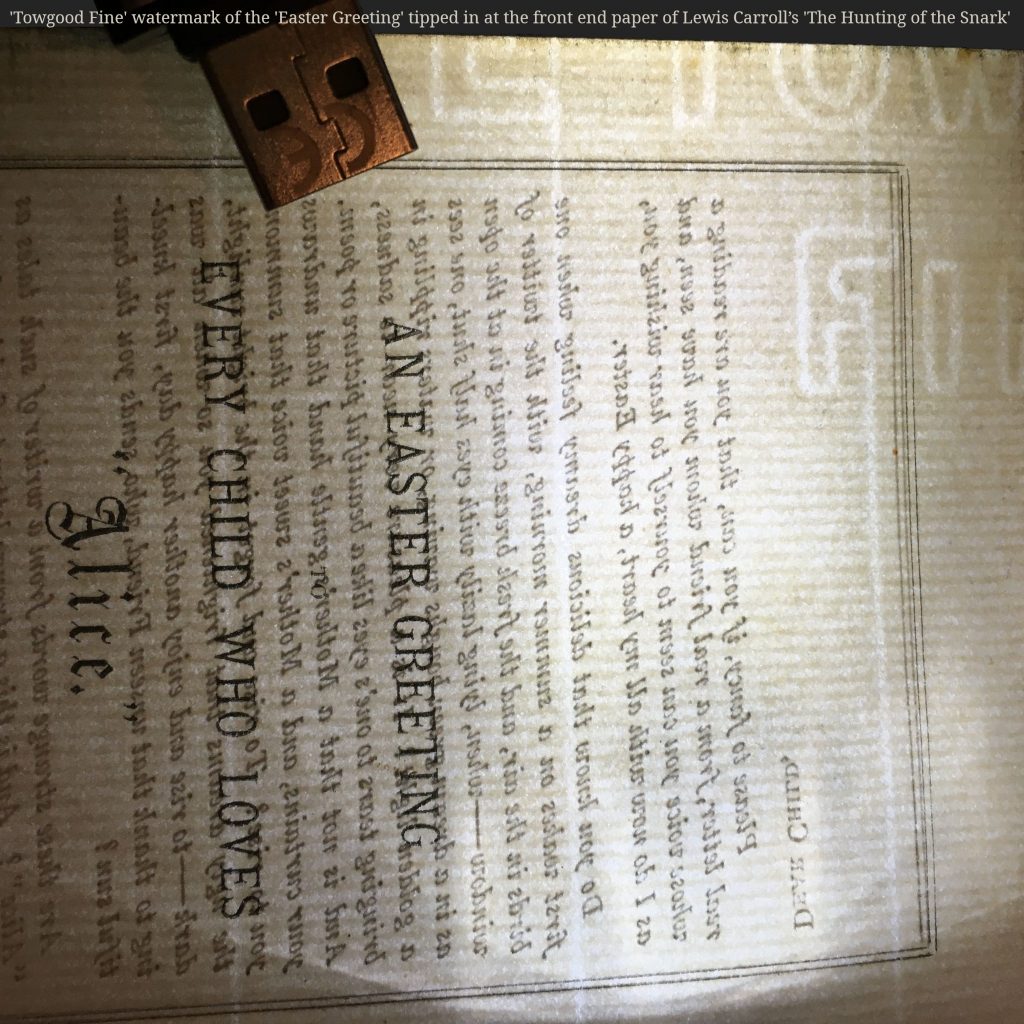
Easter Greeting by Lewis Carroll, printed by James Parker & Co. (Oxford, 1876) for C. L. Dodgson (aka Lewis Carroll) privately on cream laid fine paper with the “Towgood Fine” watermark. Tipped in at the black front end paper of Lewis Carroll’s The Hunting of the Snark, 1st edition and 1st printing, Macmillan & Co. (London, 1876).

2017-11-17, update: 2024-05-01
“No doubt,” said I, “they settled who
Was fittest to be sent
Yet still to choose a brat like you,
To haunt a man of forty-two,
Was no great compliment!”
In his 29th annotation (MG029) to The Hunting of the Snark, Martin Gardiner stated:
Curiously, Carroll refers to his age as 42 in his poem Phantasmagoria (Canto 1, Stanza 16) though at the time [1869 or earlier] the poem was written, he was still in his thirties. The number 42 certainly seems to have had some sort of special significance for Carroll.
It’s a popular assumption, but did Carroll really refer to his age? It’s only “curiously” if one assumes that Carroll was referring to his age before he reached that age. To me that simply means that for the number 42, Carroll did not refer to his own age. With “brat” he might have addressed a cleric who intended to reinstate the dogma of eternal punishment as described in the last article of Thomas Cranmer’s Forty-Two Articles.
2018-11-11, updated: 2024-04-07
All men shall not be saved at the length. They also are worthy of condemnation, who endeavour at this time in restore the dangerous opinion that all men, by they never so ungodly, shall at length be saved, when they have suffered pains for their sins a certain time appointed by God’s justice.
Article 42 on eternal damnation in Thomas Cranmer’s Forty-Two Articles (1552)
No one shall speak to the Man at the Helm, and the Man at the Helm shall speak to no one.
Rule 42 (possibly mocking Cranmer’s Article 42), with the second part of the sentence having been “completed” by the Bellman in Lewis Carroll’s The Hunting of the Snark (1876)
Pope Francis said eternal damnation is not a torture chamber but distance from God.
Vatican Radio, 2016-11-25 (archive)
If something like eternal damnation (Article 42) would exist, then that also would be an eternal disconnect (Rule 42) between the Abrahamic god and those who adhere to that god.
What are those Forty-Two Articles?
The Forty-Two Articles were intended to summarise Anglican doctrine, as it now existed under the reign of Edward VI, who favoured a Protestant faith. Largely the work of Thomas Cranmer, they were to be short formularies that would demonstrate the faith revealed in Scripture and the existing Catholic creeds. Completed in 1552, they were issued by Royal Mandate on 19 June 1553. The articles were claimed to have received the authority of a Convocation, although this is doubtful. With the coronation of Mary I and the reunion of the Church of England with the Catholic Church, the Articles were never enforced. However, after Mary’s death, they became the basis of the Thirty-nine Articles. In 1563, Convocation met under Archbishop Parker to revise the articles. Convocation passed only 39 of the 42, and Elizabeth reduced the number to 38 by throwing out Article XXIX to avoid offending her subjects with Catholic leanings. In 1571, the Article XXIX, despite the opposition of Bishop Edmund Gheast, was inserted, to the effect that the wicked do not eat the Body of Christ. This was done following the queen’s excommunication by the Pope Pius V in 1570. That act destroyed any hope of reconciliation with Rome and it was no longer necessary to fear that Article XXIX would offend Catholic sensibilities. The Articles, increased to Thirty-nine, were ratified by the Queen, and the bishops and clergy were required to assent.
Source: Wikipedia, 2018-03-15
Henry VIII was succeeded by his son, Edward VI, in 1547. During Edward’s reign, the Church of England adopted a stronger Protestant identity. The Book of Common Prayer of 1549 authorised a reformed liturgy, and this prayer book was revised in 1552 to make it more explicitly Protestant. To make the English Church fully Protestant, Cranmer also envisioned a reform of canon law and the creation of a concise doctrinal statement, which would become the Forty-two Articles. Work on a doctrinal statement was delayed by Cranmer’s efforts to forge a doctrinal consensus among the various Protestant churches to counter the work of the Catholic Council of Trent. When this proved impossible, Cranmer turned his attention to defining what the Church of England believed.
The Forty-two Articles were drafted by Cranmer and a small group of fellow Protestants. The title page claimed that the articles were approved by Convocation when in reality they were never discussed or adopted by the clerical body. They were also never approved by Parliament. The articles were issued by Royal Mandate on 19 June 1553. The articles were to be short formularies that would demonstrate the faith revealed in Scripture and the existing ecumenical creeds. The theology of the articles has been described as a “restrained” Calvinism.
Edward died in 1553. With the coronation of Mary I and the reunion of the Church of England with the Catholic Church, the articles were never enforced. However, after Mary’s death, they became the basis of the Thirty-nine Articles. In 1563, Convocation met under Archbishop Parker to revise the articles. Convocation passed only 39 of the 42, and Elizabeth reduced the number to 38 by throwing out Article XXIX to avoid offending her subjects with Catholic leanings. In 1571, despite the opposition of Bishop Edmund Gheast, Article XXIX was re-inserted, declaring that the wicked do not eat the Body of Christ. This was done following the queen’s excommunication by the Pope Pius V in 1570. That act destroyed any hope of reconciliation with Rome and it was no longer necessary to fear that Article XXIX would offend Catholic sensibilities. The Articles, increased to Thirty-nine, were ratified by the Queen, and the bishops and clergy were required to assent.
Source: Wikipedia, 2021-03-28
Eternal damnation still was a controversial issue in the era of the Oxford Movement.
ON APPEAL FROM THE ARCHES COURT OF CANTERBURY.
[…] An Article setting forth extracts of a review of a work that a Clergyman of the Church of England had reviewed, charging that he had therein advisedly declared, that after this life there would be no judgment of God, awarding either eternal happiness or eternal misery, contrary to the Three Creeds, the Absolution, the Catechism, and the Burial and Commination Service: Held not established by the passages of the work pleaded. It is not penal for a Clergyman to express a hope of the ultimate pardon of the wicked [2 Moo. P.C. (N.S.) 432, 433]. […]
Source: 15 E.R. (Essays and Reviews) 943; Date: 1863-06-26; Court: Privy Court; Appellant: Rev. Rowland Williams, D.D.; Respondent: Rev. Walter Kerr Hamilton, Lord Bishop of Salisbury; Appellant: Rev. Henry Bristow Wilson, Clerk; Respondent: Rev. James Fendall, Clerk
The Deacon C. L. Dodgson (aka Lewis Carroll) objected to the belief in eternal punishment in 1897, but his article on Eternal Punishment was not published during his lifetime. In that article, one of Dodgson’s points is that “αἰών” should be translated as “of indefinite duration”, not as “eternal”. (See p. 52 in Robert D. Sutherland’s Language and Lewis Carroll, 1970.) The controversy on eternal punishment seems not to have ended yet.
I assume, that Carroll’s “forty-two” serves as a reference to Thomas Cranmer’s Forty-Two Articles. And Revd. Karen Gardiner suggested in The Carrollian (July 2018, № 31, p.25~41), that this is a reference mainly to Article 42 (about eternal damnation) in Cranmer’s Forty-Two Articles.
The main argument of Gardiner’s June 2018 paper is “that Carroll’s frequent and unexplained use of the number 42, and in particular his development of Rule 42 in the preface of The Hunting of the Snark and Rule 42 in Alice’s trial scene highlight the doctrine of eternal punishment that Carroll was so concerned about.”
Today, “42” mostly is known as an answer to an unknown question. That answer had been revealed in a popular travel guide and invented by Douglas Adams as an answer to that unknown question. Of course neither Lewis Carroll nor Douglas Adams would have provided us with spoilers which could help us to understand their “42”. Holding your readers responsible for their interpretations is much more fun to writers like Adams and Carroll. Therefore Adams told us that the “42” just popped up in his mind out of the air when he enjoyed the view of his garden. And Carroll told us that the last line “For the Snark was a Boojum, you see!” in The Hunting of the Snark popped up in his mind during a walk near Guilford (incidentally the birthplace of Ford Prefect, and then again not his real birthplace).
Lewis Carroll’s Snark and Douglas Adams’ Guide (the BBC radio series) have more in common than just having fits instead of chapters. But among both authors, it probably was only the Deacon Dodgson to whom “42” had a special relevance in the history of the church, that vessel which had been snarked so many times.
2017-12-25, updated: 2024-03-06
It will be no surprise that [Lewis Carroll] extended this intellectual concept outside of mathematics: in 1897, for example, he wrote that the articles of Christian faith
are what would be called in Science “axioms, ” … quite incapable of being proved, simply because proof must rest on something already granted. … (Letters 2: 1122)
His extension of the concept to language is demonstrated in a passage from an appendix to Symbolic Logic, in which he wrote that
if I find an author saying, at the beginning of his book, “Let it be understood that by the word ‘black’ I shall always mean ‘white,’ and that by the word ‘white’ I shall always mean ‘black, ‘” I meekly accept his judgment, however injudicious I may deem it.
Carroll envisions an author, like a mathematician, setting out his axioms at the beginning of a work (though he clearly deems it “injudicious” to arbitrarily invert such a well-respected custom).
The notion that conventions are axiomatic enables more than Carroll’s insights into structural linguistics: it brings a sense of arbitrariness to all social behaviour.
Darien Graham-Smith, p. 38~39
2024-03-03
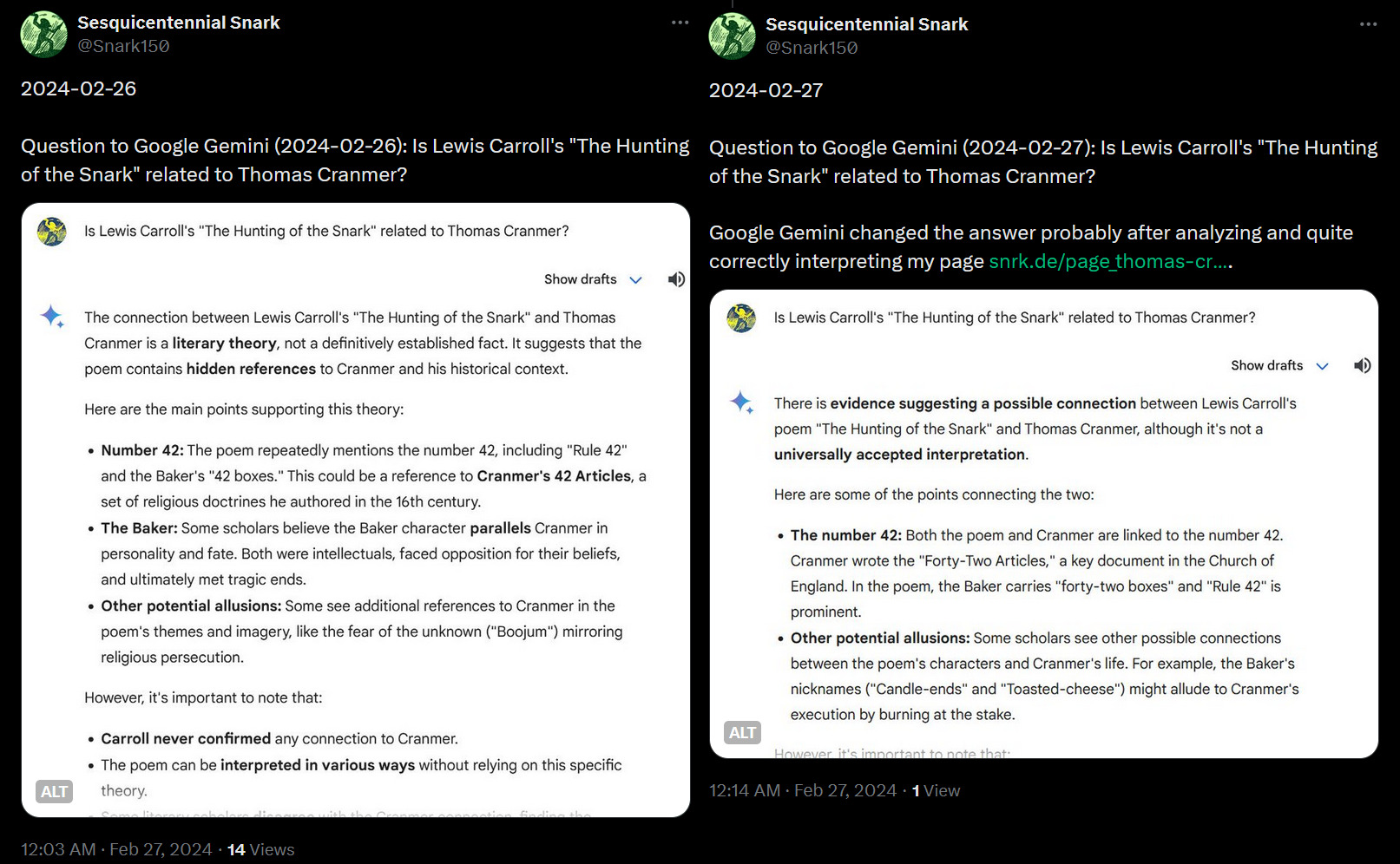
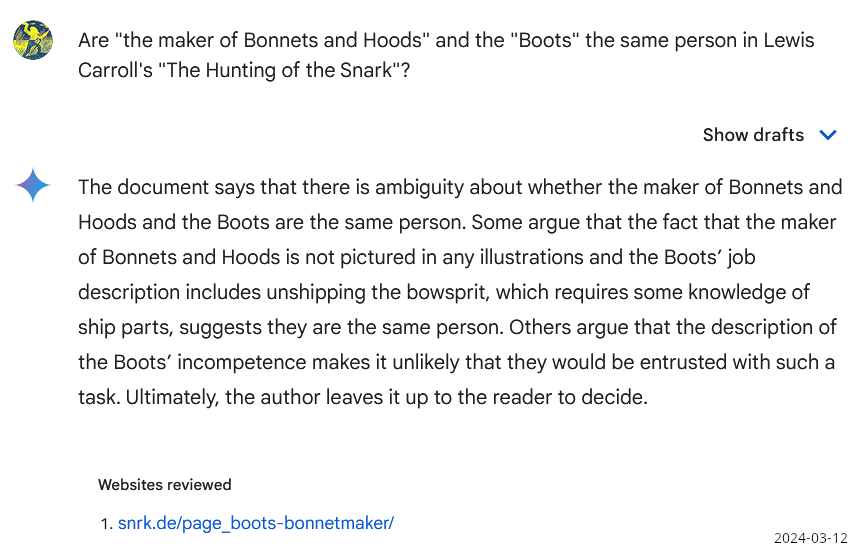
Google Gemini’s AI is plagiarizing.
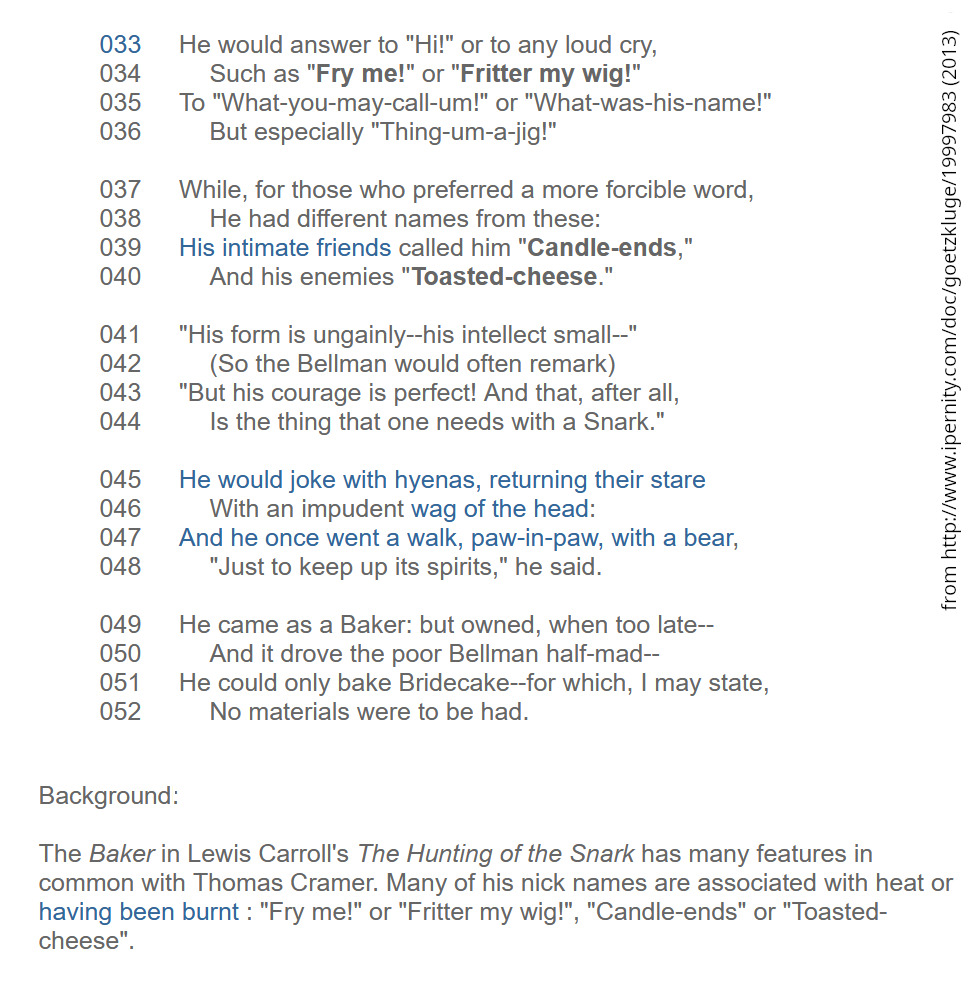
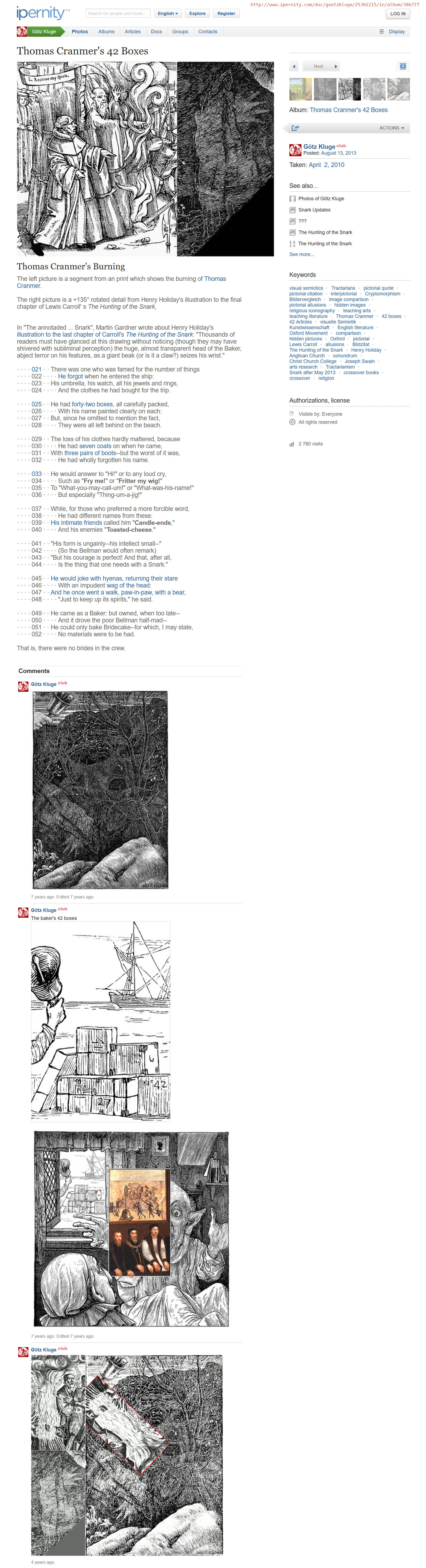
The idea came to me already in 2010, but it took until 2013 that I explicitely linked the Baker’s “hot” nicknames to the burning of Thomas Cranmer.
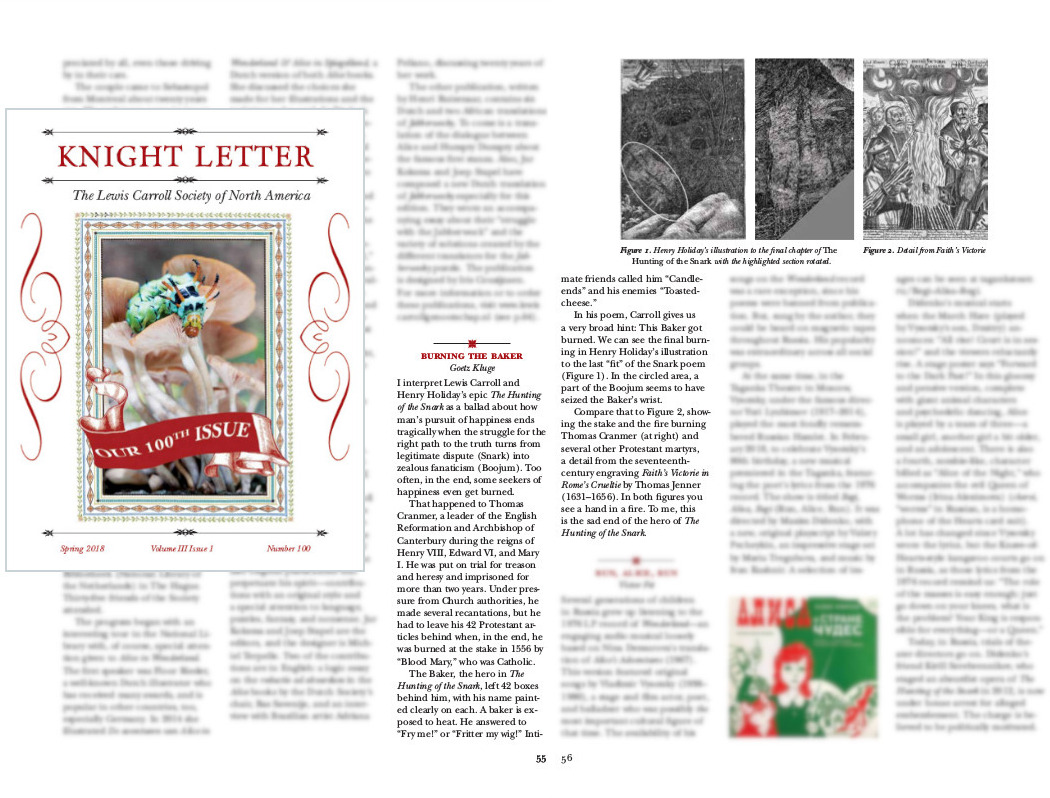
Since then I (not “some scholars”) am the only one who interpreted the Baker’s nicknames in Lewis Carroll’s “The Hunting of the Snark” in that way. Since 2024 Google Gemini does that too, but the AI doesn’t mention the source. e.g. snrk.de/knight-letter-links/kl-spring2018/:
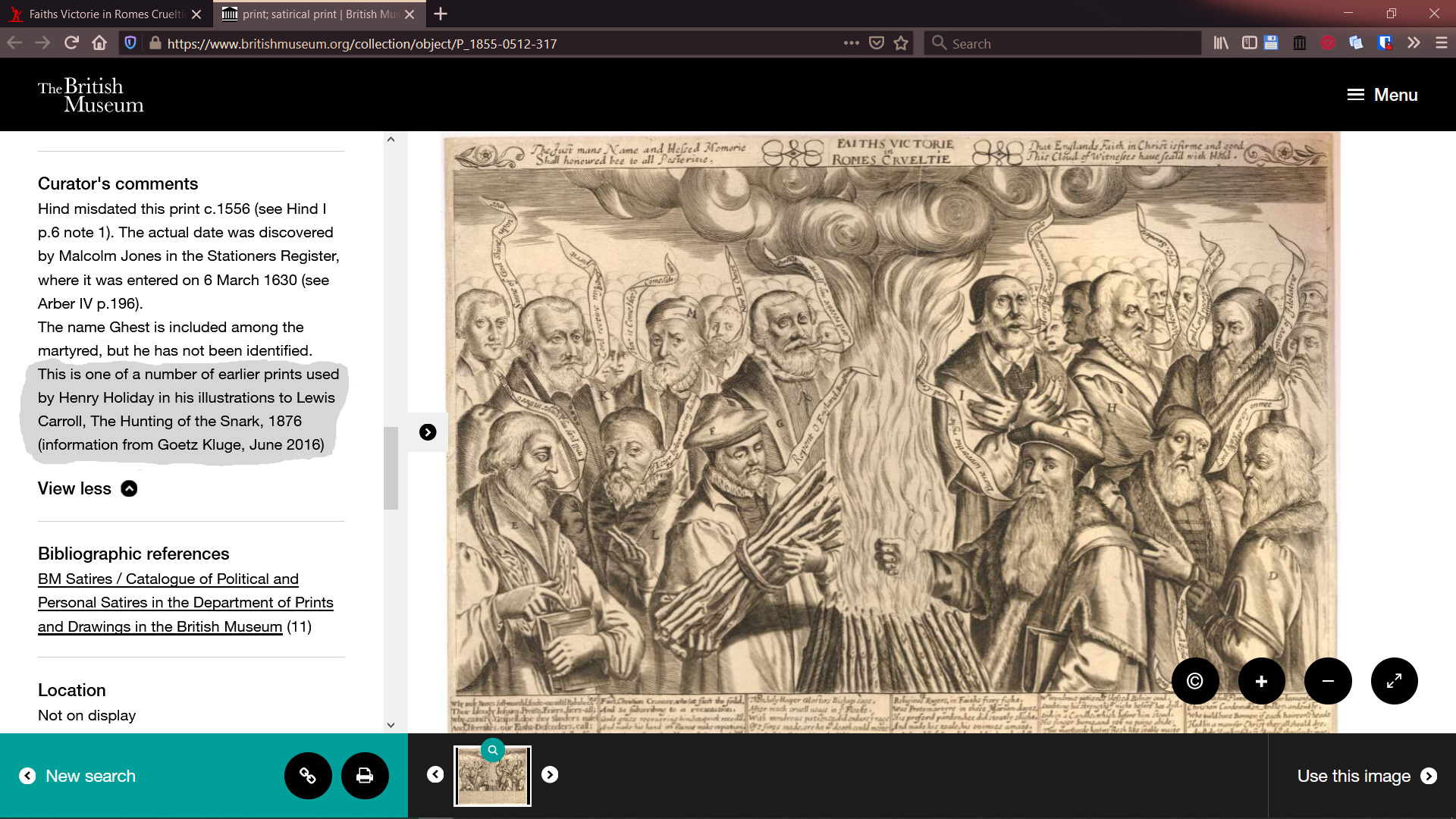
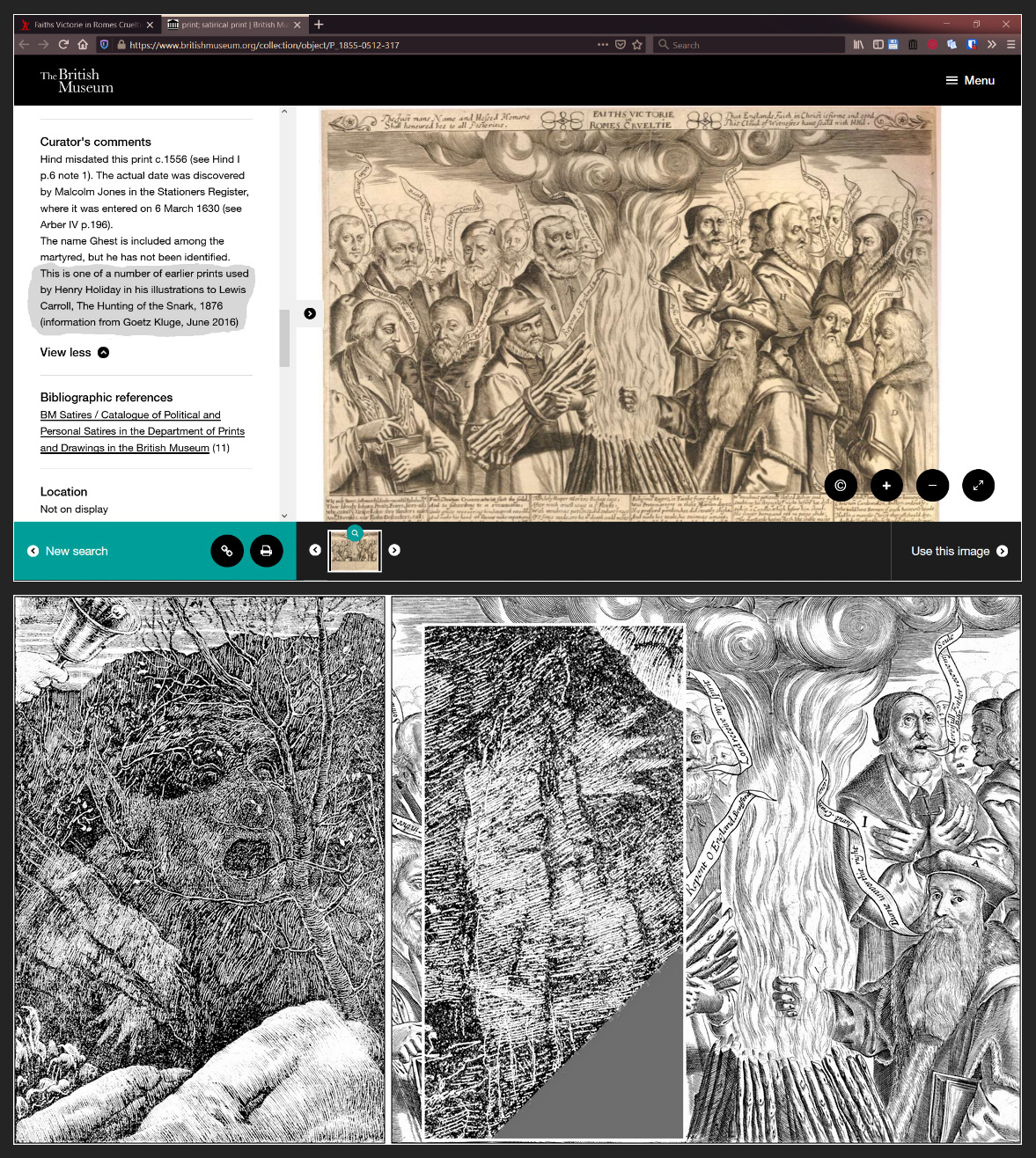
There is a curator’s comment (that of course isn’t plagiarism) about my findings in the website of the British Museum.
See also:
※ on this blog: Thomas Cranmer’s Burning (2017)
※ ex Twitter: [1] [2] (2024)
※ academia.edu (2016)
※ reddit (2016) (archived)
※ flickr (2010) (archived, text only)
2024-02-29
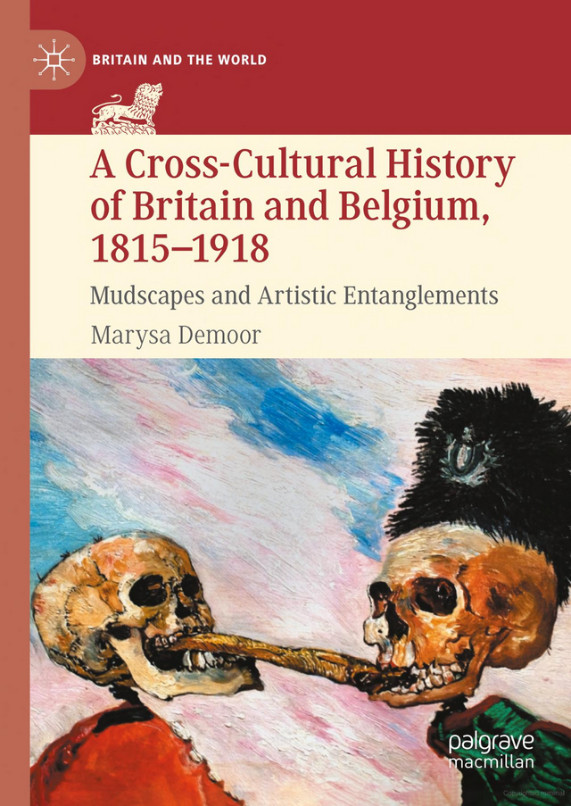
This perhaps is the first reference in academia to my findings: Chapter 7 Surrealist Entanglements (excerpts which refer to my findings) in Marysa Demoor‘s book A Cross-Cultural History of Britain and Belgium, 1815-1918: Mudscapes and Artistic Entanglements, Springer Nature (Palgrave Macmillan), 2022-03-21.
(Review by Marnix Verplancke, translated by Kate Connelly.)
What Marysa Demoor’s wrote about Henry Holiday’s pictorial references in Lewis Carroll’s The Hunting of the Snark confirms what I wrote my article Nose is a Nose is a Nose in the LCNSA Knight Letter (№ 99, Fall 2017, p. 30~31). I found Holiday’s pictorial references to Gheeraerts’ Image Breakers in 2009. Actually, a reference from another Snark illustration by Henry Holiday to Gheeraerts’ print started my Snark hunt in December 2008.
Henry Holiday’s references to Gheeraerts are also mentioned in Marysa Demoor’s article Een culturele brexit? Grotesk! (2022-05-07, archive) in the Belgian De Standaard.
Professor Demoor didn’t specify her sources for what she wrote about Henry Holiday’s references to Marcus Gheeraerts the Elder, William Sidney Mount and Benjamin Duchenne.
Mastodon | Reddit | ex Twitter
2022-11-21, updated: 2024-02-27
The Hunting of the Snark needs to be read at least twice. It is crossover literature. You read it differently at different ages. The book is an excellent example for crossover literature (and crossover picture books): Children read it as a nonsense story. It is “dark”, but funny nevertheless. Adult readers know more than children. Some of them will recognize the textual and pictorial references in Lewis Carroll, Henry Holiday and Joseph Swain’s tragicomedy.
Henry Holiday’s illustration (engraved by Joseph Swain) to the final chapter of Lewis Carroll’s The Hunting of the Snark has been published almost 150 years ago. Children probably will not understand that the illustration is a reference to the burning of Thomas Cranmer. He and the Baker (the ambivalent hero in The Hunting of the Snark) perhaps hoped that after having left their 42 articles behind, the Boojum won’t get them.
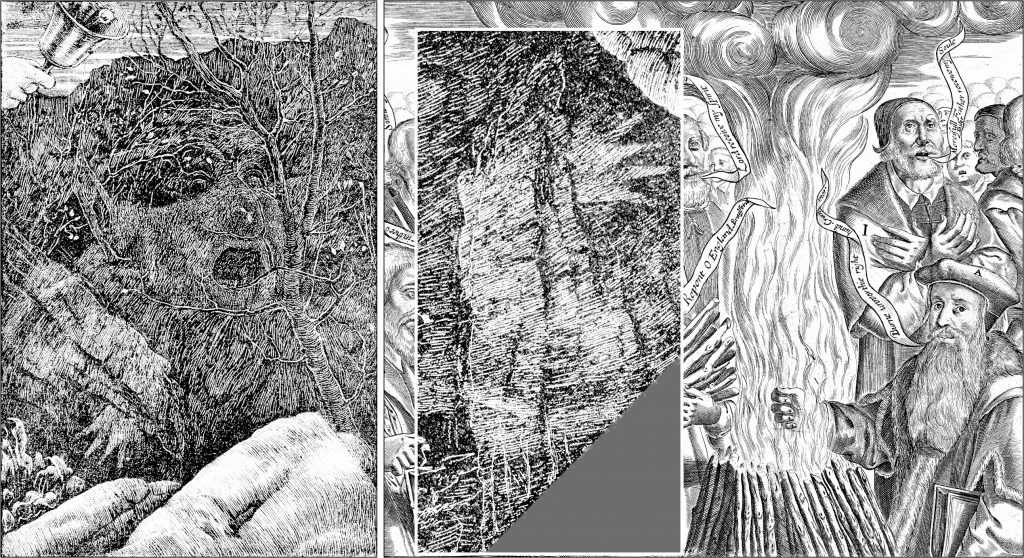
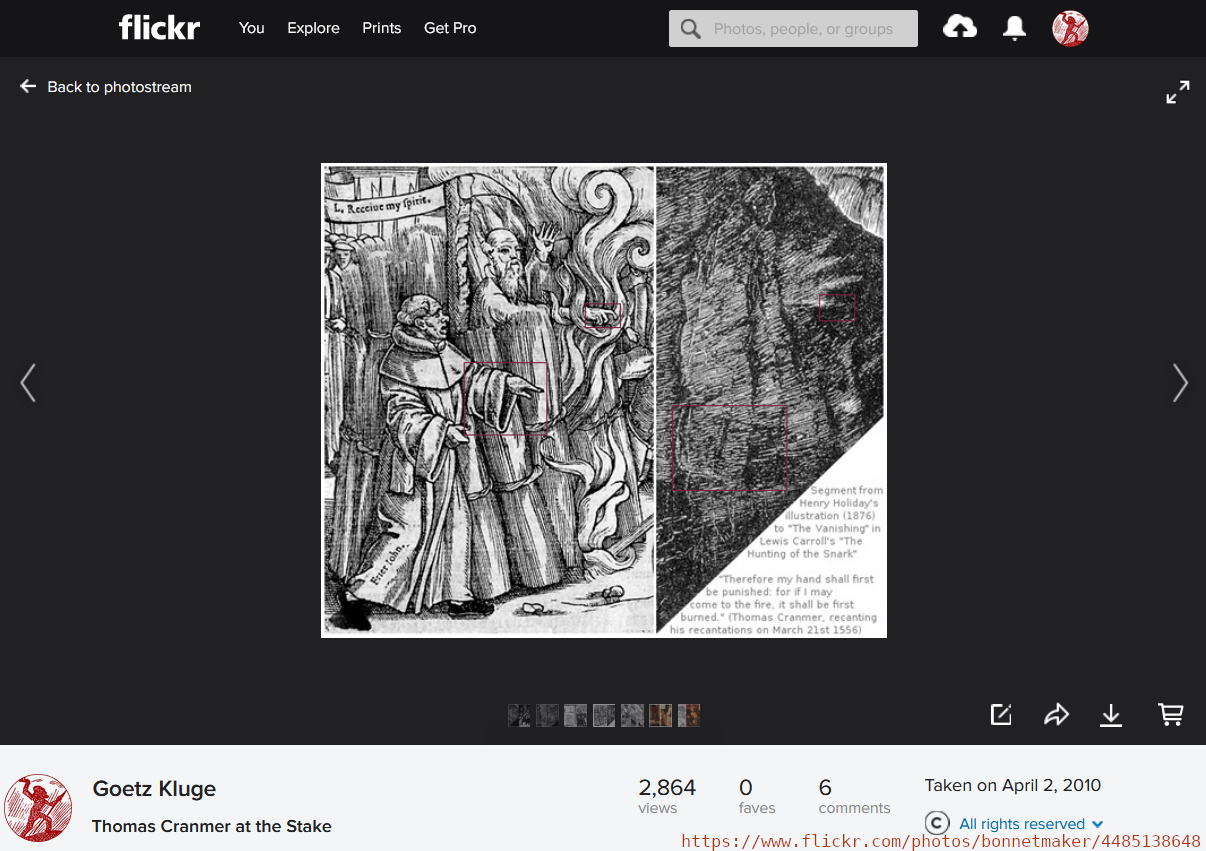
Comparison of two illustrations:
The rotated detail from Henry Holiday’s illustration neither is a “claw” nor a “beak”. I assume that it depicts a fire. And there is a hand in both fires. Carroll and Holiday almost too successfully made sure that the readers of The Hunting of the Snark don’t understand their references to Thomas Cranmer too early: Carroll’s tragycomedy was published in 1876. It took almost 120 years until Angus MacIntyre suggested in The Reverend Snark, Jabberwocky 23(1994), p. 51~52: “The Baker’s 42 Boxes are the original Protestant Articles of 1553, with Thomas Cranmer’s name on each.” Henry Holiday’s pictorial reference (I started to search for it in 2010) to Thomas Cranmer’s burning confirms the link between The Hunting of the Snark and Thomas Cranmer.
2018-05-07, updated: 2024-02-10
Annotations to “10 Interesting Facts About The Hunting of the Snark“ (Rose Theatre, 2017-09-21)
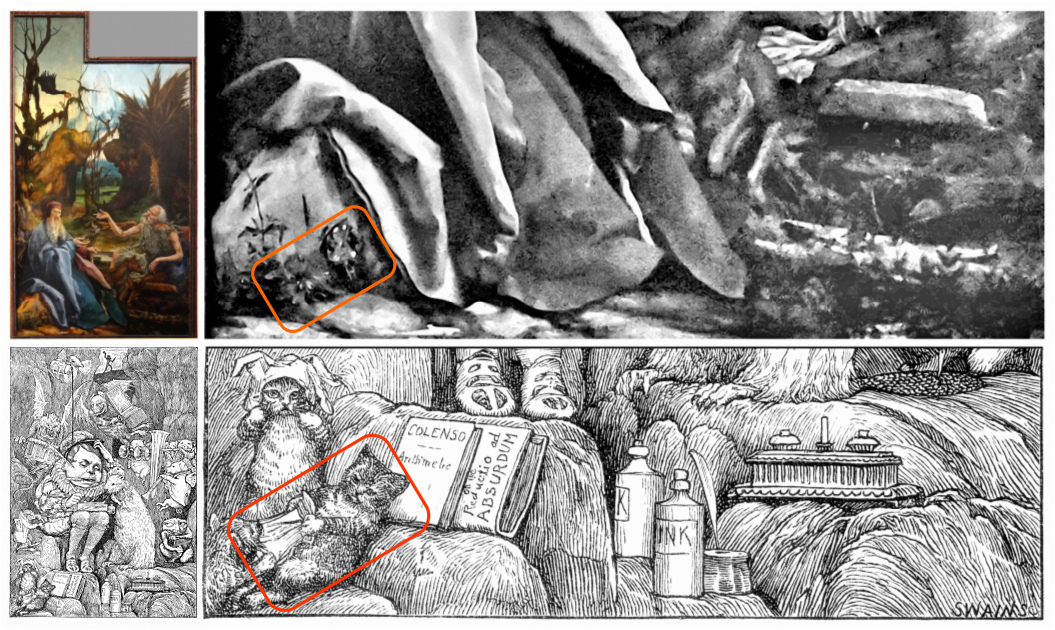
2020-08-21, update: 2023-12-13
The Butcher in the 5th fit of The Hunting of the Snark:
“The method employed I would gladly explain,
While I have it so clear in my head,
If I had but the time and you had but the brain —
But much yet remains to be said.“In one moment I’ve seen what has hitherto been
Enveloped in absolute mystery,
And without extra charge I will give you at large
A Lesson in Natural History.”In his genial way he proceeded to say
(Forgetting all laws of propriety ,
And that giving instruction, without introduction,
Would have caused quite a thrill in Society).
Comic Arithmetic, Rule III, Subtraction
Subtraction teaches to “take from” or to find the difference of two numbers; having taken too much in, and slept out; to find the difference in sovereigns and shillings between that and sleeping at home according to the “
conventional laws of virtuous propriety .” (Vide Miss Martineau.)
2023-11-23
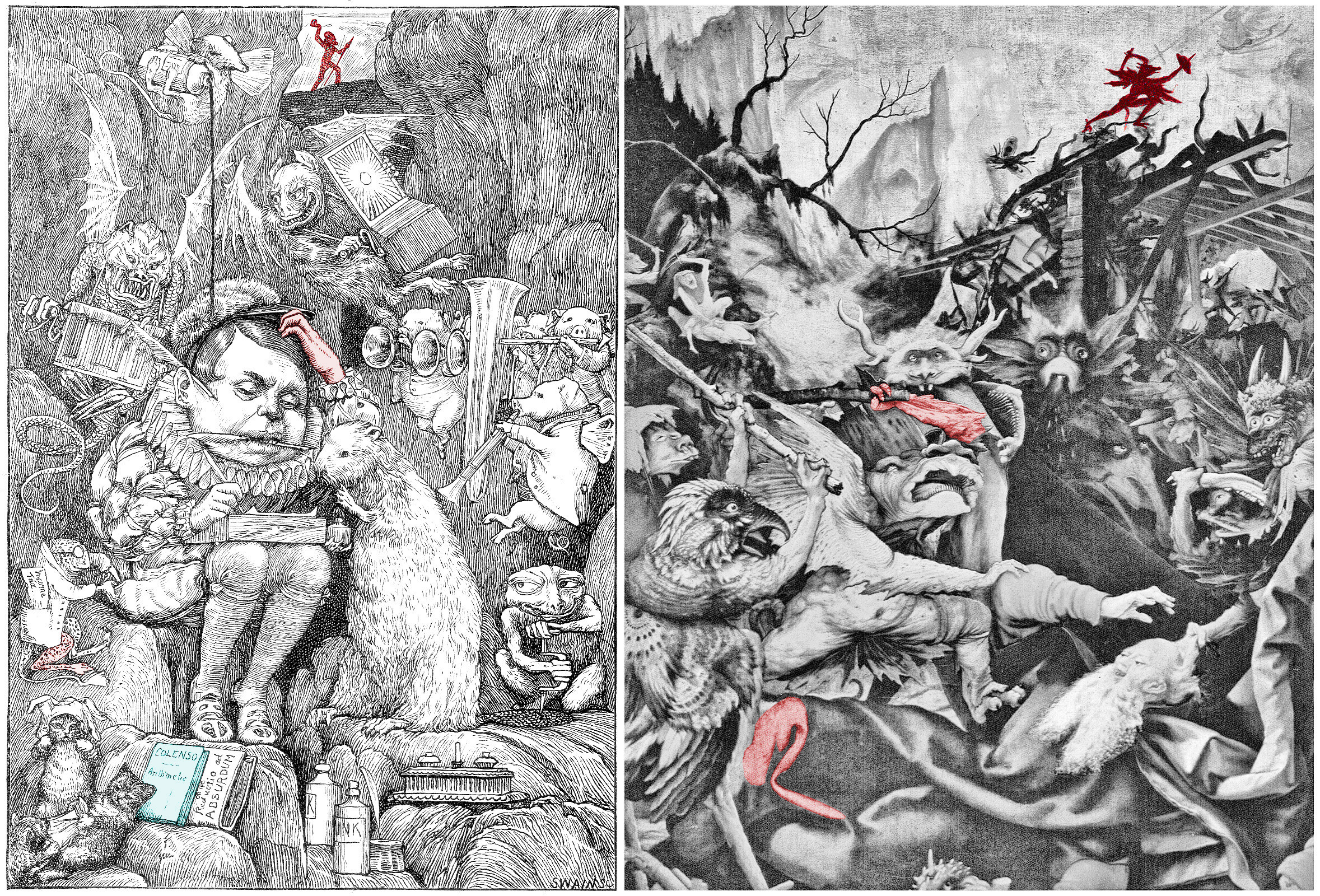
This is one of the comparisons where am not so sure whether Holiday alluded to the work of another artist. If he did, then you might wait a little bit before you look at my spoiler where I marked possible(?) clues given to us by Holiday.
2017-11-08, updated: 2023-11-08
My first Snark encounter was in 2005. Then, after almost four years, I entered the Snark hunting grounds in December 2008. http://www.artandpopularculture.com/User:Goetzkluge could give you an idea where I was in 2010.

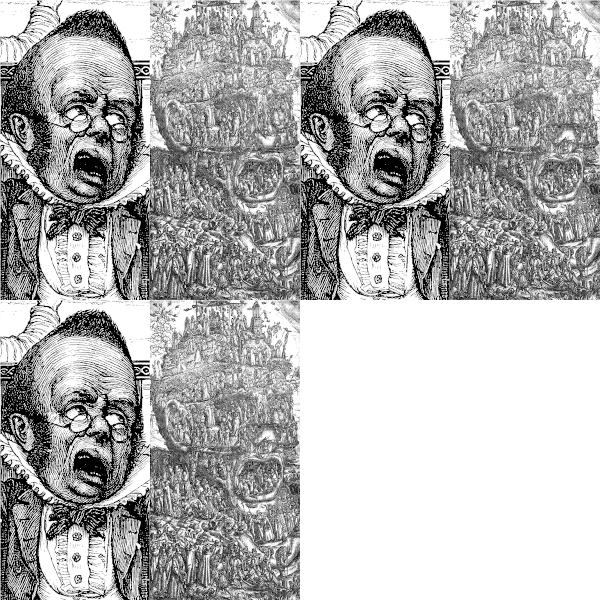
The image shows illustrations by Henry Holiday (from The Hunting of the Snark, 1876) and Marcus Gheeraerts the Elder (Allegory of Iconoclasts, aka The Image Breakers, around 1567): In the “mouth” of Gheeraerts’ “head” a praying priest is depicted. The shape of the priest also is visible in the “mouth” of Holiday’s vanishing “Baker”.
There is more — with acknowledgements to Mahendra Singh, to John Tufail and to the Internet.
And there are more big heads.
Articles in this blog about Henry Holiday’s illustration to the chapter The Vanishing.
2017-08-28, updated: 2023-11-03

Watch those fingers: The photo has been “photoshopped” (by Henry Holiday or Joseph Swain?) already many years before I worked on it using GIMP. Holiday’s tinkering with the little finger and the thumb of his left hand might be a “Victorian craze“.
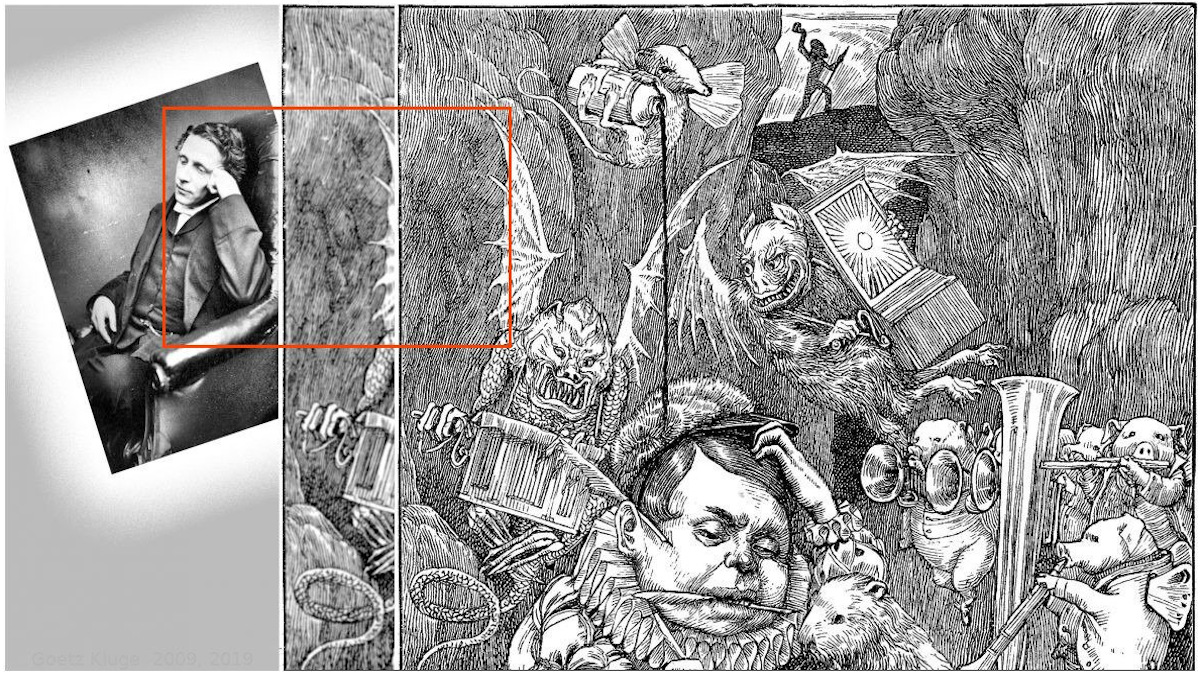
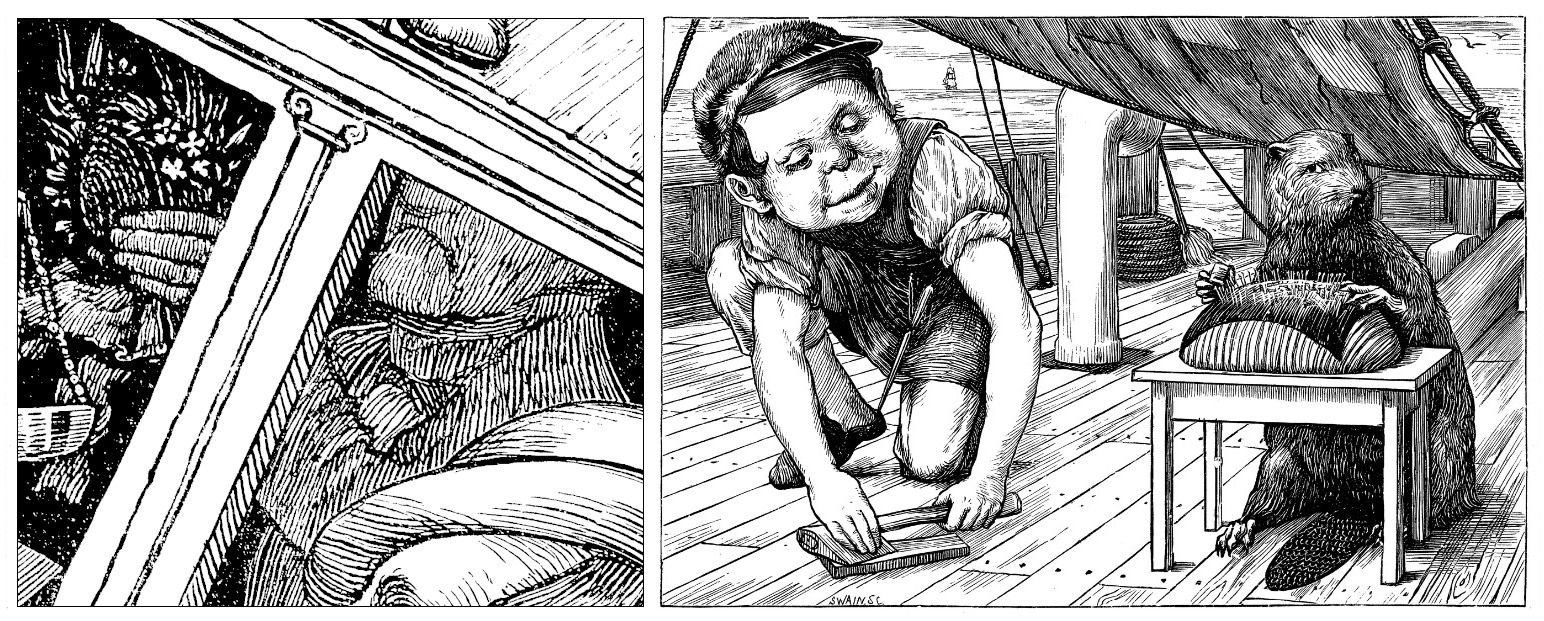
The image shows Henry Holiday and segments of one of Henry Holiday’s illustrations (cut by Joseph Swain) to Lewis Carroll’s The Hunting of the Snark. The segments show the Bonnetmaker and a bonnet.
The Bonnetmaker drawing could be a little self portrait, a cameo of Henry Holiday in The Hunting of the Snark. The photo is a portrait perhaps taken by Joseph Swain or a self portrait. Henry Holiday was in his mid thirties when he illustrated Carroll’s Snark tragicomedy, and the National Portrait Gallery dated a portrait photo of Henry Holiday (NPG x18530) with “1870s”, where the face shown in that photo does not look too different from the face in the assembly shown above.
Such little self portraits in drawings have a long tradition.
In German there is the term “Assistenzfigur”. That is a person positoned in the background or beside the main person or main object depicted in a painting. You may think of such a person as the static version of a “film extra” in a movie. She or he serves a a kind of helper or assistant. Sometimes one of these extras is the artist who made the painting. In German we call such an image in the image an “Assistenzselbstbildnis” or “Assistenzselbstbild” or “Selbstbildnis in Assistenz”. Perhaps the first known self-portraits in assistance where a kind of signature of the artist.
The “self-portrait in assistance” first became available since the 14th century to master builders and sculpturer, shortly after that in Italy also to fresco painters, and since the 15th and 16th century also to painters of large altar- and panel paintings; see Raupp, S. 8
Source (in German): Footnote on p. 162 in Suzanne Valadon – Identitätskonstruktion… (2001) by Valeska Doll referring to Untersuchungen zu Künstlerbildnissen und Künstlerdarstellungen in den Niederlanden im 17. Jahrhundert (1984) by Hans-Joachim Raupp.
In that matter there also are references to Raupp in Melanie Munduch: Die Selbstbildnisse Luca Giordanos (2012)
#Assistenzselbstbildnis: ex Twitter
For diskussion of the finger “photoshopping”: ex Twitter
Original post: 2017-09-28. Update: 2023-10-13