Eternal Disconnect

All men shall not be saved at the length. They also are worthy of condemnation, who endeavour at this time in restore the dangerous opinion that all men, by they never so ungodly, shall at length be saved, when they have suffered pains for their sins a certain time appointed by God’s justice.

Article 42 on eternal damnation in Thomas Cranmer’s Forty-Two Articles (1552)


No one shall speak to the Man at the Helm, and the Man at the Helm shall speak to no one.

Rule 42 (possibly mocking Cranmer’s Article 42), with the second part of the sentence having been “completed” by the Bellman in Lewis Carroll’s The Hunting of the Snark (1876)


Pope Francis said eternal damnation is not a torture chamber but distance from God.

Vatican Radio, 2016-11-25 (archive)

 
If something like eternal damnation would exist, then that also would be an eternal disconnect (Rule 42) between the Abrahamic god and those who adhere to that god. Thomas Cranmer’s Article 42 didn’t make it into the Elizabethan 39 Articles, but the debate about eternal damnation seems to be eternal itself.


What are those Forty-Two Articles?
From Wikipedia, the free encyclopedia:

The Forty-two Articles were the official doctrinal statement of the Church of England for a brief period in 1553. Written by Archbishop Thomas Cranmer and published by King Edward VI’s privy council along with a requirement for clergy to subscribe to it, it represented the height of official church reformation prior to the reign of Queen Elizabeth I. It staked out a position among Protestant movements of the day, opposing Anabaptist claims and disagreeing with Zwinglian positions without taking an explicitly Calvinist or Lutheran approach. []


Eternal damnation still was a controversial issue in the era of the Oxford Movement.

ON APPEAL FROM THE ARCHES COURT OF CANTERBURY.
[…] An Article setting forth extracts of a review of a work that a Clergyman of the Church of England had reviewed, charging that he had therein advisedly declared, that after this life there would be no judgment of God, awarding either eternal happiness or eternal misery, contrary to the Three Creeds, the Absolution, the Catechism, and the Burial and Commination Service: Held not established by the passages of the work pleaded. It is not penal for a Clergyman to express a hope of the ultimate pardon of the wicked [2 Moo. P.C. (N.S.) 432, 433]. […]

Source: 15 E.R. (Essays and Reviews) 943; Date: 1863-06-26; Court: Privy Court; Appellant: Rev. Rowland Williams, D.D.; Respondent: Rev. Walter Kerr Hamilton, Lord Bishop of Salisbury; Appellant: Rev. Henry Bristow Wilson, Clerk; Respondent: Rev. James Fendall, Clerk
 

The Deacon C. L. Dodgson (aka Lewis Carroll) objected to the belief in eternal punishment in 1897, but his article on Eternal Punishment was not published during his lifetime. In that article, one of Dodgson’s points is that “αἰών” should be translated as “of indefinite duration”, not as “eternal”. (See p. 52 in Robert D. Sutherland’s Language and Lewis Carroll, 1970.) The controversy on eternal punishment seems not to have ended yet.
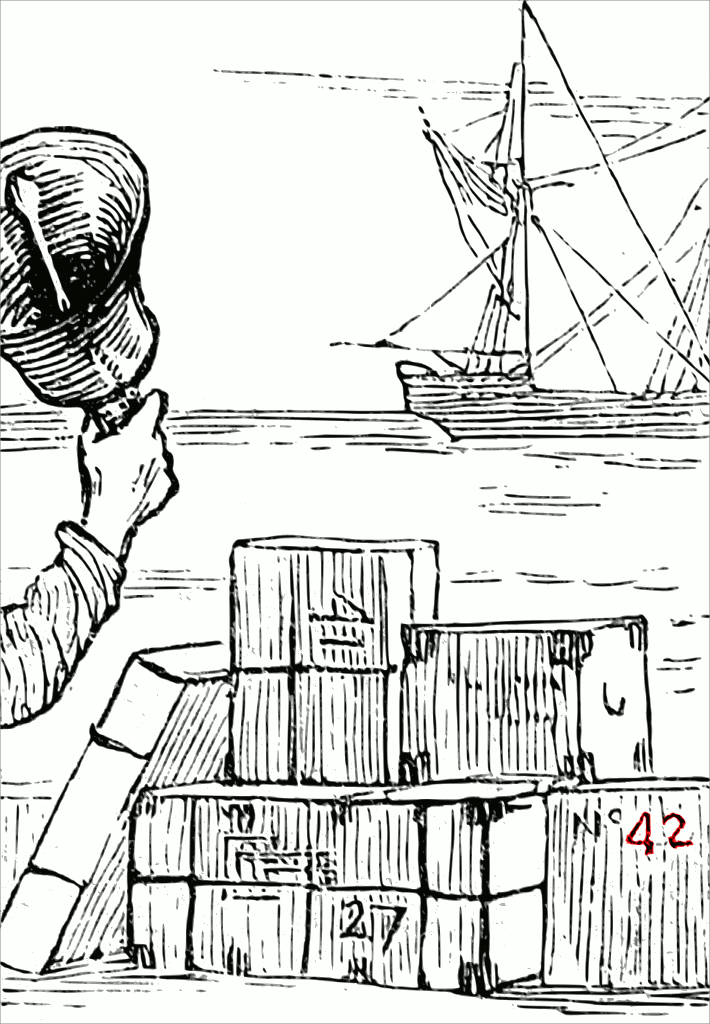
I assume, that Carroll’s “forty-two” serves as a reference to Thomas Cranmer’s Forty-Two Articles. And Revd. Karen Gardiner suggested in The Carrollian (July 2018, № 31, p.25~41), that this is a reference mainly to Article 42 (about eternal damnation) in Cranmer’s Forty-Two Articles.

The main argument of Gardiner’s June 2018 paper is “that Carroll’s frequent and unexplained use of the number 42, and in particular his development of Rule 42 in the preface of The Hunting of the Snark and Rule 42 in Alice’s trial scene highlight the doctrine of eternal punishment that Carroll was so concerned about.”«But if Rule 42 is not just a random number, preferred by some inexplicable reason by Carroll, but is actually a theological nod to a discarded article of faith, then the riddle may be solved. The rule may indeed be the oldest (that is, from 1553 rather than 1571) and so the King, in some senses, is correct. But Alice is also correct. This rule has already been rejected as unnecessary and flawed and therefore cannot be used by the court to justify ejecting her.
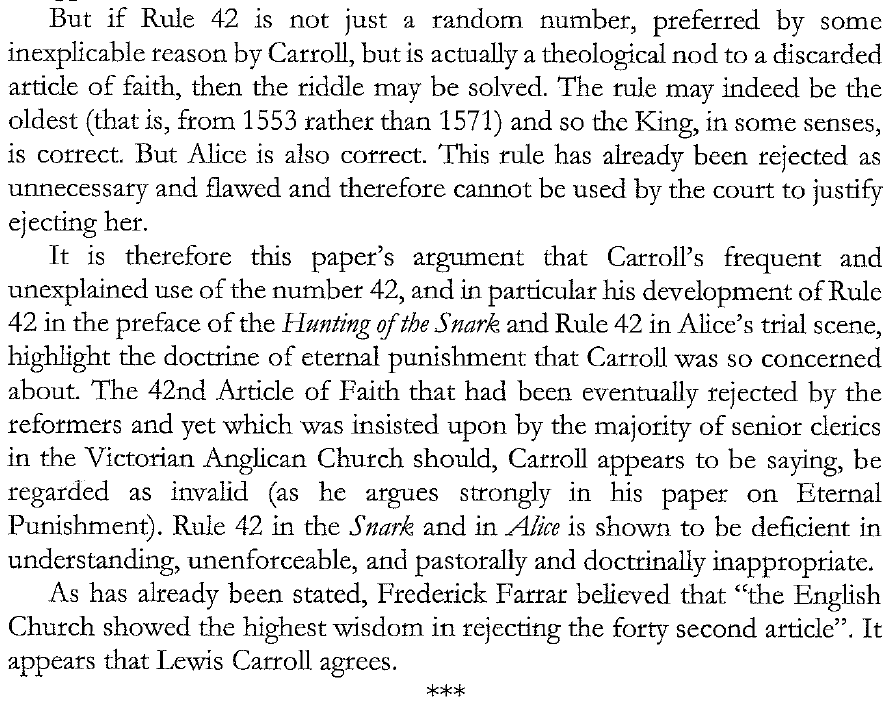
It is therefore this paper’s argument that Carroll’s frequent and unexplained use of the number 42, and in particular his development of Rule 42 in the preface of the 'Hunting of the Snark'; and Rule 42 in Alice’s trial scene, highlight the doctrine of eternal punishment that Carroll was so concerned about. The 42nd Article of Faith that had been eventually rejected by the reformers and yet which was insisted upon by the majority of senior clerics in the Victorian Anglican Church should, Carroll appears to be saying, be regarded as invalid (as he argues strongly in his paper on Eternal Punishment). Rule 42 in the Snark and in Alice is shown to be deficient in understanding, unenforceable, and pastorally and doctrinally inappropriate.

As has already been stated, Frederick Farrar believed that “the English Church showed the highest wisdom in rejecting the forty second article”. It appears that Lewis Carroll agrees.»


Today, “42” mostly is known as an answer to an unknown question. That answer had been revealed in a popular travel guide and invented by Douglas Adams as an answer to that unknown question. Of course neither Lewis Carroll nor Douglas Adams would have provided us with spoilers which could help us to understand their “42”. Holding your readers responsible for their interpretations is much more fun to writers like Adams and Carroll. Therefore Adams told us that the “42” just popped up in his mind out of the air when he enjoyed the view of his garden. And Carroll told us that the last line “For the Snark was a Boojum, you see!” in The Hunting of the Snark popped up in his mind during a walk near Guilford (incidentally the birthplace of Ford Prefect, and then again not his real birthplace).

Lewis Carroll’s Snark and Douglas Adams’ Guide (the BBC radio series) have more in common than just having fits instead of chapters (sections of a poem). But among both authors, it probably was only the Deacon Dodgson to whom “42” had a special relevance in the history of the church, that vessel which had been snarked so many times.

 
Links:

 
2017-12-25, updated: 2026-05-13

Benjamin Jowett


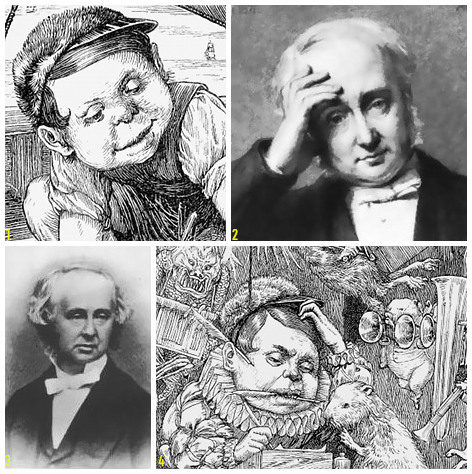
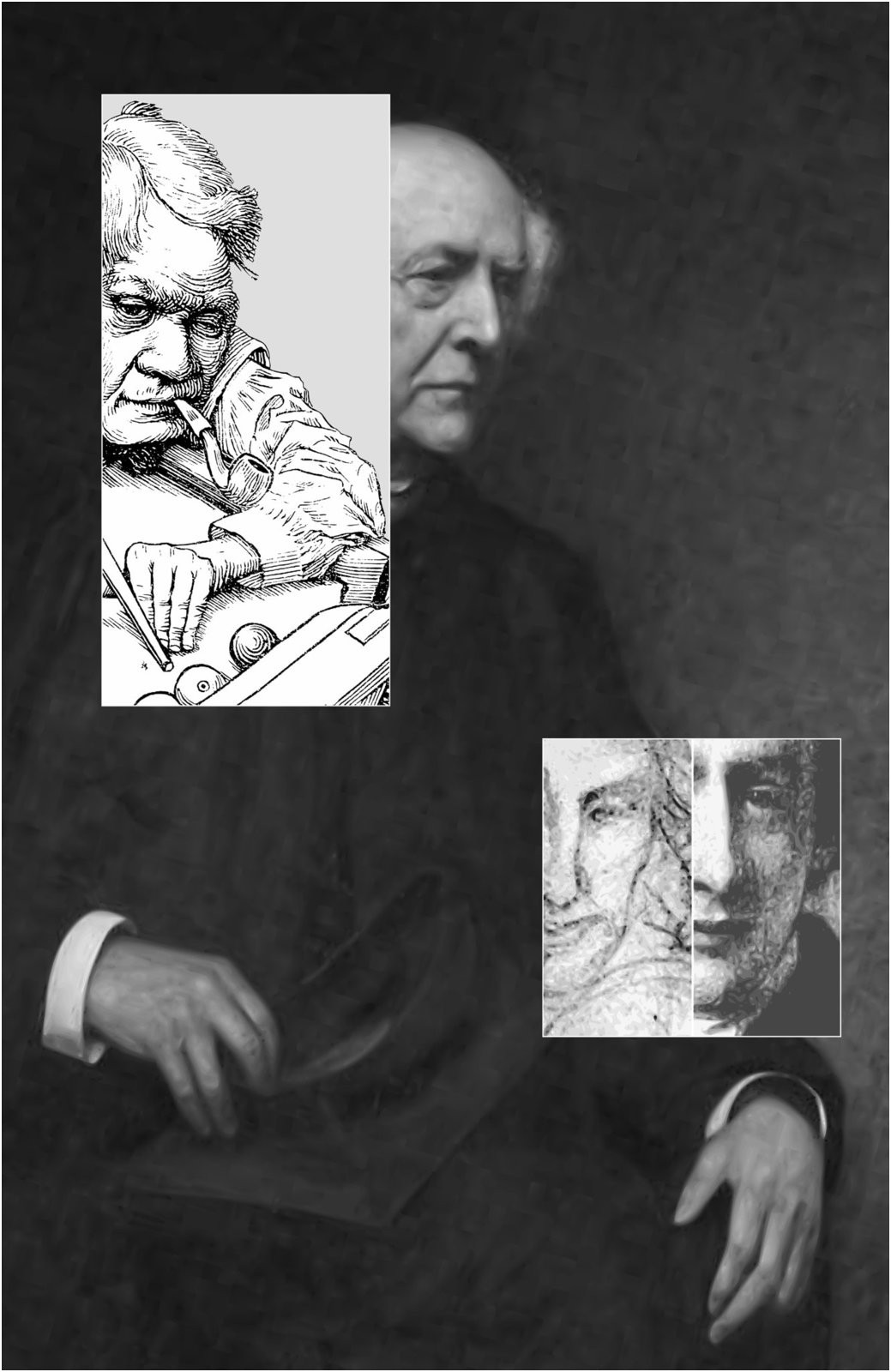
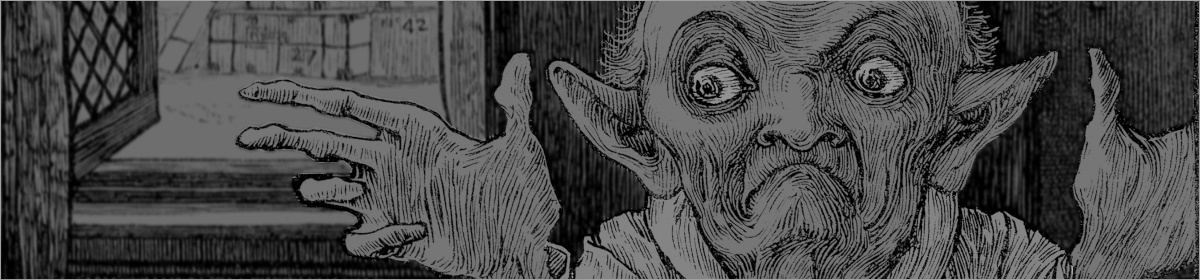
Image sources: (1, 4) Henry Holiday, (2) probably by The Autotype Company, after Désiré François Laugée, (3) from cover of Benjamin Jowett and the Christian Religion by Peter Hinchliff.

[…]
Need I rehearse the history of Jowett?
I need not, Senior Censor, for you know it.
That was the Board Hebdomadal, and oh!
Who would be free, themselves must strike the blow!
[…]

C.L. Dodgson, from Notes by an Oxford chiel (1874)

 
For comparison (inspired by Dodgson?):

First come I. My name is J-W-TT.
There’s no knowledge but I know it.
I am Master of this College,
What I don’t know isn’t knowledge.

Source: The Balliol Rhymes (written in the 1880s), ed. W. G. Hiscock, 2nd edn. (1939; Oxford: printed for the editor, 1955): 1-25. PN 6110 C7H5 Robarts Library (Wikipedia: In 1880, seven undergraduates of Balliol published 40 quatrains of doggerel lampooning various members of the college under the title The Masque of B–ll––l, now better known as The Balliol Masque, in a format that came to be called the “Balliol rhyme“.The college authorities suppressed the publication fiercely.)

I suggest that The Barrister’s Dream in Lewis Carroll’s The Hunting of the Snark is about E.B. Pusey’s attempt to trial Jowett for heresy at the Vice-Chancellor’s Court for unpaid bills for heresy. According to Karen Gardiner (see p. 55 below), the trial began on 1863-03-20. The judge was an academic common lawyer. Jowett’s lawyer objected to the formally civilian court being turned into something like a court of common law, which had no jurisdiction in spiritual matters. The Punch (the anonymous author Dodgson?) called it the “small debts and heresies court“. The judge disagreed, provided it could be shown that Jowett had been guilty of breaking any of the university statues. As this could not be shown, the case was dismissed. Thus, the trial was a mess like the trial in the Barrister’s dream.

“In the matter of Treason the pig would appear
      To have aided, but scarcely abetted:
While the charge of Insolvency fails, it is clear,
      If you grant the plea ‘never indebted.’

 
See also:
※ Lewis Carroll, «Take care of the sense and the sounds will take care of themselves.» in Alice’s Adventures in Wonderland
※ Lewis Carroll, «The New Method of Evaluation as applied to π», 1865
※ John Tufail, The Jowett Controversy, 2010 (document creation date)
※ Karen Gardiner, Escaping Justice in Wonderland (An adaption of a paper given at the Glasgow International Fantasy Conference 2018), published in The Carrollian No. 33 p. 47 ~ 60, March 2020 (abstract, 2018).
Essays and Reviews

 
Instagram | Reddit

2018-05-03, update: 2022-10-17

Henry George Liddell

A Billiard-marker, whose skill was immense,
 Might perhaps have won more than his share—
But a Banker, engaged at enormous expense,
 Had the whole of their cash in his care.

The Times announces that Liddell of Westminster is to be the new Dean: the selection does not seem to have given much satisfaction in the college.

Quote: C.L. Dodgson, 1855-06-07, @DodgsonDiaries on Twitter

more
 

2017-08-28, updated: 2019-06-08

Snark and Boojum Today

Lewis Carroll’s and Henry Holiday’s The Hunting of the Snark made me digging into British history and the history the Anglican church (especially the Oxford Movement).

It’s not history, at least not a finished one.

To me, Carroll’s tragicomedy (a tragedy in Henry Holiday’s view) is about the doctrinal conflicts (some of them lethal) arising along the travel to truth, whatever that might be. These conflicts within and between belief systems surely didn’t end today. Also the concrete disputes which might have inspired the Rev. Dodgson (aka Lewis Carroll) in the 19th century seem to be going on even today. All that is quite strange to me (not only because I am a German). I can’t take sides, because I don’t even understand how and why the disputed issues can be issues at all.

http://www.ibtimes.co.uk/church-england-has-sent-clear-message-its-conservative-churchgoers-youre-not-wanted-1611289:

The Church of England has sent a clear message to its conservative churchgoers – you’re not wanted.

The treatment of Bishop Philip North, an Anglo-Catholic, shows the Church’s prospects for unity are grim.
By Andrew Sabisky March 13, 2017 13:16 GMT

It is with a heavy heart that I must announce that the Church of England is at it again. Fresh off a truly disastrous session of General Synod (the Church’s parliament), it has plunged itself headlong into further public ignominy.

The latest disaster concerns Bishop Philip North, currently the Bishop of Burnley. He was chosen by the bureaucracy to be the new Bishop of Sheffield (a promotion from suffragan to diocesan status). []

Not only the ongoing struggles in the Anglican Church still are turning Snarks into Boojums. The multicultural beasts are very alife today, perhaps more than ever.


106        … the Captain they trusted so well
107    Had only one notion for crossing the ocean,
108        And that was to tingle his bell.

109    He was thoughtful and grave—but the orders he gave
110        Were enough to bewilder a crew.
111    When he cried “Steer to starboard, but keep her head larboard!”
112        What on earth was the helmsman to do?

113    Then the bowsprit got mixed with the rudder sometimes:
114        A thing, as the Bellman remarked,
115    That frequently happens in tropical climes,
116        When a vessel is, so to speak, “snarked.”

117    But the principal failing occurred in the sailing,
118        And the Bellman, perplexed and distressed,
119    Said he had hoped, at least, when the wind blew due East,
120        That the ship would not travel due West!

Beyond Oxford and beyond the church, Carroll’s tragicomedy also applies to the conflicts (some of them lethal) arising along the travel to truth in worldly matters. In the last years more and more Boojums got in the way of the travellers. Most of them are notorious liars. How evil they are you’ll understand if you see what kind of leadership they admire.

 
1st post: 2017-01-21, update: 2018-08-07

Consent Management Platform by Real Cookie Banner