It seems that Mike Wilks snarked his wimmelbild a bit.

2026-01-20
Götz Kluge's blog about Lewis Carroll and Henry Holiday's tragicomedy
It seems that Mike Wilks snarked his wimmelbild a bit.

2026-01-20
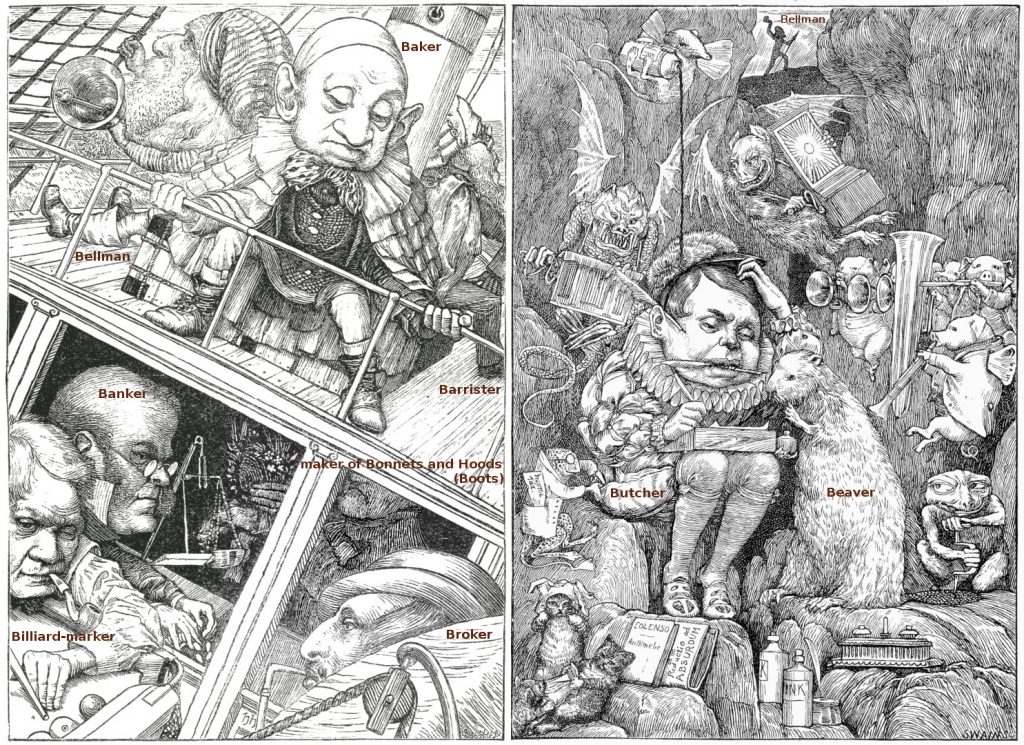
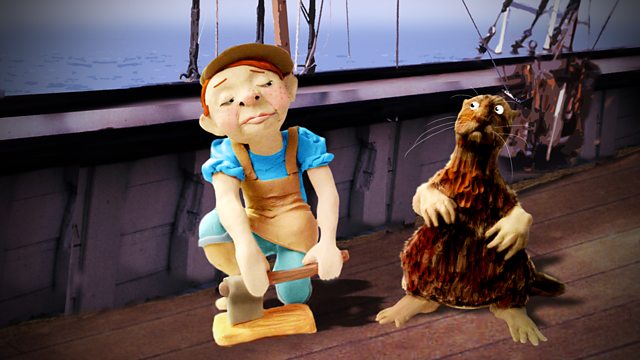
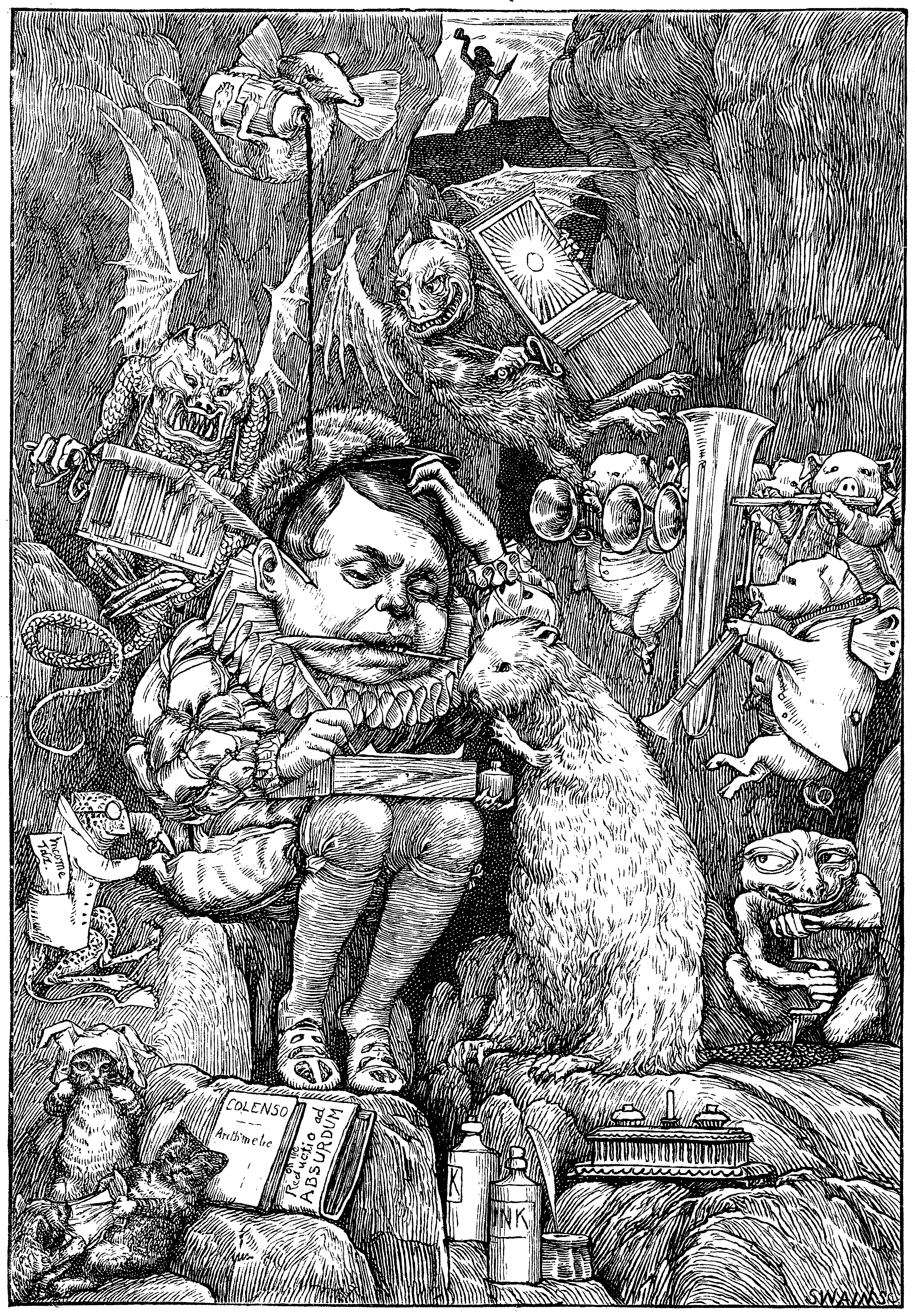
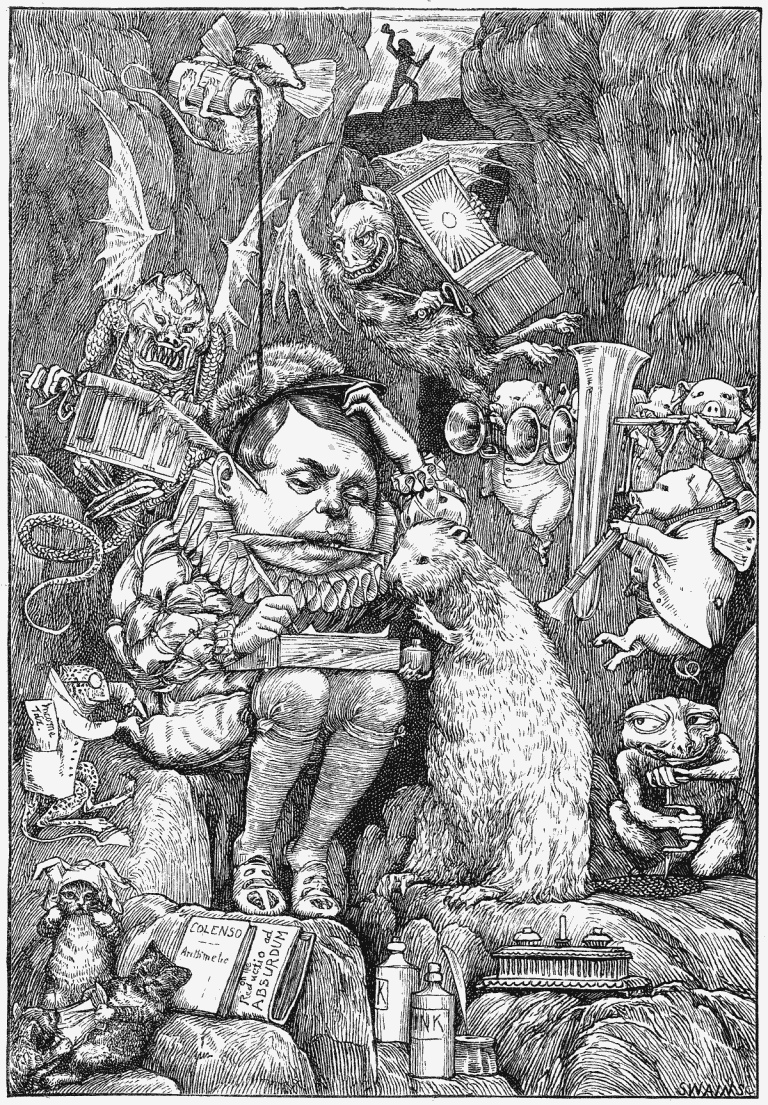
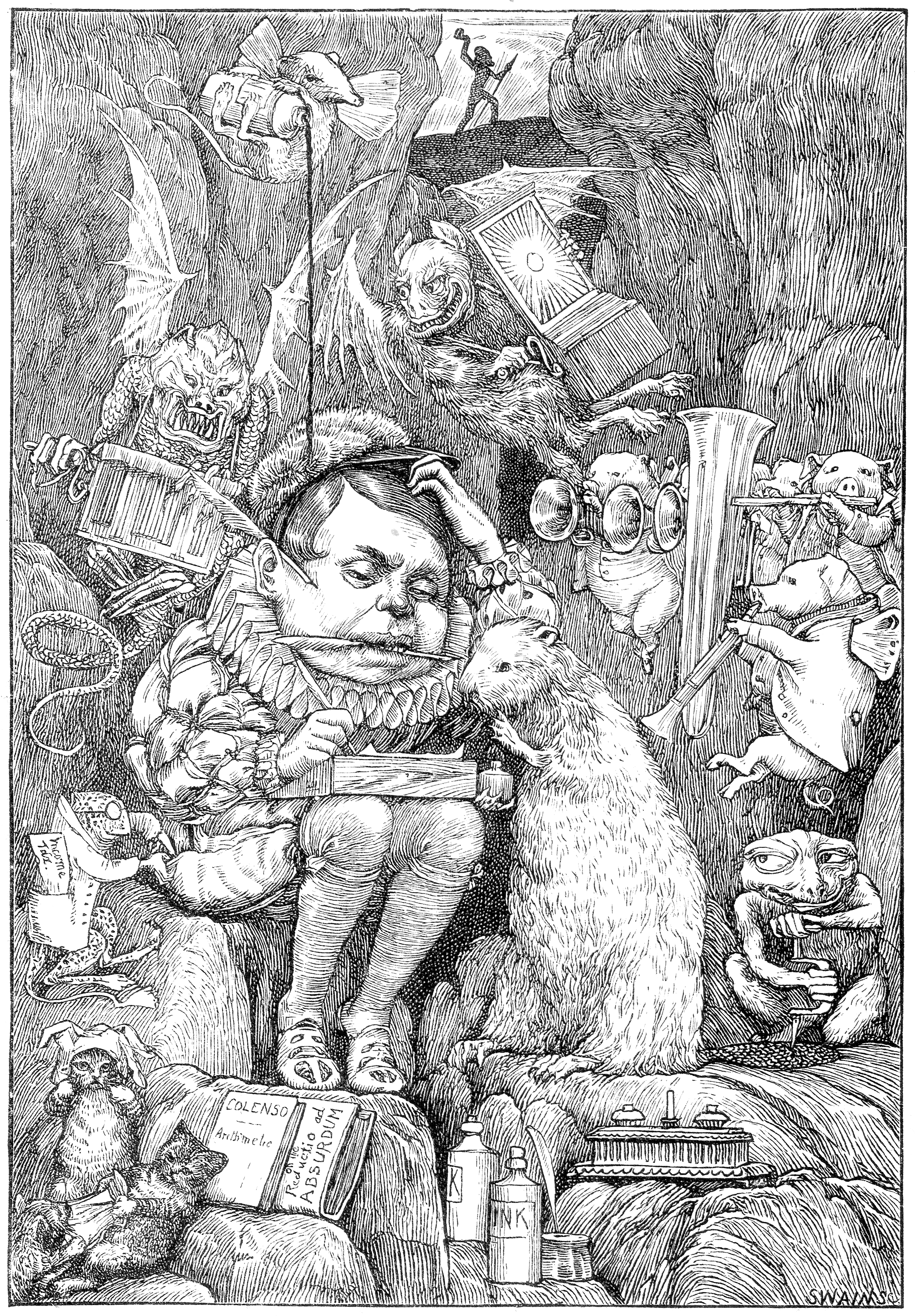
The Butcher reasoning with the Beaver.This is the illustration (partially inspired by various works of other artists) to the chapter The Beaver’s Lesson.
Images:
2017-09-26, updated: 2026-01-20
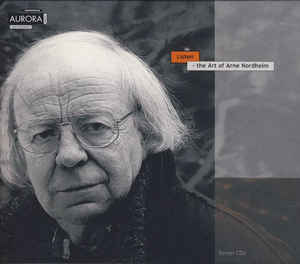
As for the Snark music known to me, Arne Nordheim’s The Return of the Snark – For Trombone And Tape is among my favorites. Nordheim composed this 15 minutes piece in the year 1987. Gaute Vikdal plays the trombone.
The recording is part of the 7 CDs album Listen – The Art of Arne Nordheim. There are other recordings of Nordheim’s Snark compositions available in the Internet, like The Hunting of the Snark for Trombone only. But I like the Return most.
2018-11-02, update: 2026-01-20
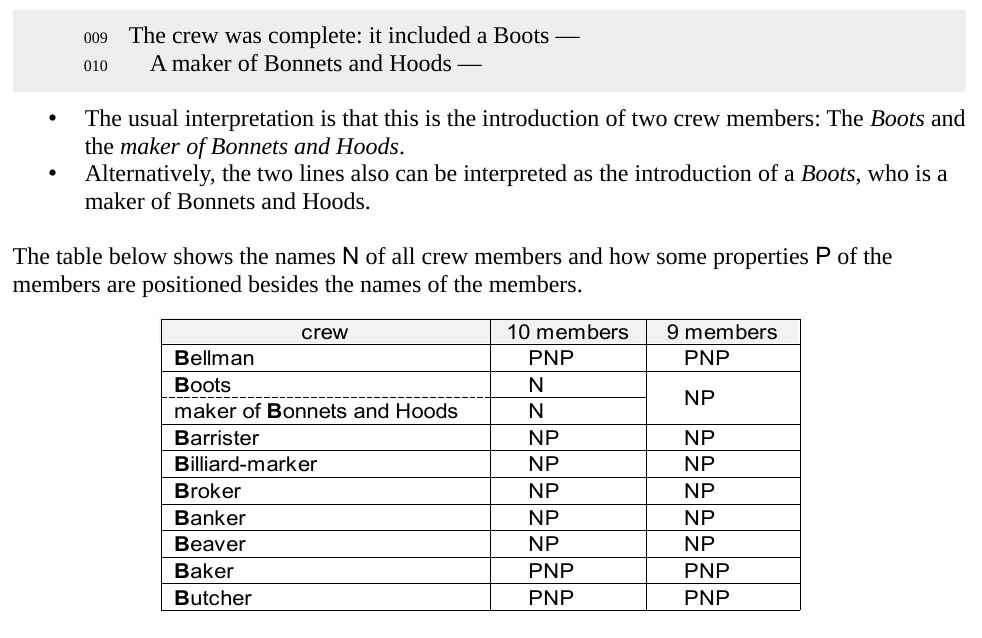
Most readers of The Hunting of the Snark assume that the Snark hunting party consists of ten members. However, probably for a good reason, only nine members can be seen in Henry Holiday’s illustrations (engraved by Joseph Swain) to Lewis Carroll’s ballad. Actually, I really think that the Snark hunting party consists of nine members only. But if you, as almost everybody else, prefer ten Snark hunters, that’s fine too. Lewis Carroll gave you (and me) a choice – incidentally(?) in the 9th and the 10th line of his tragicomedy.
Let us take all the crew members in order of their introduction:

More about the cast of Lewis Carroll and Henry Holiday’s Snark tragicomedy:
⭐ 9 or 10 hunters?
⭘ Care and Hope
⭘ The Snark
⭘ The Boojum
For your comments: Bluesky
2017-11-06, updated: 2026-01-15
As to the meaning of the Snark, I’m very much afraid I didn’t mean anything but nonsense. Still, you know, words mean more than we mean to express when we use them; so a whole book ought to mean a great deal more than the writer means. So, whatever good meanings are in the book, I’m glad to accept as the meaning of the book. The best that I’ve seen is by a lady (she published it in a letter to a newspaper), that the whole book is an allegory on the search after happiness.
Lewis Carroll
Letter (1884-06-13?) to the Lowrie (Lowry?) children in the USA who had written to Lewis Carroll about the meaning of The Hunting of the Snark (see also: Evelyn Hatch, ed., A Selection of the Letters of Lewis Carroll to his Child-Friends, London, 1933, pp. 242-243)
What disturbs and depresses young people is the hunt for happiness on the firm assumption that it must be met with in life. From this arises constantly deluded hope and so also dissatisfaction. Deceptive images of a vague happiness hover before us in our dreams, and we search in vain for their original. Much would have been gained if, through timely advice and instruction, young people could have had eradicated from their minds the erroneous notion that the world has a great deal to offer them.
Arthur Schopenhauer (paraphrased)
Günther Flemming made me aware of this text (it’s not really a quote) in a comment to his translation of The Hunting of the Snark, p. 156, ISBN 978-3-8442-6493-7.
The original German text: Was nun den Rest der ersten Lebenshälfte, die so viele Vorzüge vor der zweiten hat, also das jugendliche Alter, trübt, ja unglücklich macht, ist das Jagen nach Glück, in der festen Voraussetzung, es müsse im Leben anzutreffen sein. Daraus entspringt die fortwährend getäuschte Hoffnung und aus dieser die Unzufriedenheit. Gaukelnde Bilder eines geträumten, unbestimmten Glückes schweben, unter kapriziös gewählten Gestalten, uns vor, und wir suchen vergebens ihr Urbild. Daher sind wir in unsern Jünglingsjahren mit unserer Lage und Umgebung, welche sie auch sei, meistens unzufrieden; weil wir ihr zuschreiben, was der Leerheit und Armseligkeit des menschlichen Lebens überall zukommt, und mit der wir jetzt die erste Bekanntschaft machen, nachdem wir ganz andere Dinge erwartet hatten. – Man hätte viel gewonnen, wenn man, durch zeitige Belehrung, den Wahn, daß in der Welt zu viel zu holen sei, in den Jünglingen ausrotten könnte. (Lebensweisheit, chapter 6 Vom Unterschiede der Lebensalter)
2019-12-11, update: 2025-12-13
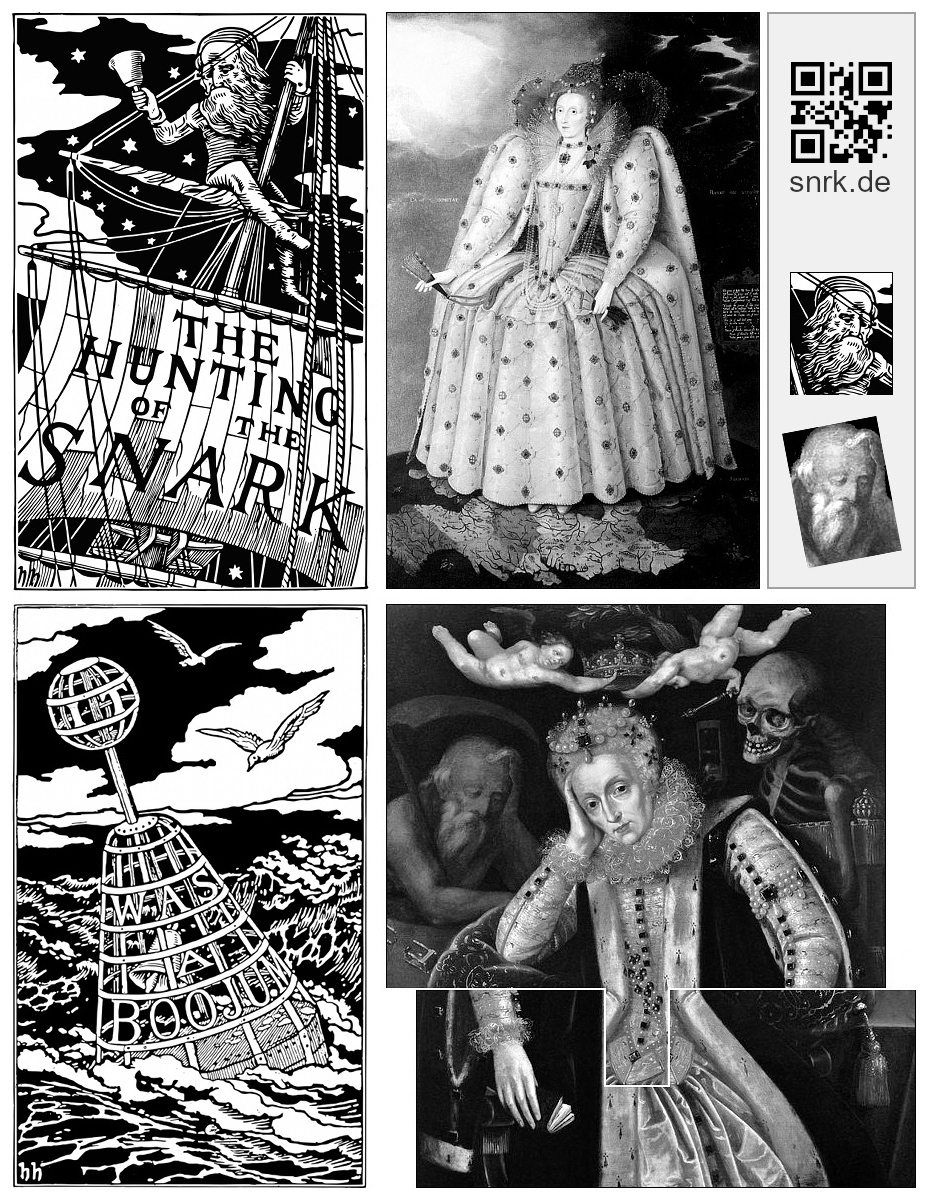
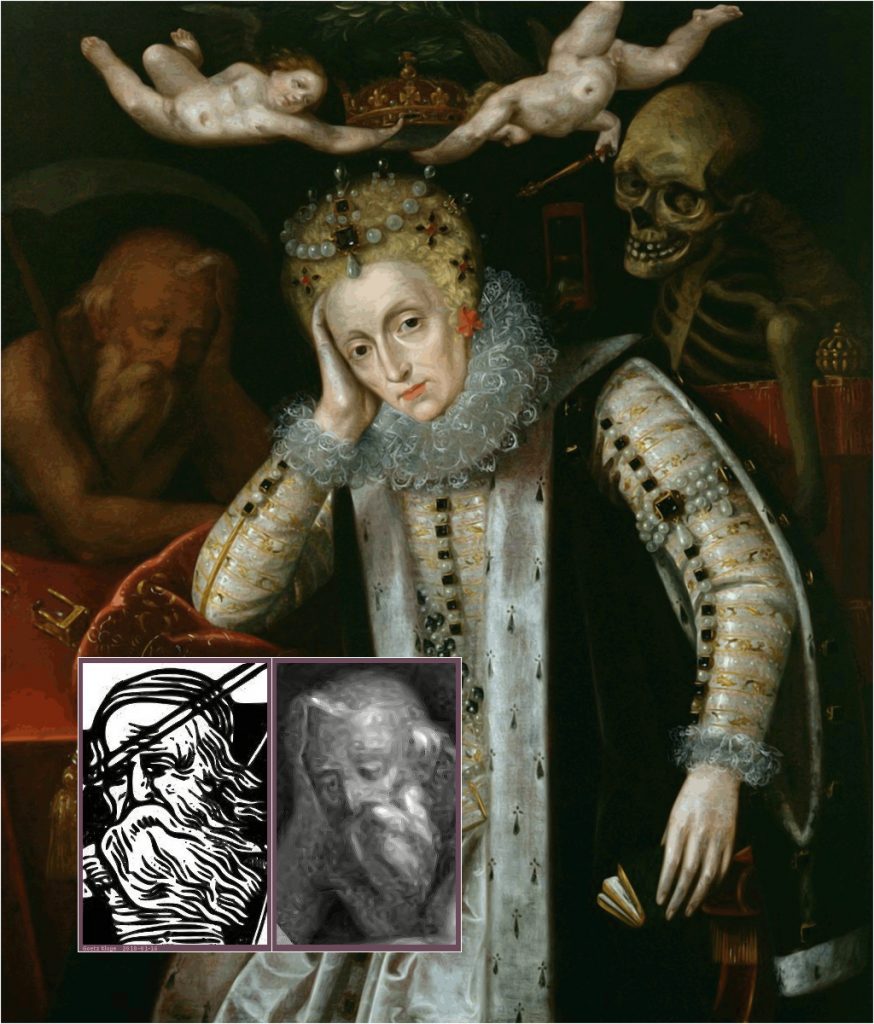
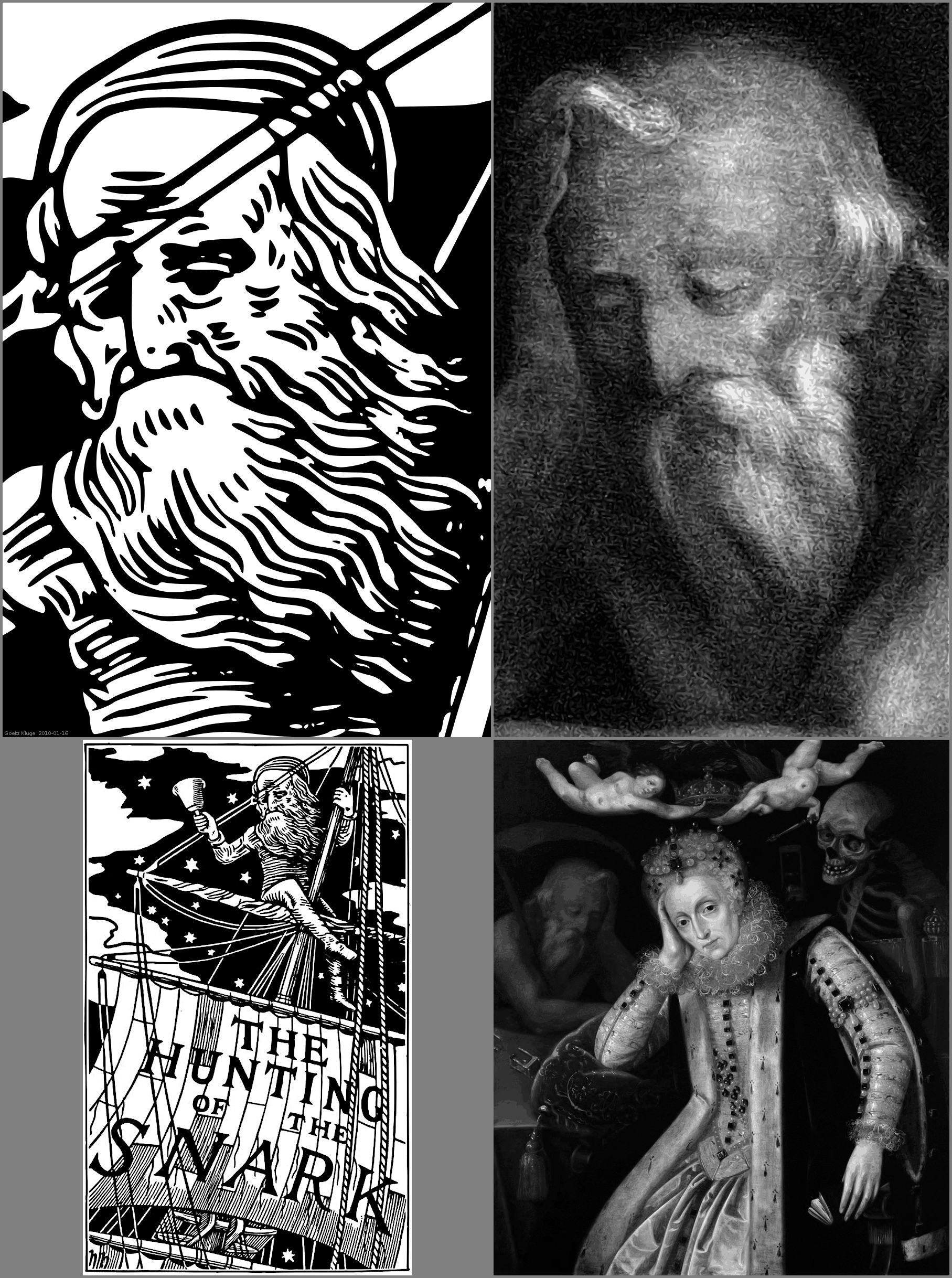
Here the Bellman is Father Time ringing his bell.

The image on the upper right side is a detail from that painting. It shows the head of Father Time in mirror view.
The image on the left side is a depiction of the Bellman from Henry Holiday’s front cover illustration (inset) to Lewis Carroll’s The Hunting of the Snark (1876).

2018-10-11, updated: 2025-12-12
One of the surest tests [of a poet’s superiority or inferiority] is the way in which a poet borrows. Immature poets imitate; mature poets steal; bad poets deface what they take, and good poets make it into something better, or at least something different. The good poet welds his theft into a whole of feeling which is unique, utterly different than that from which it is torn; the bad poet throws it into something which has no cohesion. A good poet will usually borrow from authors remote in time, or alien in language, or diverse in interest.
T. S. Eliot, p. 114 in The Sacred Wood: Essays on Poetry and Criticism, 1920
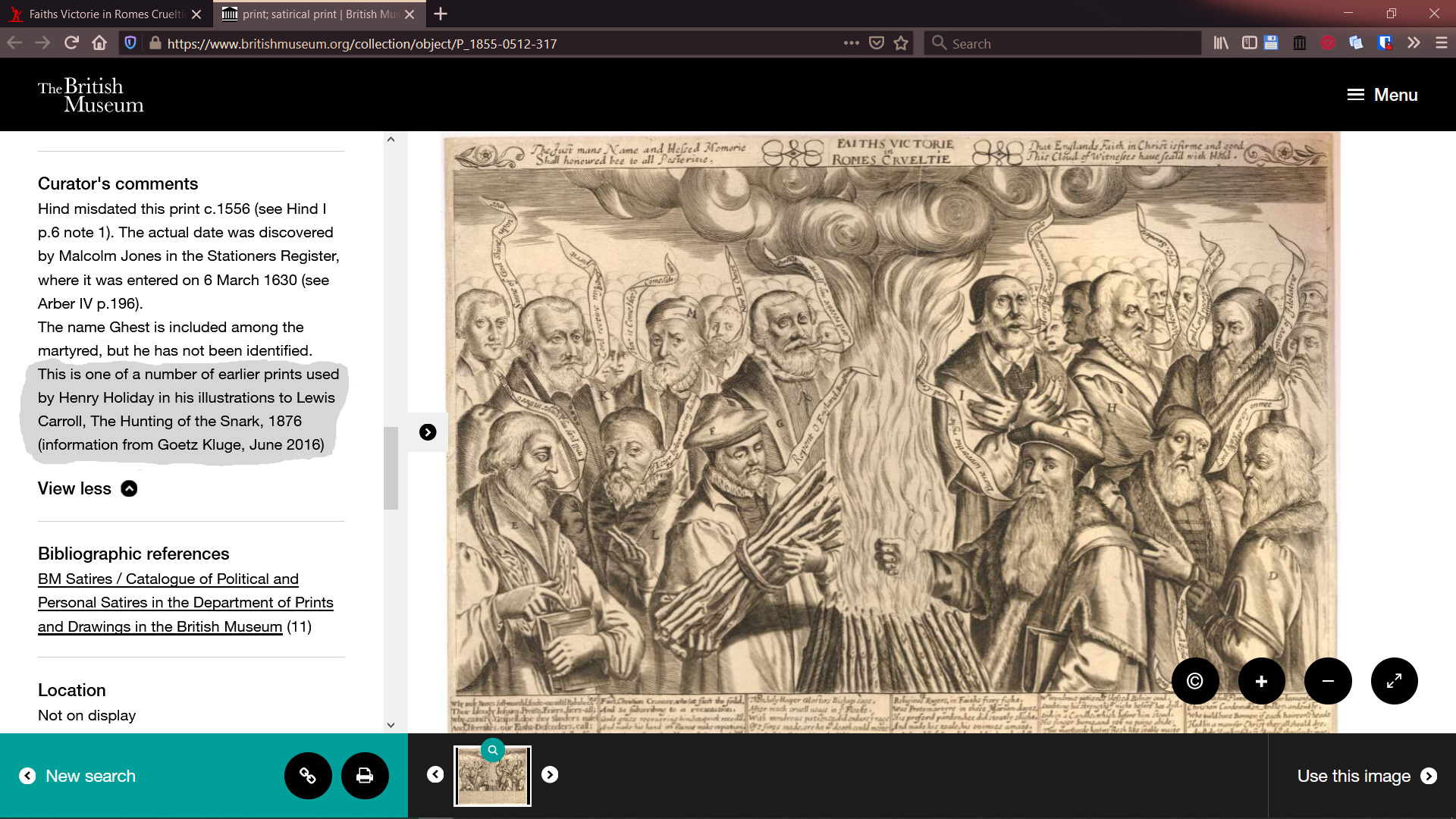
Likewise, a good illustrator welds the theft into a whole of feeling which is unique, utterly different and sometimes even funnier than that from which it is torn.

And Lewis Carroll may have borrowed from Thomas Gray.
All art is infested by other art.
(Leo Steinberg, in Art about Art, 1979)
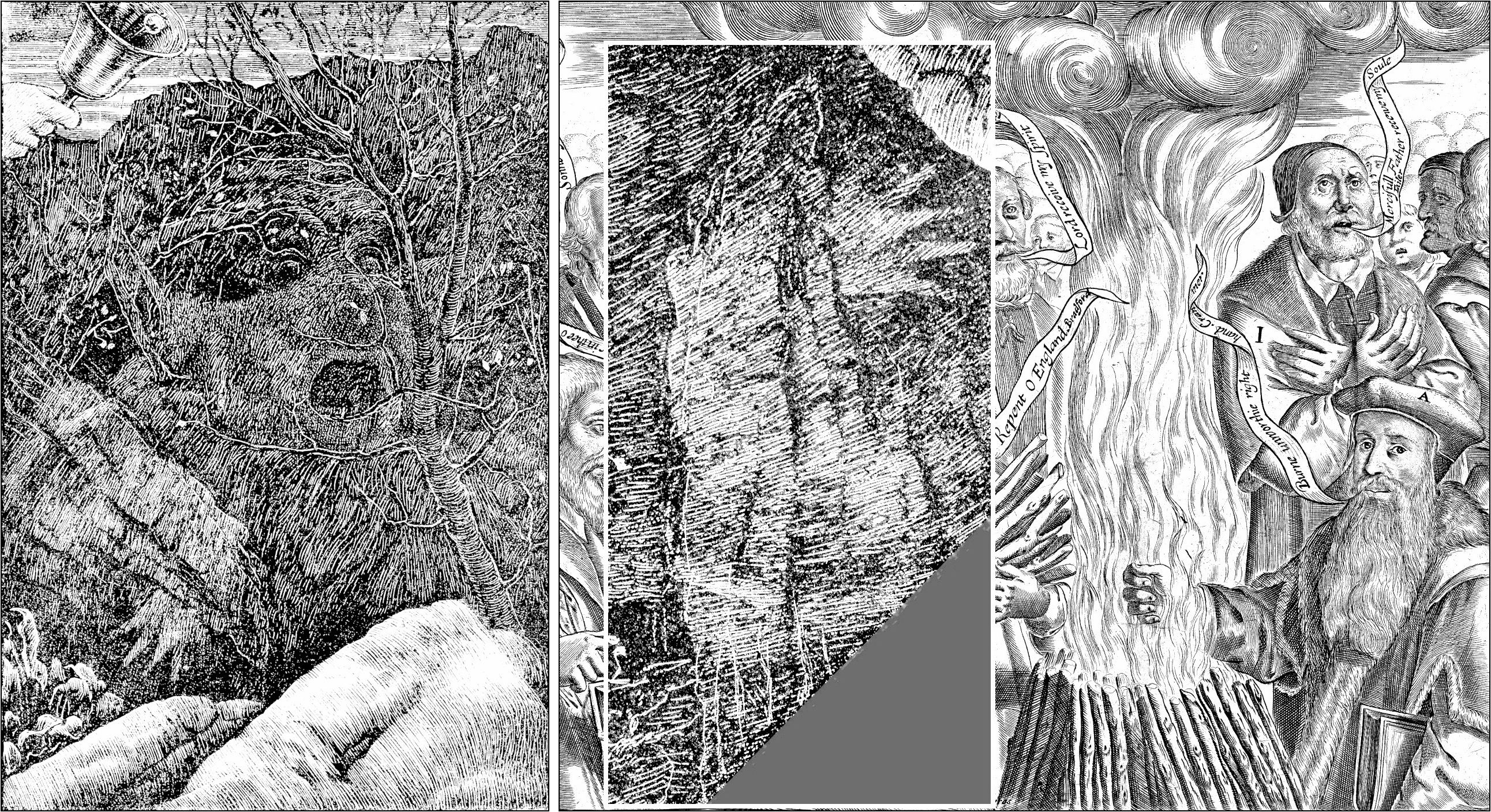
Gustave Doré was an inspired master thief too:
Segments from:
※ Plate I (mirror view) of Gustave Doré’s illustrations to Miguel de Cervantes’ Don Quixote (1863),
※ Matthias Grünewald’s Temptation of St Anthony (c. between 1512 and 1516, a panel of the Isenheim Altarpiece, now located at Musée Unterlinden, Colmar, France).


2018-02-18, update: 2025-12-11
The Lewis Carroll Collection
Christ Church holds three distinct collections of material relating to Lewis Carroll, aka Charles Ludwidge Dodgson. These collections include a wide variety of material, from autograph letters and a wealth of manuscripts, original photographic prints, proof sheets and presentation copies, to a large number of editions of the “Alice” books in different languages.
Illustrated editions include 19th century black and white etchings and a huge range of 20th century illustrations. Some illustrators are famous in their own right, like Salvador Dali, Ralph Steadman and Barry Moser. The collections also include an impressive array of secondary material (biographies, books about various aspects of Carroll’s work, etc.) and are available for the use of researchers upon application to the Library.
The whole corpus of the Lewis Carroll collection is currently the object of intense study and scrutiny, being reviewed and catalogued. This is a work in progress. A significant part of the Lewis Carroll collection has now been digitized. More will follow in due course. This project aims to provide an enhanced experience for viewers, allowing them to flip the pages, zoom in, and read very detailed descriptions. In 2018, the digitized part of the Lewis Carroll collection has been organized in the following sections:
The Making of ‘Alice’
Other Works by Lewis Carroll
Miscellaneous Carroll Material
Photography
Carroll Friends and ContemporariesAccess to all fully digitized resources is made available both through the college website, or directly via the Digital Bodleian portal. Crucially for research, our digitized items are integrated with the International Image Interoperability Framework (IIIF), a set of software standards established and adhered to by an ever expanding community of libraries and cultural heritage institutions, including the British Library, Bayerische Staatsbibliothek, la Bibliothèque Nationale de France, Cambridge University Library, Harvard University Library, MIT, Stanford University, Trinity College Dublin, the Vatican and Yale University. All this gives scholars an unprecedented level of uniform and rich access to image-based resources hosted around the world.
Source (2018): http://www.chch.ox.ac.uk/library-and-archives/lewis-carroll-collection-0
Snark related links are offered in “Other Works by Lewis Carroll“. At present the links also lead to scans of Henry Holiday’s illustrations.
I like Edward Wakeling’s detailed description of Holiday’s illustrations. The Ocean Chart is not mentioned. That is no mistake: That chart quite probably isn’t an illustration by Henry Holiday. My own collection of scans does contain the Ocean Chart, as it is about all illustrations to The Hunting of the Snark. That includes the illustration not made by Henry Holiday.
2018-01-31, updated (direct links replaced by archived links): 2025-12-09
Lewis Carroll did not coin the term snark. The term snark is older than Charles Lutwidge Dodgson (Lewis Carroll).

※ For comments: Bluesky and Reddit.
※ Links: notoneoffbritishisms.com.
This is an update to the post Snarking.
2025-11-03, updated: 2025-12-07
There are three important 150th anniversaries of “The Hunting of the Snark”. Pan Macmillan (including Picador), the BBC and The Guardian already missed two of them.
There are more Snark related entries in Carroll’s notes.
Microblog: Bluesky

John Tufail’s “The Illuminated Snark” (p. 15) lead me to this comparison. In 2004 he interpreted the starry night sky in Henry Holiday’s front cover illustration to Lewis Carroll’s “The Hunting of the Snark” (1876) as a map, where the white clouds represented land with rivers. I liked the suggestion, but did not find any real-world map to which Holiday might have alluded. Holiday engraved that illustration himself.
I discovered John Tufail’s paper in 2009. Only today, after 15 years, I got the idea to compress and flip a large segment of a map of the British isles vertically. That’s my “slowness in taking a jest”. You see the result. Sadly, I can’t tell John that anymore. I appreciated his guidance a lot. The white clouds weren’t the land, but as for a map having been hidden in the illustration, John was right.

For comments: reddit: r/LewisCarroll, r/Maps, r/MapPorn
2024-05-12, update: 2025-11-30
But the principal failing occurred in the sailing,
And the Bellman, perplexed and distressed,
Said he had hoped, at least, when the wind blew due East,
That the ship would not travel due West!
※ www.nicholassoames.org.uk (2018-12-06): Full speech
※ Youtube: The Snark reference starts at 00:09:03.
※ e𝕏 twitter: [1] [2]
2018-12-30, update: 2025-11-29
Taking Three as the subject to reason about —
A convenient number to state —
We add Seven, and Ten, and then multiply out
By One Thousand diminished by Eight.
The result we proceed to divide, as you see,
By Nine Hundred and Ninety Two:
Then subtract Seventeen, and the answer must be
Exactly and perfectly true.
Not all of Thomas Cranmer‘s 42 Articles made it into the Elizabethian 39 Articles of the Anglicans.
(3 10+7 10+10 10)×(1000 10-8 10) = 19840 10 = 231504 6 .
231504 10 can be devided by 42 10 as well as by 39 10 without remainder.
But did Lewis Carroll know that? 😉
| 3 | 3 |
| + 7 | 10 |
| + 10 | 20 |
| × (1000-8) | 19840 |
| / 992 | 20 |
| – 17 | 3 |
| 100110110000000 2 | 1111100000 2 |
| 1000012211 3 | 1100202 3 |
| 10312000 4 | 33200 4 |
| 1113330 5 | 12432 5 |
| 231504 6 | 4332 6 |
| 111562 7 | 2615 7 |
| 46600 8 | 1740 8 |
| 30184 9 | 1322 9 |
| 19840 10 | 992 10 |
| 139A7 11 | 822 11 |
| B594 12 | 6A8 12 |
| 9052 13 | 5B4 13 |
| 7332 14 | 50C 14 |
| 5D2A 15 | 462 15 |
| 4D80 16 | 3E0 16 |
| 40B1 17 | 376 17 |
| 3744 18 | 312 18 |
| 2GI4 19 | 2E4 19 |
| 29C0 20 | 29C 20 |
| 22KG 21 | 255 21 |
| 1ILI 22 | 212 22 |
| 1EBE 23 | 1K3 23 |
| 1AAG 24 | 1H8 24 |
| 16IF 25 | 1EH 25 |
| 1392 26 | 1C4 26 |
| 105M 27 | 19K 27 |
| P8G 28 | 17C 28 |
| NH4 29 | 156 29 |
| M1A 30 | 132 30 |
| KK0 31 | 110 31 |
| JC0 32 | V0 32 |
| I77 33 | U2 33 |
| H5I 34 | T6 34 |
| G6U 35 | SC 35 |
| FB4 36 | RK 36 |
2024-02-14, update: 2025-11-17
Lewis Carroll needed a clear mind for whatever he wrote. Drugs like laudanum would not have been helpful during writing.
The drug link is a homespun thing. You’ll find it on a host of random forums.
But the experts are usually sceptical. Carroll wasn’t thought to have been a recreational user of opium or laudanum, and the references may say more about the people making them than the author.
“The notion that the surreal aspects of the text are the consequence of drug-fuelled dreams resonates with a culture, particularly perhaps in the 60s, 70s and 80s when LSD was widely-circulated and even now where recreational drugs are commonplace,” says Dr Heather Worthington, Children’s Literature lecturer at Cardiff University.
Source: Is Alice in Wonderland really about drugs?
(by Sophie Robehmed, BBC magazine 2012-08-20)
Let me be perfectly clear here: Lewis Carroll didn’t do recreational drugs. Certainly there were drug references in Alice’s Adventures in Wonderland and these were picked up on by people with interests in that area, particularly in the late sixties. That is not to say that Carroll never took Laudanum for a medical problem on the advice of a doctor. There is NO direct proof (in his letters or his diaries) that he ever took narcotic drugs. You might ask yourself why students insist that he did and why some teachers teach that he did.
- Alice gets linked to the drug culture. No, Lewis Carroll did not use mind altering drugs to increase his creativity. He used his imagination. If you have one, it’s better than drugs. If you don’t, the drugs won’t help you. With apologies to the late Timothy Leary.
- This can’t be true
- A couple of acid blotters
- Chemical Alice the band
- Using Alice to JUST SAY NO
Source: lewiscarroll.org (2002)
“This is how I feel whenever someone assumes Lewis Carroll was on drugs.
People don’t believe that some people just have fucking amazing imaginations and are extremely creative.”
Source (for logged-in Bluesky users): raccoon-overlord.bsky.social (2025-11-16)
2019-12-12, update: 2025-11-16
2019-07-12, updated: 2025-11-13
The Mathematical World of C.L. Dodgson (Lewis Carroll) https://t.co/nmGpkaXScD vía @YouTube
— Profesor Raul Alva G (@Prof_Raul_Alva) October 21, 2019
On voting:
https://www.youtube.com/watch?t=2038&v=wYjnUDV3pTM
2019-10-22: Below you find text (2018-05-13) moved from https://snrk.de/page_the-new-belfry#voting to this blog article.
Carroll/Dodgson tried to fight against apodictic assertiveness and oversimplification not only by means of nonsense poetry but also by means of mathematics. He expected decisions to have a solid base – like fair voting:
One small part of Dodgson’s work, though, has impressed social scientists: his analysis of the mathematics of voting. His interest in the topic was sparked by the deliberations of his colleagues at Christ Church over such matters as how to choose a new belfry. Dodgson’s pamphlets on voting were largely ignored until 1958, when a British economist, Duncan Black, noticed that there had been nothing so good on the topic since just after the French Revolution.
https://www.economist.com/node/11662202, 2009
Ostensibly, [Dodgson] was pondering the best way for the governing body of Christ Church, Oxford, where he was a tutor in mathematics, to decide on the design for a controversial belfry, and to pick new members of the college. […] For college elections, Dodgson first proposed a version of Borda’s method, and also a version of Condorcet’s (though he appears not to have known about Borda’s and Condorcet’s work). Later, he developed an interest in politics beyond the walls of Christ Church, and, in the eighteen-eighties, he tried to find ways to secure equitable representation in Parliament for minorities.
https://www.newyorker.com/magazine/2010/07/26/win-or-lose, 2010
Dodgson’s method of taking votes on more than two issues (1876) attempts to find winners in case initially there is no winner. The method was applied at Christ Church college for a small number of candidates. However, for large lists of choices, the rearranging of candidates (until a winner is found) requires a computing power which surely was not available then. And in 2006 it still was a challenge (see McCabe-Dansted below).
2019-10-22, updated: 2025-11-11
The onomatopoeic word “snarking” already had been used in the year 1866.

more | Snark is older than Lewis Carroll
2017-08-28, updated: 2025-11-03
How can we recognize a Snark? The Bellman explains it (🎶🎶🎶): A Snark is not necessarily evil, but once it turns into a Boojum, you are in trouble.
“Come, listen, my men, while I tell you again
The five unmistakable marks
By which you may know, wheresoever you go,
The warranted genuine Snarks.
“Let us take them in order.
It next will be right
To describe each particular batch:
Distinguishing
※ those that have feathers, and bite,
※ And those that have whiskers, and scratch.
“For, although common Snarks do no manner of harm,
Yet, I feel it my duty to say,
Some are Boojums –” The Bellman broke of in alarm,
For the Baker had fainted away.
…
“He remarked to me then,” said that mildest of men,
“ ‘If your Snark be a Snark, that is right:
Fetch it home by all means – you may serve it with greens,
And it’s handy for striking a light.
“ ‘You may seek it with thimbles—and seek it with care;
You may hunt it with forks and hope;
You may threaten its life with a railway-share;
You may charm it with smiles and soap –’ ”
(“That’s exactly the method,” the Bellman bold
In a hasty parenthesis cried,
“That’s exactly the way I have always been told
That the capture of Snarks should be tried!”)
“ ‘But oh, beamish nephew, beware of the day,
If your Snark be a Boojum! For then
You will softly and suddenly vanish away,
And never be met with again!’
…
“I engage with the Snark — every night after dark —
In a dreamy delirious fight:
I serve it with greens in those shadowy scenes,
And I use it for striking a light:
“But if ever I meet with a Boojum, that day,
In a moment (of this I am sure),
I shall softly and suddenly vanish away —
And the notion I cannot endure!”
Important: The descriptions above are opinions of the Bellman, the Baker and the Baker’s Uncle. The views of these characters are not necessarily Lewis Carroll’s views: “I do not hold myself responsible for any of the opinions expressed by the characters in my book.” (Lewis Carroll, Sylvie and Bruno Concluded). However, the “delirious fight” “every night after dark” could be a reference to the author’s own “mental troubles“.
Among the forks mentioned above (used to hunt the Snark and carried by this landing crew of a naval expedition) is a tuning fork (held by the Banker).
On his naval expedition with the HMS Beagle, Charles Darwin used a tuning-fork to let spiders dance, and for dissection (don’t tell the spiders) he used lace-needles together with his microscope (like the one carried by the beaver).
2017-09-18, edited 2025-10-30
Among the issues the The Hunting of the Snark is about, one of them perhaps might be reasoning. There are several remedies against bad reasoning. One of them is clear thinking. That is what Kwame Anthony Appiah‘s Thinking It Through – An Introduction to Contemporary Philosophy (2003) is about. The book also is available as PDF file (archive).
See also: http://appiah.net/ (archive).
Recently my browser gave me a warning when I checked whether the
2017-12-01, update: 2025-10-28
en.wikipedia.org/wiki/Jabberwocky#Reception:
[…] [Jabberwocky] has also been interpreted as a parody of contemporary Oxford scholarship and specifically the story of how Benjamin Jowett, the notoriously agnostic Professor of Greek at Oxford, and Master of Balliol, came to sign the Thirty-Nine Articles, as an Anglican statement of faith, to save his job. […]
Stephen Prickett (2005): Victorian Fantasy, Baylor University Press, p. 113, ISBN 1-932792-30-9
Unlike Benjamin Jowett, the Rev. Dodgson (aka Lewis Carroll) didn’t sign, but managed to save his job nevertheless without being ordained as a priest. (I am not so sure about the Jowett link, because «the first stanza of “Jabberwocky” was originally written by Carroll at the age of 13 under the title “Stanza of Anglo-Saxon poetry”.» [Darien Graham-Smith, p. 36])
’Twas brillig, and the slithy toves
Did gyre and gimble in the wabe;
All mimsy were the borogoves,
And the mome raths outgrabe.“Beware the Jabberwock, my son!
The jaws that bite, the claws that catch!
Beware the Jubjub bird, and shun
The frumious Bandersnatch!”He took his vorpal sword in hand:
Long time the manxome foe he sought—
So rested he by the Tumtum tree,
And stood awhile in thought.And as in uffish thought he stood,
The Jabberwock, with eyes of flame,
Came whiffling through the tulgey wood,
And burbled as it came!One, two! One, two! and through and through
The vorpal blade went snicker-snack!
He left it dead, and with its head
He went galumphing back.“And hast thou slain the Jabberwock?
Come to my arms, my beamish boy!
O frabjous day! Callooh! Callay!”
He chortled in his joy.’Twas brillig, and the slithy toves
Did gyre and gimble in the wabe;
All mimsy were the borogoves,
And the mome raths outgrabe.
See also:
※ https://poemanalysis.com/lewis-carroll/jabberwocky
※ Vogon poetry
※ Chamutal Noimann, Empowering Nonsense: Reading Lewis Carroll’s “Jabberwocky” in a Basic Writing Class (2014)
※ Etching of Saint George and the Dragon by Paolo Uccello (c. 1470). But there also are other inspiring sources:
Christian’s fight with Appollyon in John Bunyan’s Pilgrim’s Progress,
London: Carington Bowles, 1781.
(Source: John Bunyan Society)
Games (unfortunately not available anymore from the app shop):
Jabberwocky, Confounded, app for iOS by Christopher Gross
Music:
composer: Zoë Tweed, rendition: Sylva Winds
(flute: Yi-Hsuan Chen, bassoon: Guylaine Eckersley, oboe & voice: Drake Gritton,
clarinet: Rowan Jones, french horn: Zoë Tweed)
composer: Ben Ponniah, rendition: Peter Noden
2018-04-06, update: 2025-10-27