
Author: Goetz Kluge
The Confounded Snark
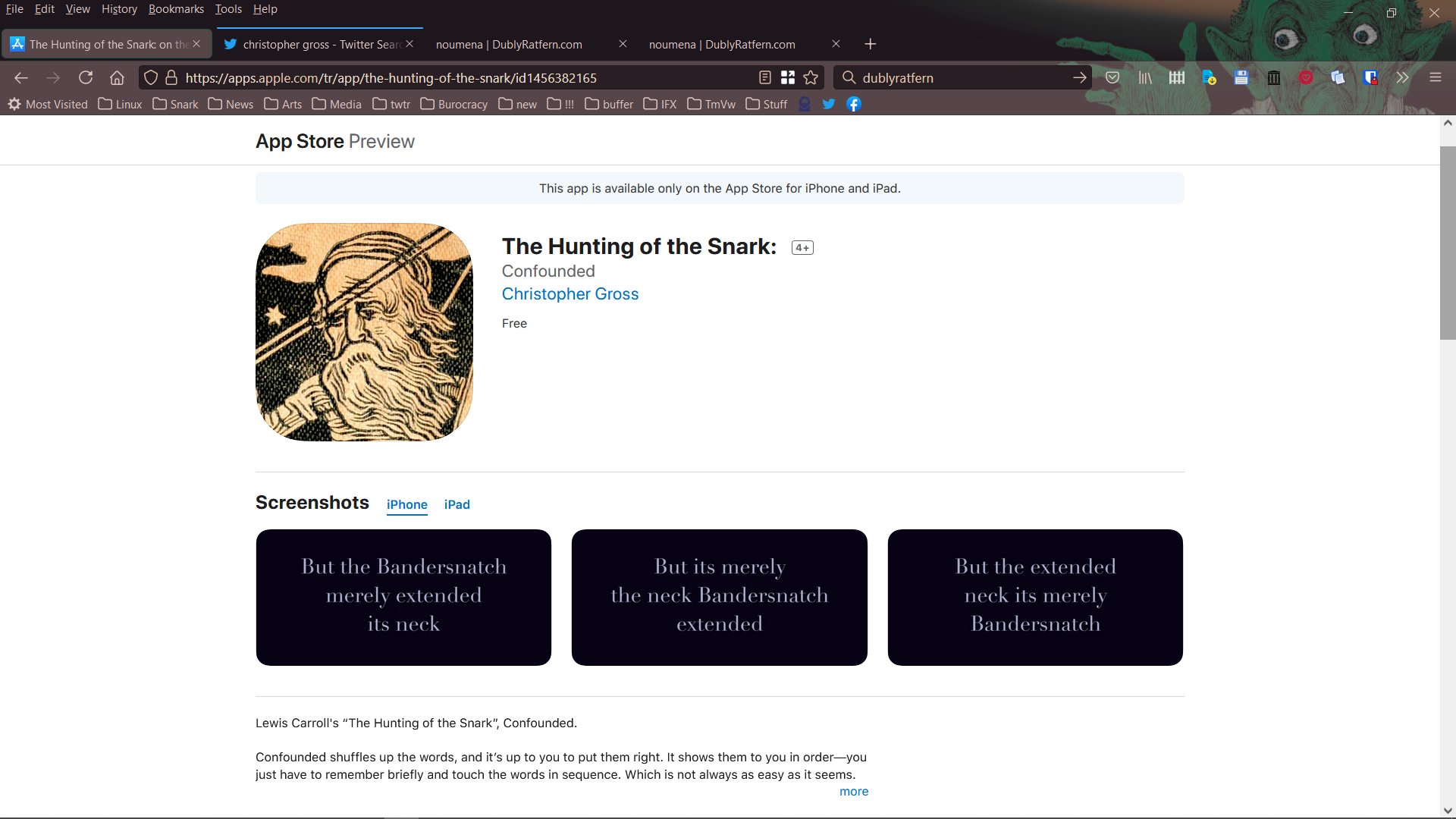 The Hunting of the Snark, Confounded, app for iOS by Christopher Gross
Julien Gartside Retells the Snark

Allusion Chains
2021-05-02, updated: 2021-06-05
About Charles Lutwidge Dodgson

May 25th: Towel Day!
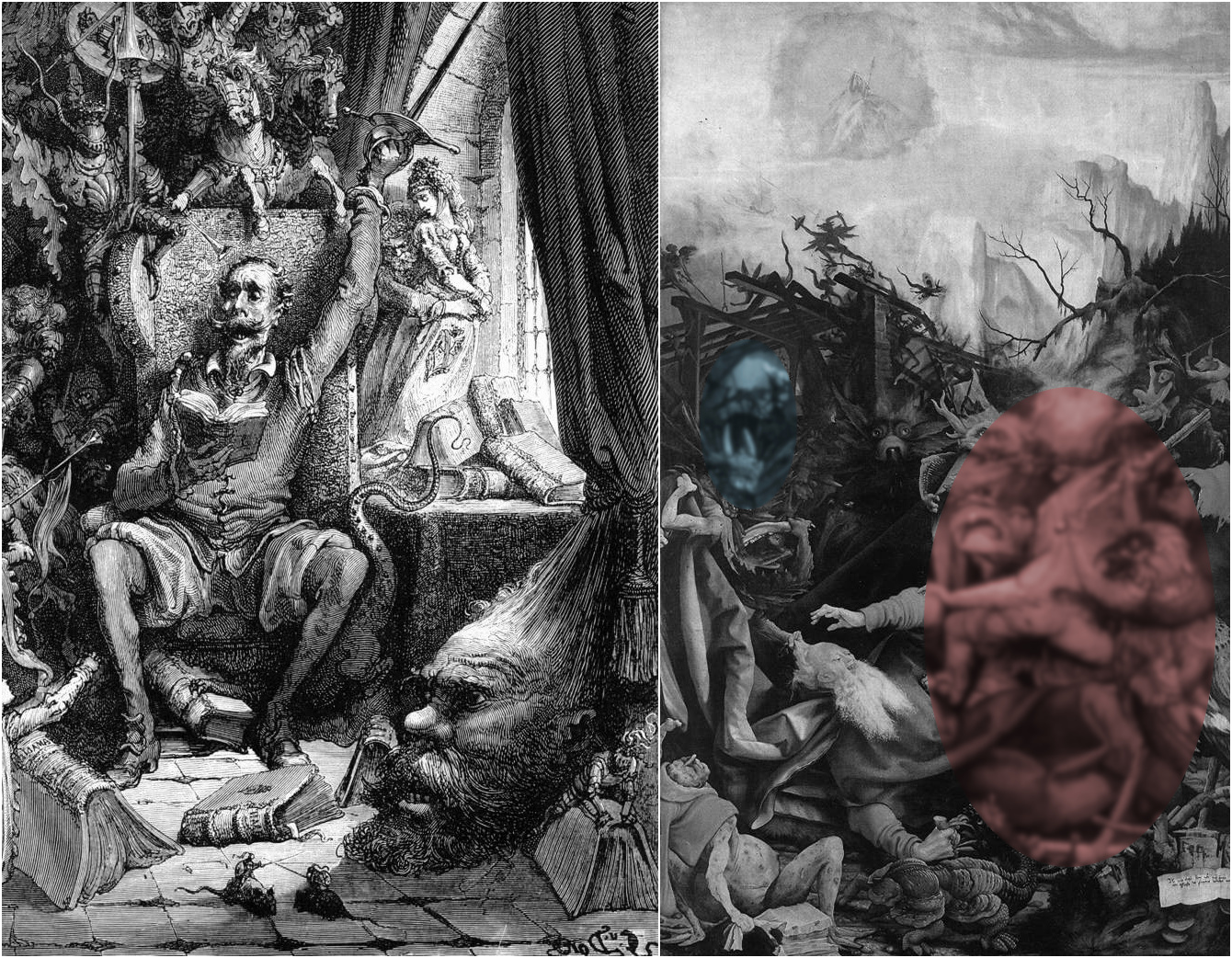
Big Head in a Mess

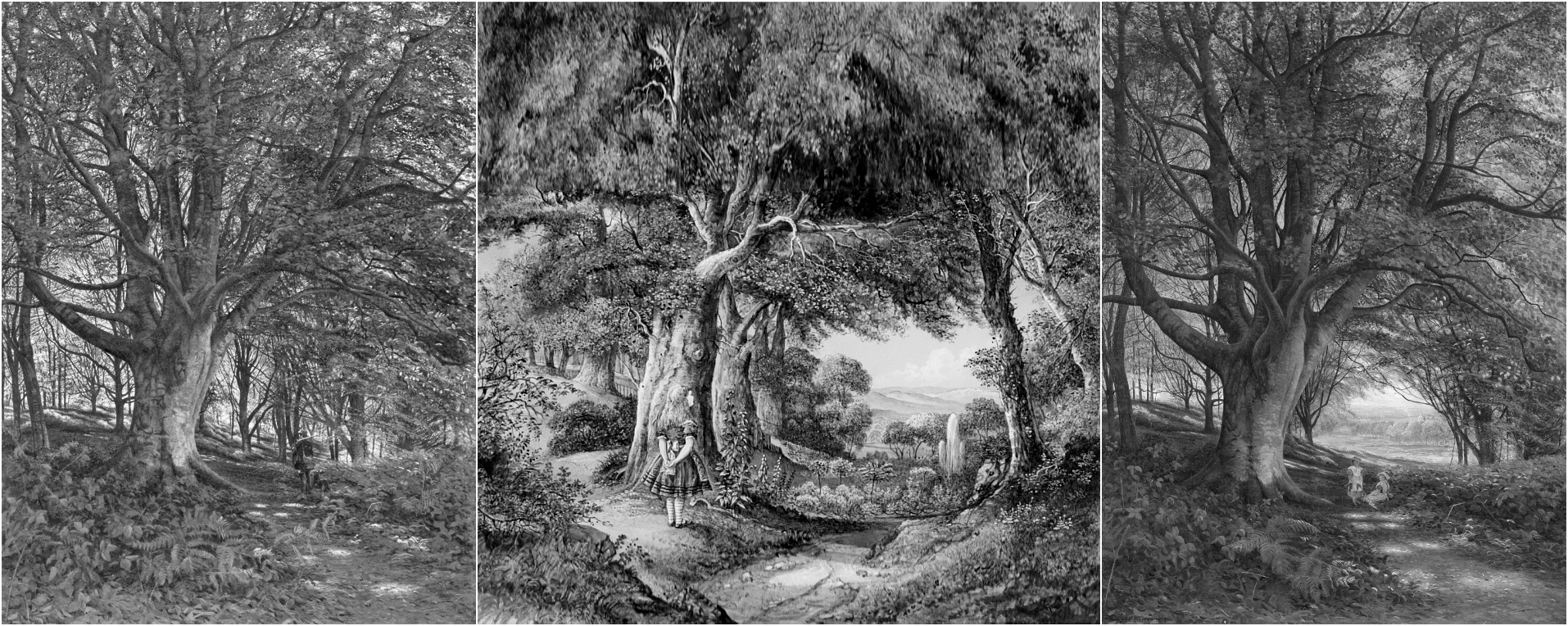
Alice in the Woods
Bycatch from my Snark hunt:
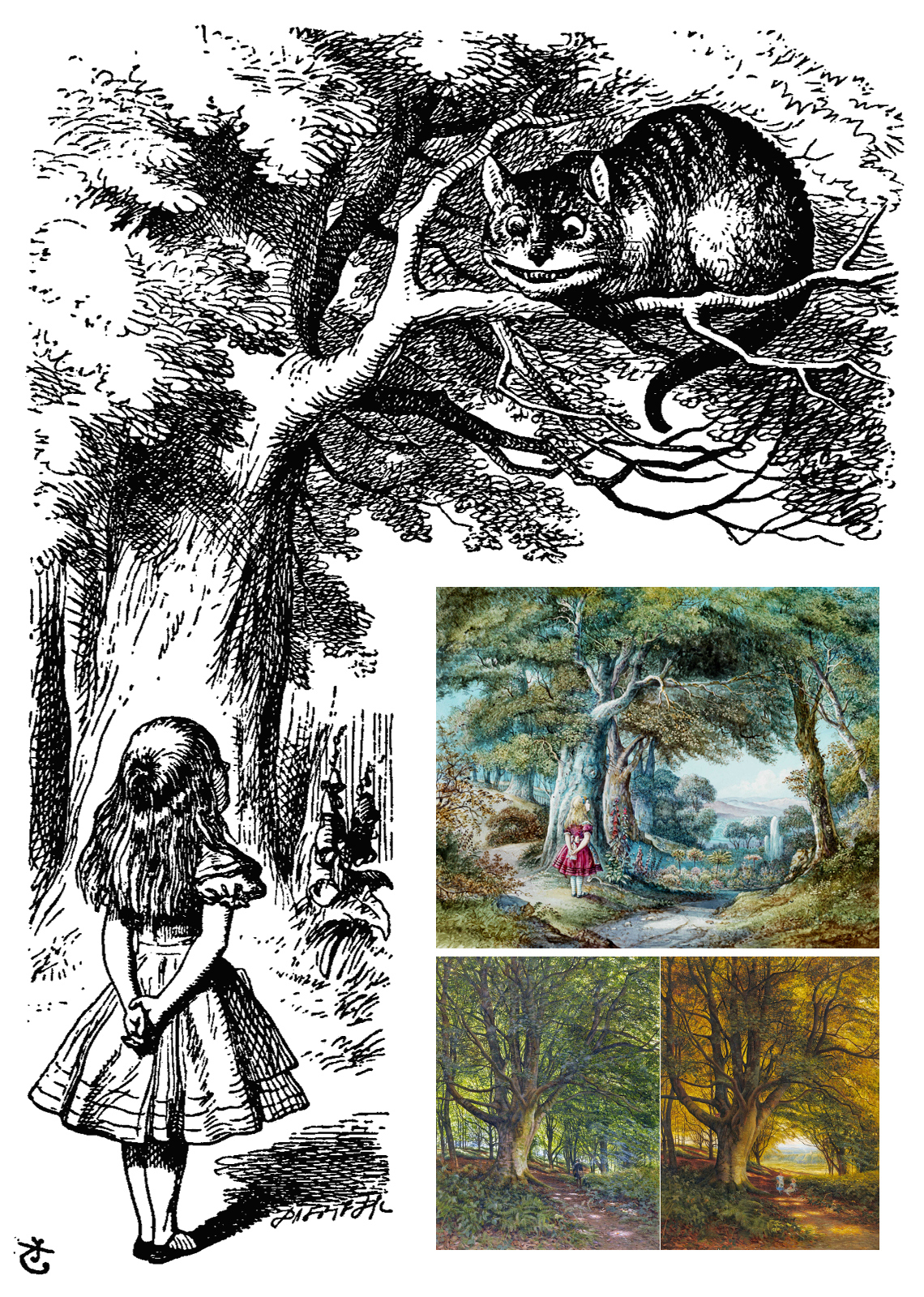
- [background]: Sir John Tenniel: Alice & Cheshire Cat (1866 or 1869?)
vintageephemera.blogspot.de/2010/08/book-illustration-cheshire-cat-alices.html - [center right]: Magic lantern slide by William Robert Hill: Alice in Wonderland (1876)
twitter.com/Bonnetmaker/status/525660964700848129 - [bottom center]: Bonomi Edward Warren: Sportsman and dog on a wooded path (1868, watercolor)
- [bottom right]: Bonomi Edward Warren: Woodland Scene in Summer with Children on a Path (1871, oil on canvas)
2018-03-31, updated: 2021-03-31
Before snrk.de
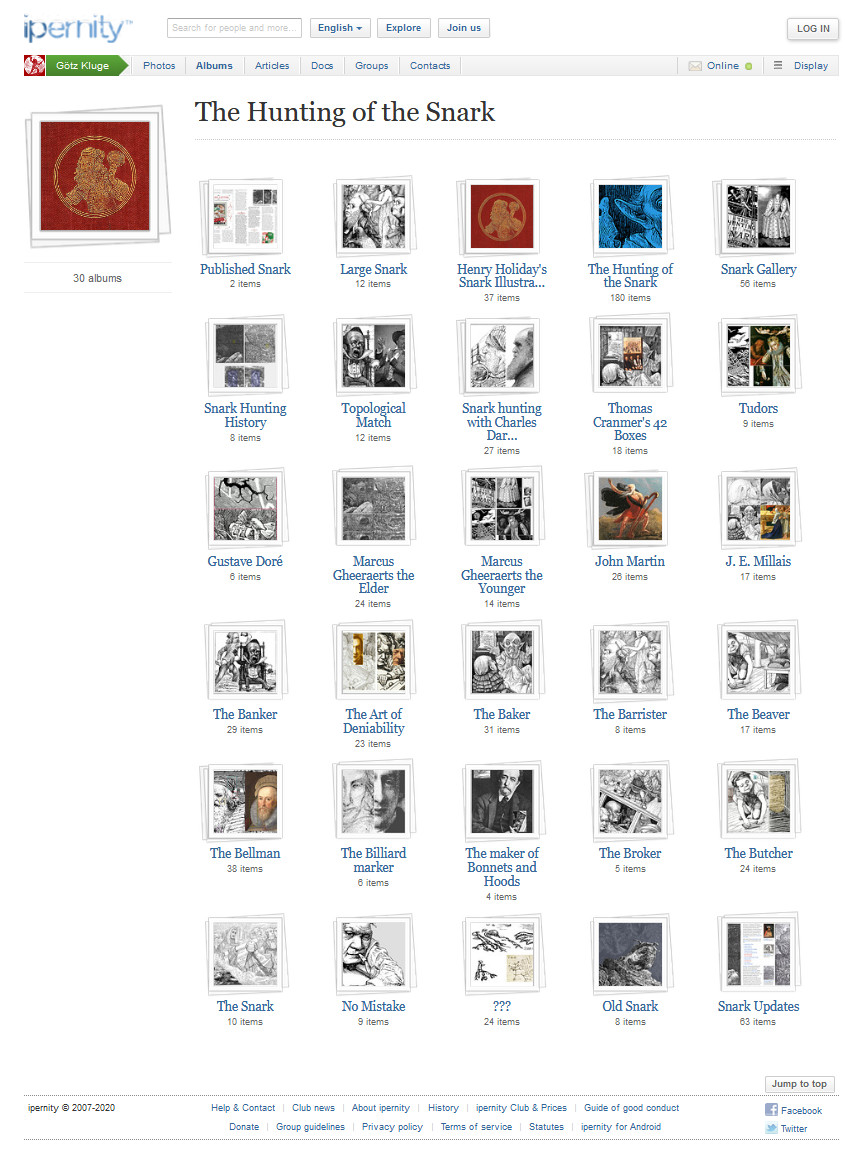 My Snark hunt started in 2009 using Flickr for presenting what I found. When Flickr messed up their layout in 2013, I moved to Ipernity, which started as a Flickr clone. (My early Snark hunting history also is described in Ipernity.) Later I also used Academia.edu and Reddit.
In Autumn 2017, I started my snrk.de blog, which now is accompanied by a Facebook page, a Facebook group and a Twitter account.
2020-12-17, update: 2021-03-21
Henry Holiday

- National Portrait Gallery: NPG x18530, portrait photo of Henry Holiday, 1870s
- National Portrait Gallery: NPG x22251, portrait photo of Henry Holiday’s father, 1870s
- Henry Holiday: «L.C. forgot that “the Snark” is a tragedy», 1876
- Henry Holiday: Reminiscences of my Life, c. 1914
- Henry Holiday: The Snark’s Significance, 1898
- Wikipedia: Henry Holiday
- Category Henry Holiday in snrk.de
2018-05-24, update: 2021-03-15
Brian Dewan’s Snark
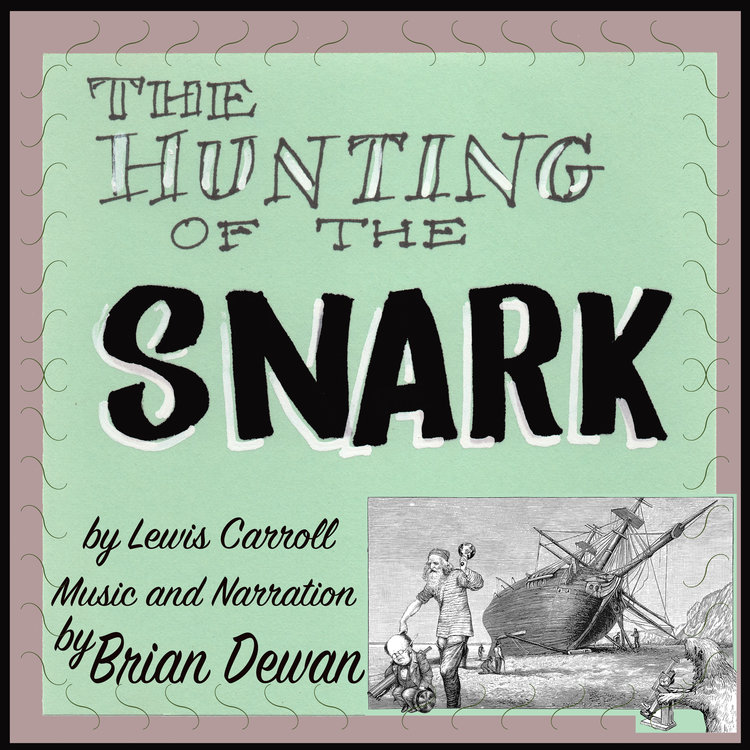 Today (2021-03-14) I learned about Brian Dewan, because he used my assemblage on the cover of his The Hunting of the Snark. His recording (2017) was aired in London and New York. The borrowing is fine with me, because for the assemblage I too borrowed illustrations. They were made by two 19th century artists.
Monstrous Things from Walls
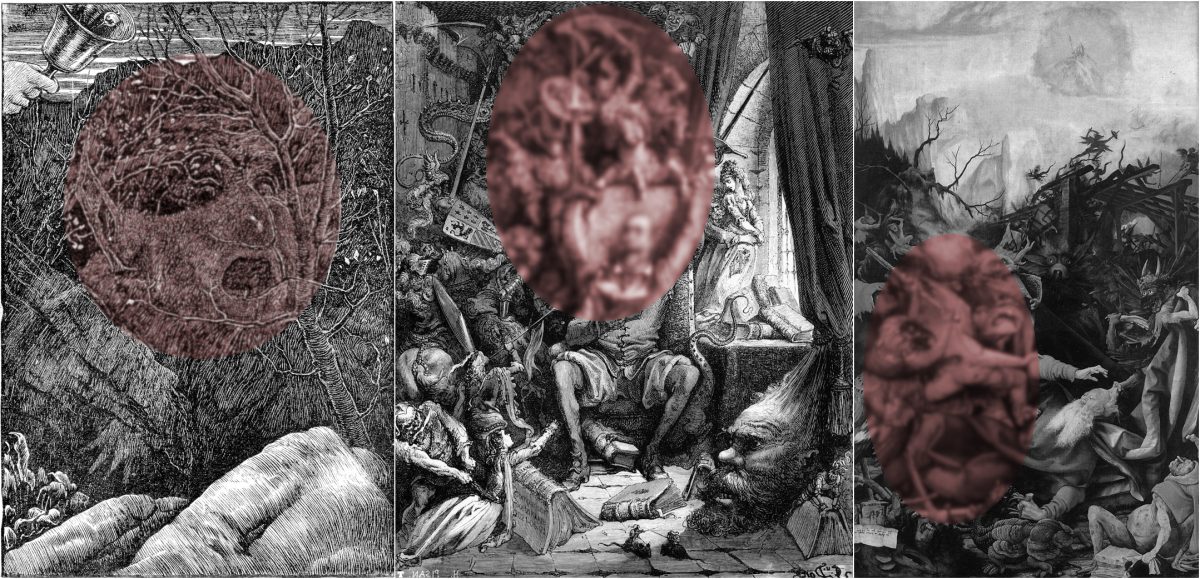
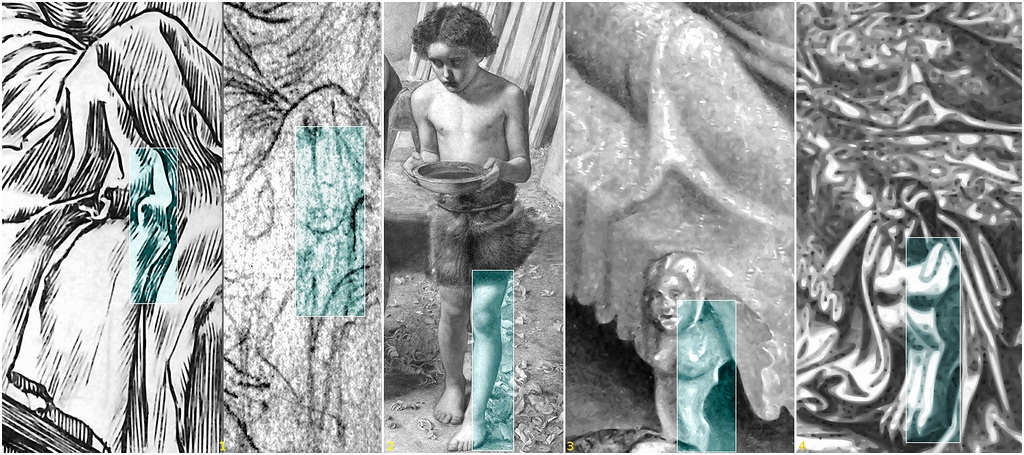
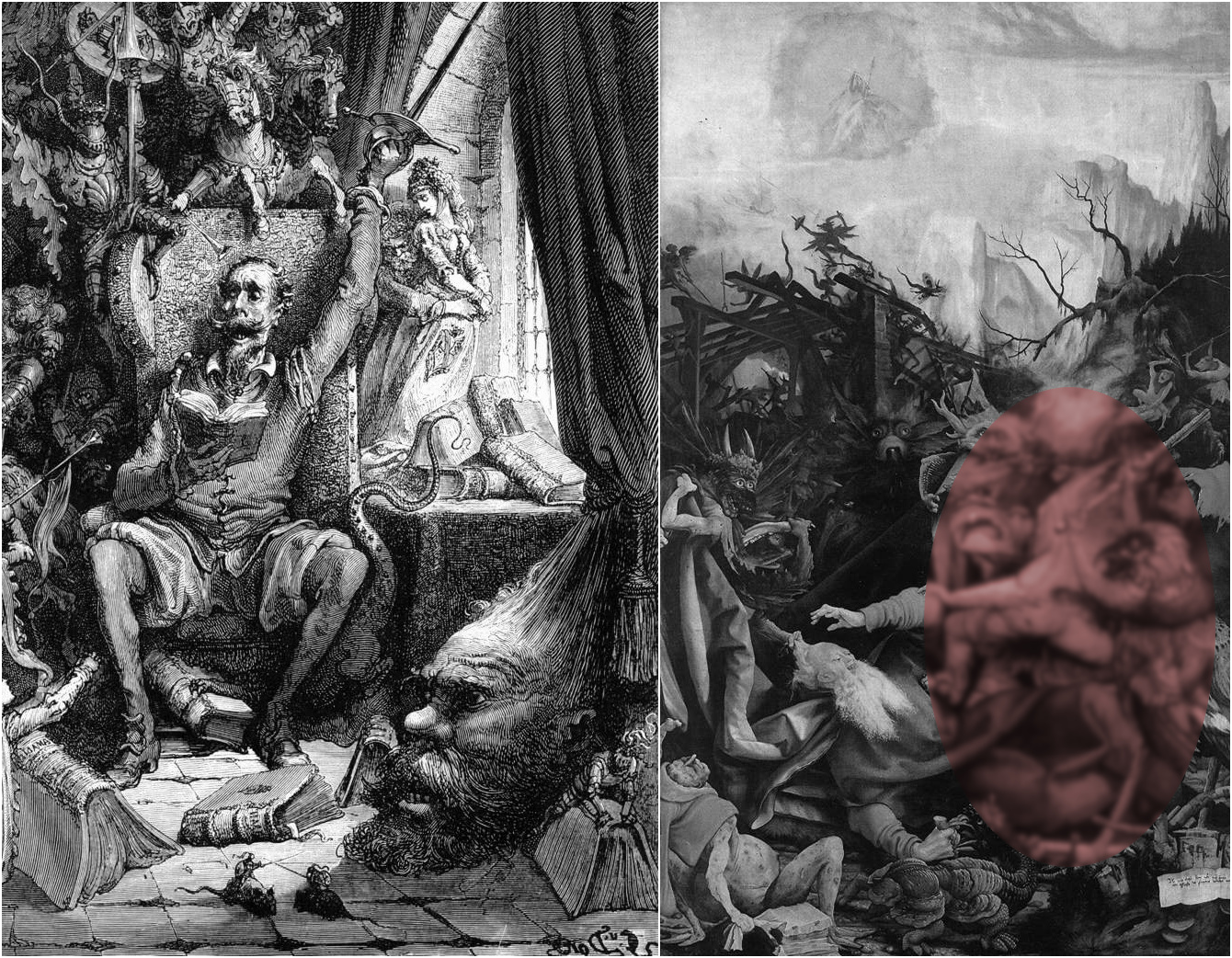 The monsters already were there. But what did Gustave Doré see in the sky in Matthias Grünewald’s painting?
Look at walls splashed with a number of stains, or stones of various mixed colours. If you have to invent some scene, you can see there resemblances to a number of landscapes, adorned with mountains, rivers, rocks, trees, great plains, valleys and hills, in various ways. Also you can see various battles, and lively postures of strange figures, expressions on faces, costumes and an infinite number of things, which you can reduce to good integrated form. This happens on such walls and varicoloured stones, (which act) like the sound of bells, in whose peeling you can find every name and word that you can imagine.
Do not despise my opinion, when I remind you that it should not be hard for you to stop sometimes and look into the stains of walls, or the ashes of a fire, or clouds, or mud or like places, in which, if you consider them well, you may find really marvelous ideas. The mind of the painter is stimulated to new discoveries, the composition of battles of animals and men, various compositions of landscapes and monstrous things, such as devils and similar things, which may bring you honor, because by indistinct things the mind is stimulated to new inventions.
Reprinted from the Oxford edition of Selections from the Notebooks of Leonardo da Vinci, edited by Irma A. Richter. The selections are from da Vinci’s A Treatise on Painting (Trattato della pittura).
(Thanks to Jono Borden for asking.)
2017-12-29, updated: 2022-03-10
Holiday’s Butcher and Millais’ Raleigh
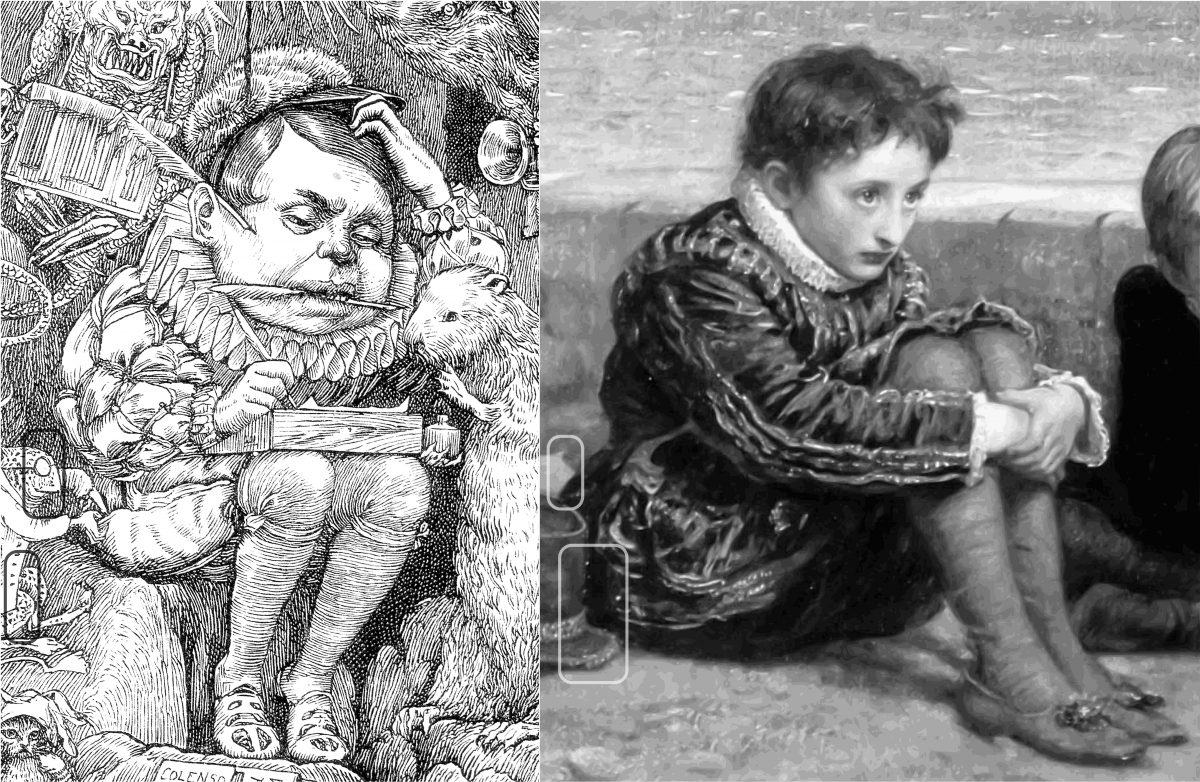
But perhaps Holiday’s ruff – and the pose of the Fit Five drawing – was inspired by the Elizabethan drama inherent in Millais’ Boyhood of Raleigh, (1869).
Louise Schweitzer, One Wild Flower (2012)
If you want to be on the safe side, just claim that the meaning of the Snark is elusive. But to the more courageous readers I recommend Louise Schweitzer’s doctoral thesis One Wild Flower.
2017-09-04, update: 2021-03-05
“Thought to be based on Gheeraert’s iconoclasm image”
Message to the Public Domain Review (2019-10-10): You are using my comparison (from December 2008) without proper referencing. This was my first discovery of one of Henry Holiday’s allusions. This finding started my Snark hunt. I think that Public Domain Review should specify the source (my proposal).
(February 2021: Now there is a link “thought by some” in publicdomainreview.org/collection/the-art-of-hidden-faces-anthropomorphic-landscapes)
Image (2019-10-10) from 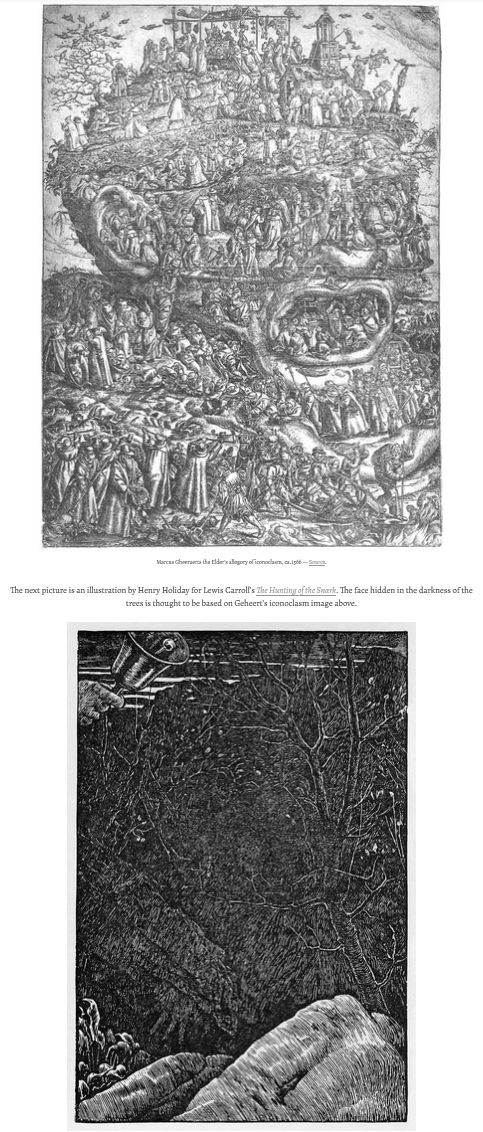 https://publicdomainreview.org/collection/the-art-of-hidden-faces-anthropomorphic-landscapes#17-0:
Marcus Gheeraerts the Elder’s allegory of iconoclasm, ca.1566 — Source.
The next picture is an illustration by Henry Holiday for Lewis Carroll’s The Hunting of the Snark. The face hidden in the darkness of the trees is thought to be based on Geheert’s iconoclasm image above.
The tenth of Henry Holiday’s original illustrations to Lewis Carroll’s The Hunting of the Snark, 1876 — Source.
By the way, it’s not “the 10th” of Henry Holiday’s original illustrations to Lewis Carroll’s The Hunting of the Snark. Holiday contributed only nine (not ten) illustrations to The Hunting of the Snark and two illustrations for the book cover. The Ocean Chart probably had been made by a typesetter, not by Henry Holiday.
And there are various way’s to write Gheeraert’s name. 😉
For discussion: Twitter | Flickr 2009
2019-10-10, updated: 2021-02-18
This is worth a follow
UofG Fantasy @UofGFantasy, Apr 13, 2020
This is worth a follow: a twitter account that offers astonishing insights into Henry Holliday’s illustrations for The Hunting of the Snark. Turns out there are dozens of visual gags in them, detectable only by the enlightened!
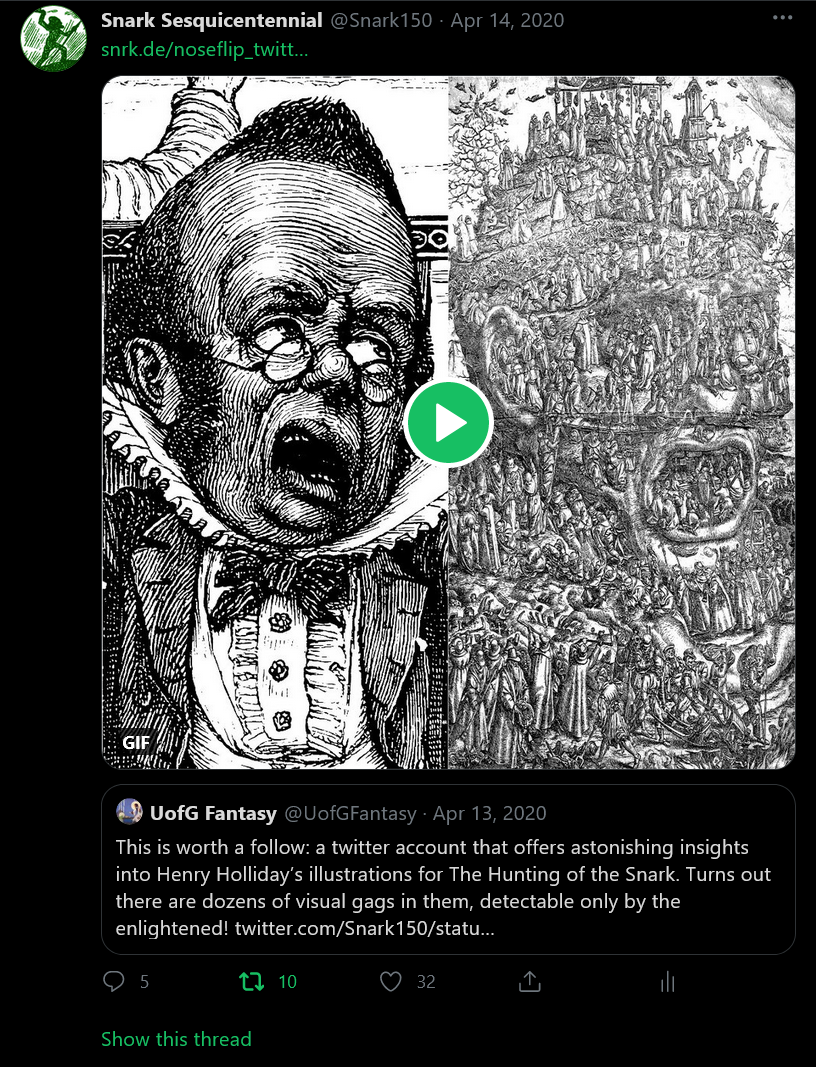
My bragging is not perfect. I accidentally deleted the Tweet which earned me the recommendation by the Centre for Fantasy and the Fantastic (University of Glasgow). But luckily the Internet doesn’t forget.
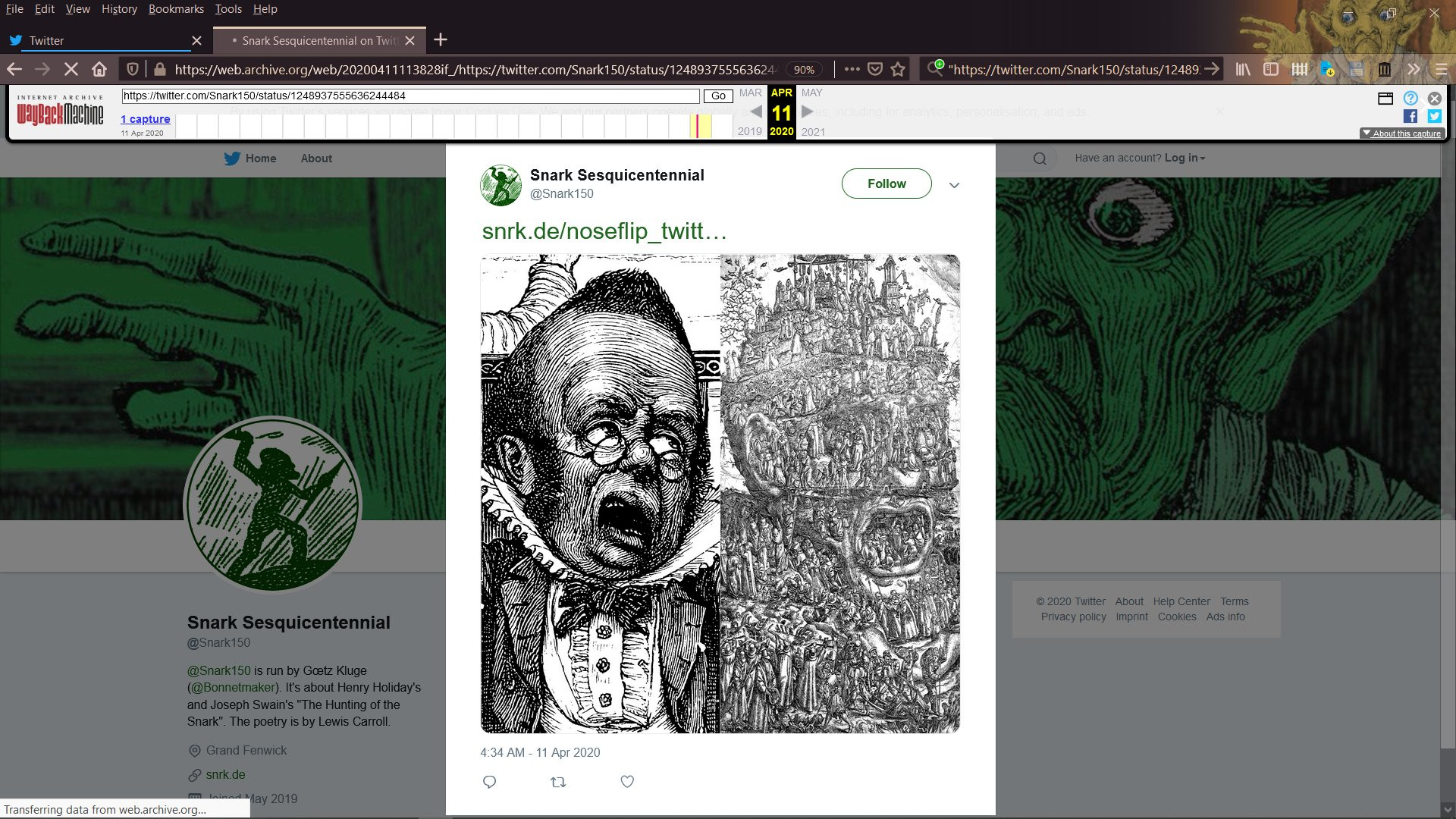 (Firefox theme: Dark Snark)
2021-02-14
Snark AV in the Internet Archive
audio video items as of 2020-01-29
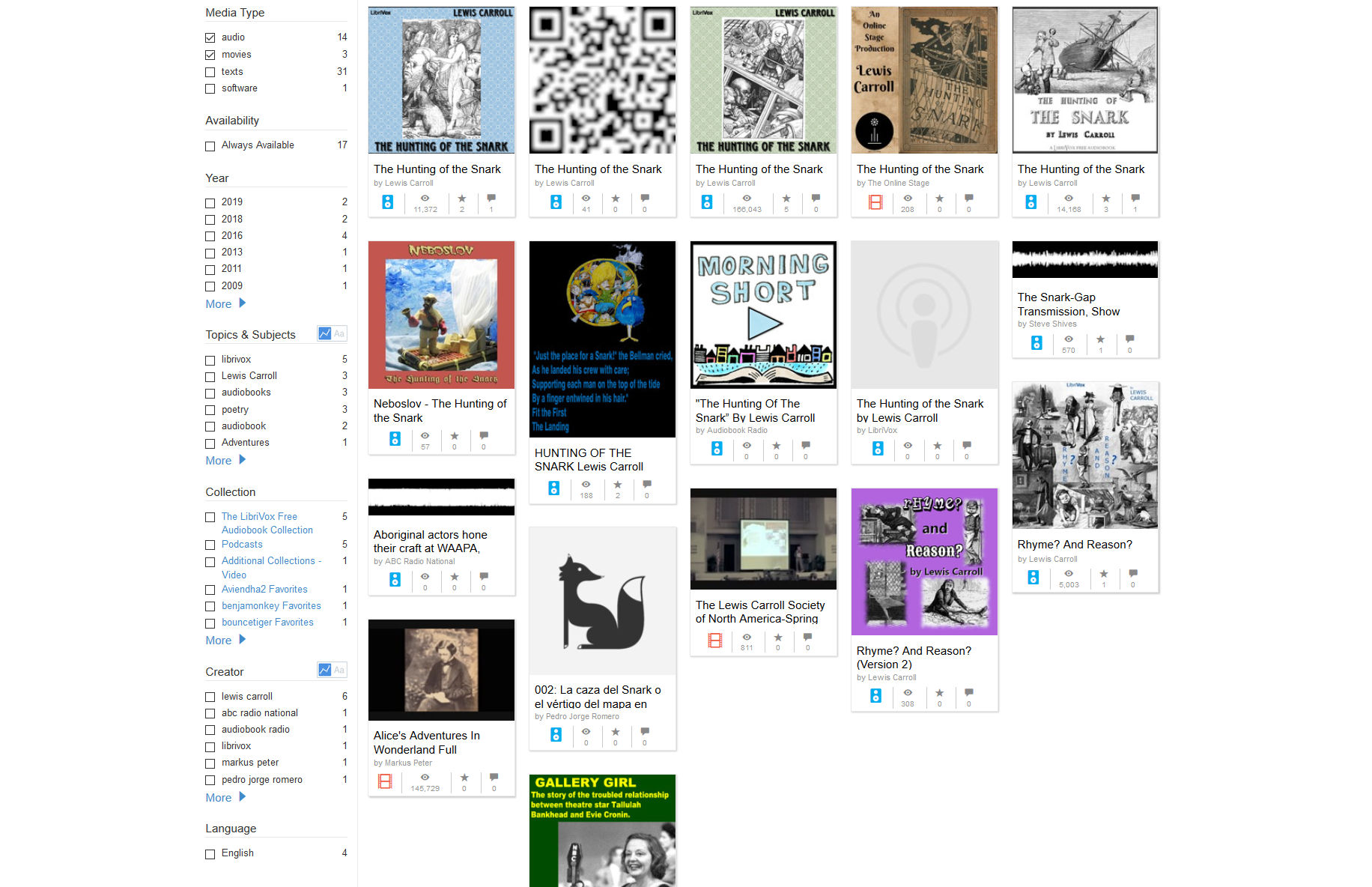
The CD cover in the top right corner is my design. You can use this Snark assemblage in compliance with license CC BY-NC-ND 4.0. Main artists: Conrad Martens & Thomas Landseer, Henry Holiday & Joseph Swain.
new search | Snark readings by LibriVox | Snark assemblage used by Librivox
2020-01-29, updated: 2021-01-31
The Face at Musée Unterlinden
2019-05-12: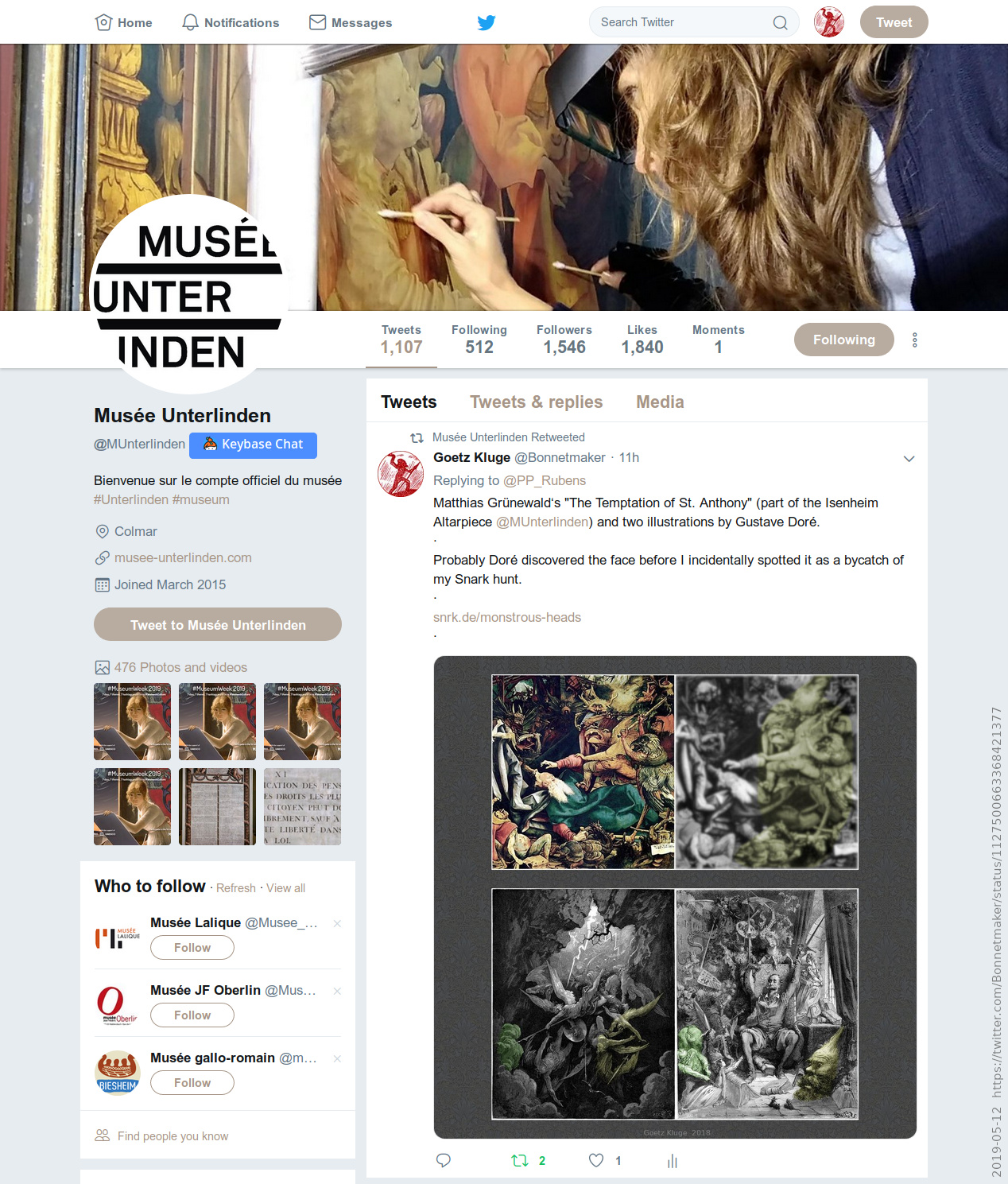
2020-12-19: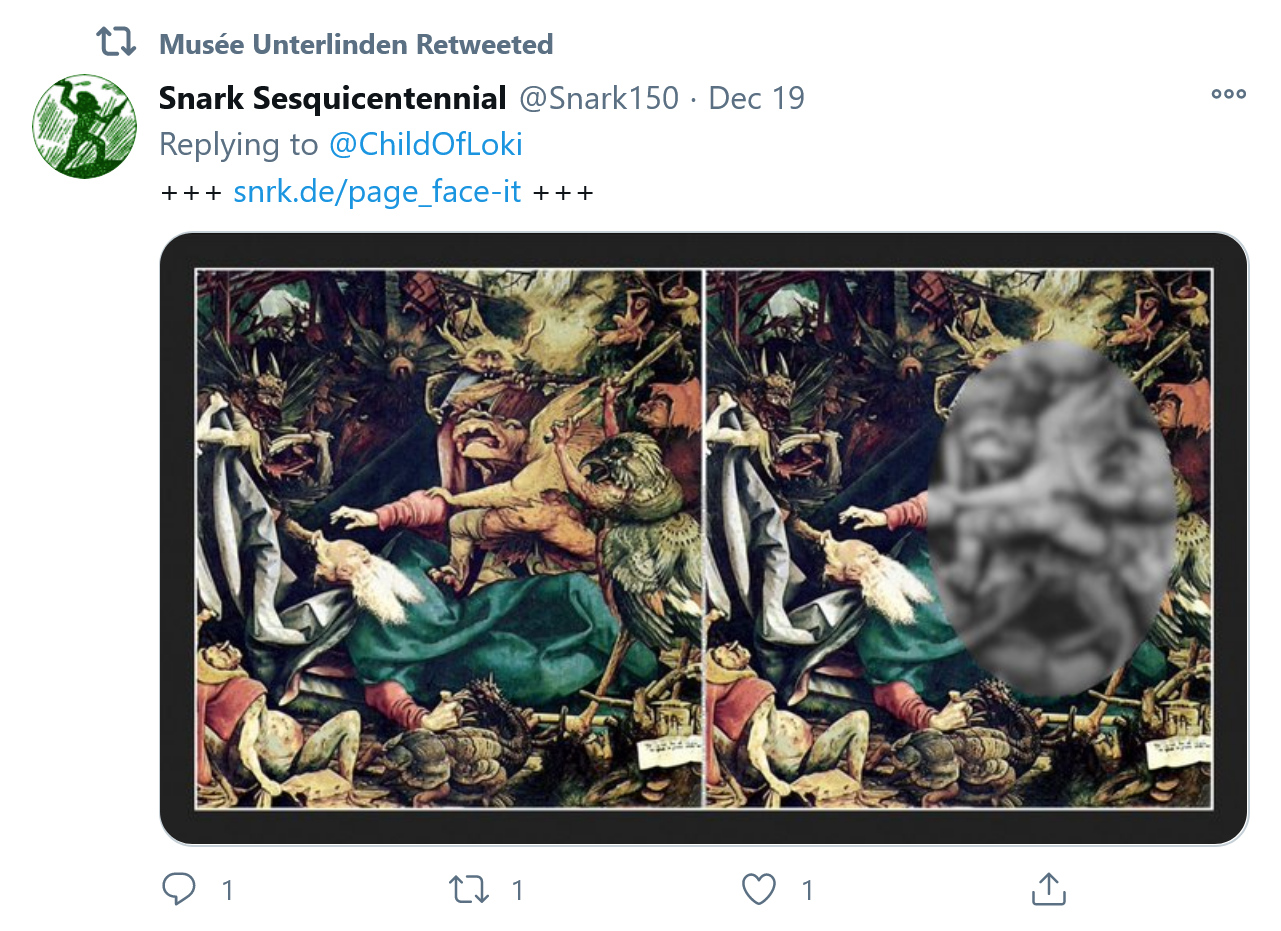
Monstrous Heads | Face it! | Tweets
Happy Holidays!
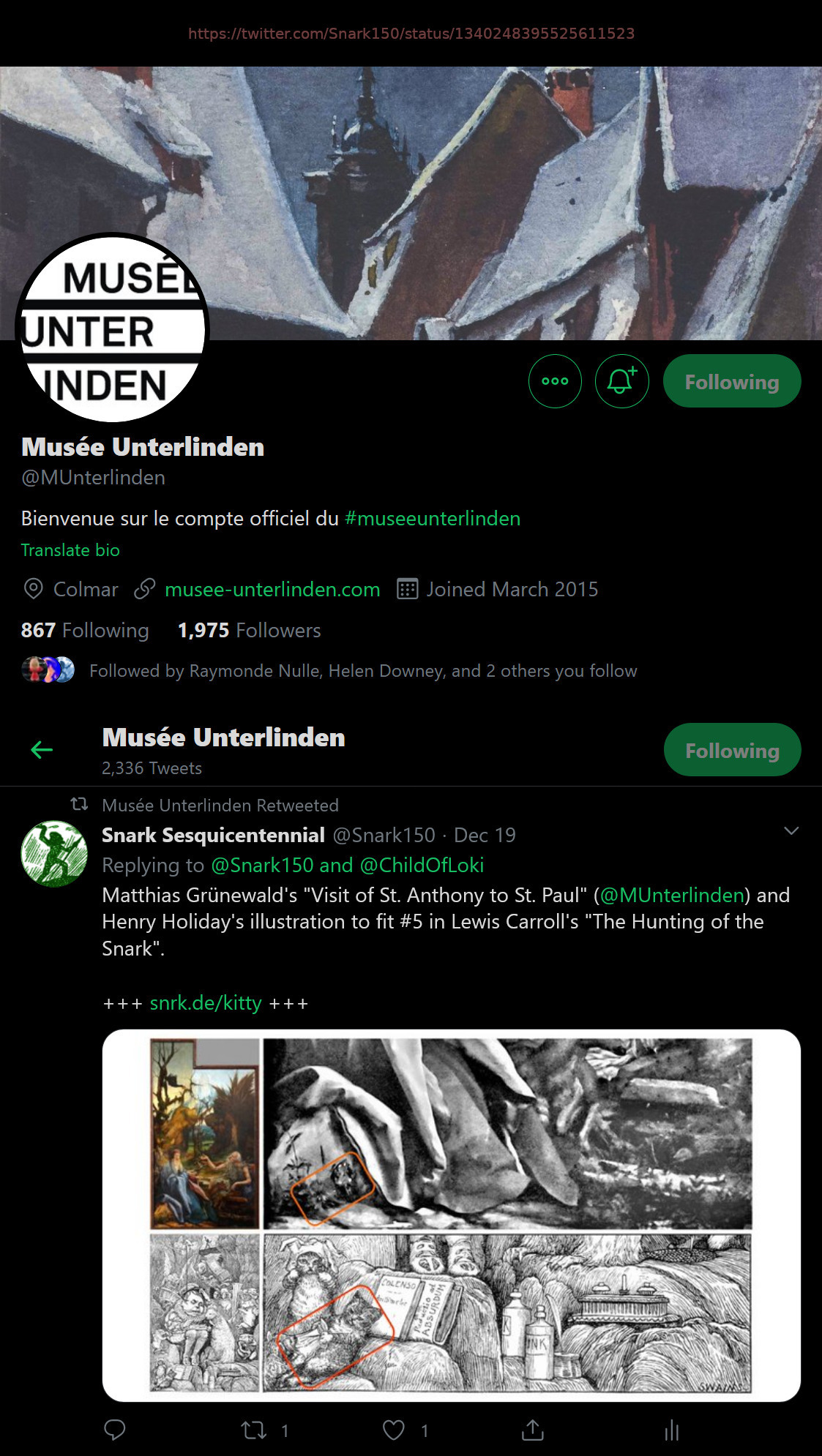 Let’s move on. 2021 is waiting for us.
Snark Hunt Appreciation